
ESIC Nursing Officer - 2019 (Shift-2)
Non Nursing Subjects
Medium
Select the option from the given choices that corresponds to the relationship in the equation (function) given below:
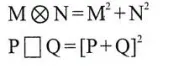
Appeared in: ESIC Nursing Officer - 2019 (Shift-2)
Explanation
- The problem defines two new mathematical operators: ⊗ for the sum of squares (M2 + N2) and □ for the square of the sum ((P + Q)2).
- The solution relies on the fundamental algebraic identity for the expansion of a binomial square: (P + Q)2 = P2 + Q2 + 2PQ.
- By substituting the definitions of the operators into this identity, we can establish the relationship between them.
- The term
(P + Q)2is replaced byP □ Q. - The term
P2 + Q2is replaced byP ⊗ Q. - This substitution directly yields the equation:
P □ Q = (P ⊗ Q) + 2PQ, which matches the correct option.
Why Other Options Were Wrong
- Option A: This option incorrectly subtracts 2PQ. The expansion of (P+Q)2 results in a positive 2PQ term. This expression would be related to the expansion of (P-Q)2, which is P2 - 2PQ + Q2.
- Option B: This option incorrectly rearranges the terms. It states P2 + Q2 = (P + Q)2 + 2PQ. Substituting the expansion of (P+Q)2 gives P2 + Q2 = (P2 + 2PQ + Q2) + 2PQ, which simplifies to 0 = 4PQ. This is not a valid general identity.
- Option D: This option, P ⊗ Q = (P □ Q) - 2PQ, is an algebraically correct rearrangement of the identity (P2 + Q2 = (P+Q)2 - 2PQ). However, the most direct derivation comes from expanding the P □ Q term, which leads directly to Option C.
Related Visual

Clinical Relevance
- Nursing practice connection: This is primarily an exam-oriented knowledge point with limited direct bedside application, so retain Solving mathematical reasoning problems involving custom-defined operators and algebraic identities as background academic context rather than a clinical decision trigger.
- While this is a mathematical reasoning question, the underlying skills are essential in nursing.
- Nurses must use strong logical and analytical skills for critical tasks like calculating medication dosages, interpreting vital signs and lab results, and making sound clinical judgments.
- Problem-solving by breaking down a complex issue into smaller, manageable parts is a core competency in providing safe and effective patient care.
How to Approach the Question
- First, carefully analyze the image to understand the definition of each custom symbol or operator. Write them down clearly: ⊗ means sum of squares, and □ means square of the sum.
- Identify the underlying mathematical concept being tested. The question asks for a relationship between (P+Q)2 and P2+Q2.
- Recall the relevant algebraic identity: (a+b)2 = a2 + 2ab + b2.
- Translate the algebraic identity into the language of the custom operators. Replace (P+Q)2 with P □ Q and P2+Q2 with P ⊗ Q.
- This substitution gives the equation: P □ Q = (P ⊗ Q) + 2PQ.
- Compare this derived equation with the given options to find the one that matches.
Concept Tested & Keywords
- Concept Tested: Solving mathematical reasoning problems involving custom-defined operators and algebraic identities.
- Stem keywords: mathematical relationship, function, equation, operator
- Lead-in keywords: Select the option
Question ID
QRrMEaxMbiM4_GU9W2SyWW
Practise the full ESIC Nursing Officer - 2019 (Shift-2)
Attempt every question from this paper in a timed mock, then review the full solution for each one.
More Mathematics Questions
- The ratio of number of girls to boys in a school of 2520 students is 27:29. How many more girls should be admitted to make the ratio 1:1?
- Three candidates contested an election and received 4500, 7500 and 8000 votes respectively. What percentage of votes did the winning candidates get?
- Two bells ring at intervals of 59 seconds and 70 seconds. If they both ring at 10 O'clock in the morning together, after how many seconds will they r…
- The average of four numbers is 61. The largest number among them is 85 and the smallest number is 21. What will be the larger of the remaining two nu…
- In what ratio should water be mixed with milk so that on selling the mixture at cost price a profit of 20% is made?
- A quality control analyst rejects 0.08% of the fabric produced, finding it defective. How many meters of fabric must he examine to reject 4 meters?
- A man traveled from his village to the post office at a speed of 25km/hr and returned at a speed of 4km/hr. If the entire journey took 5 hours and 48…
- A train is running at 60 km/hr. How much time will it require to cross a 2 km bridge?
- The average monthly income of R1 and R2 is Rs. 99,500. The average monthly income of R2 and R3 is Rs. 1,15,600 and the average monthly income of R1 a…
- If Rohan bought 20 books at the rate of Rs. 120 each, 30 books at the rate of Rs. 150 each, and 15 books at the rate of Rs. 100 each, then find the a…
More ESIC Nursing Officer - 2019 (Shift-2) Questions
- Gestational diabetes increases risk for the following, EXCEPT
- The nurse is assigned to a patient who has bacterial pneumonia and is under droplet precautions. Which personal protective equipment (PPE) will s/he…
- Artificially acquired immunity is obtained by
- Which of the following would not promote trust in the nurse-patient relationship?
- Refrigerated breastmilk should not be used if it is beyond:
- In the liver, bacteria that found their way into portal circulation are destroyed by
- The Three Features of a Community
- Medical asepsis differs from surgical asepsis in that it is aimed at:
- Cerclage (encircling cervix with suture) is done for patients with
- The most significant characteristic experienced by a patient with depression is: