
NIMHANS Nursing Officer - 2019
Edition 3
Easy
Sausage shaped abdominal mass during palpation indicative of?
Appeared in: NIMHANS Nursing Officer - 2019
Explanation
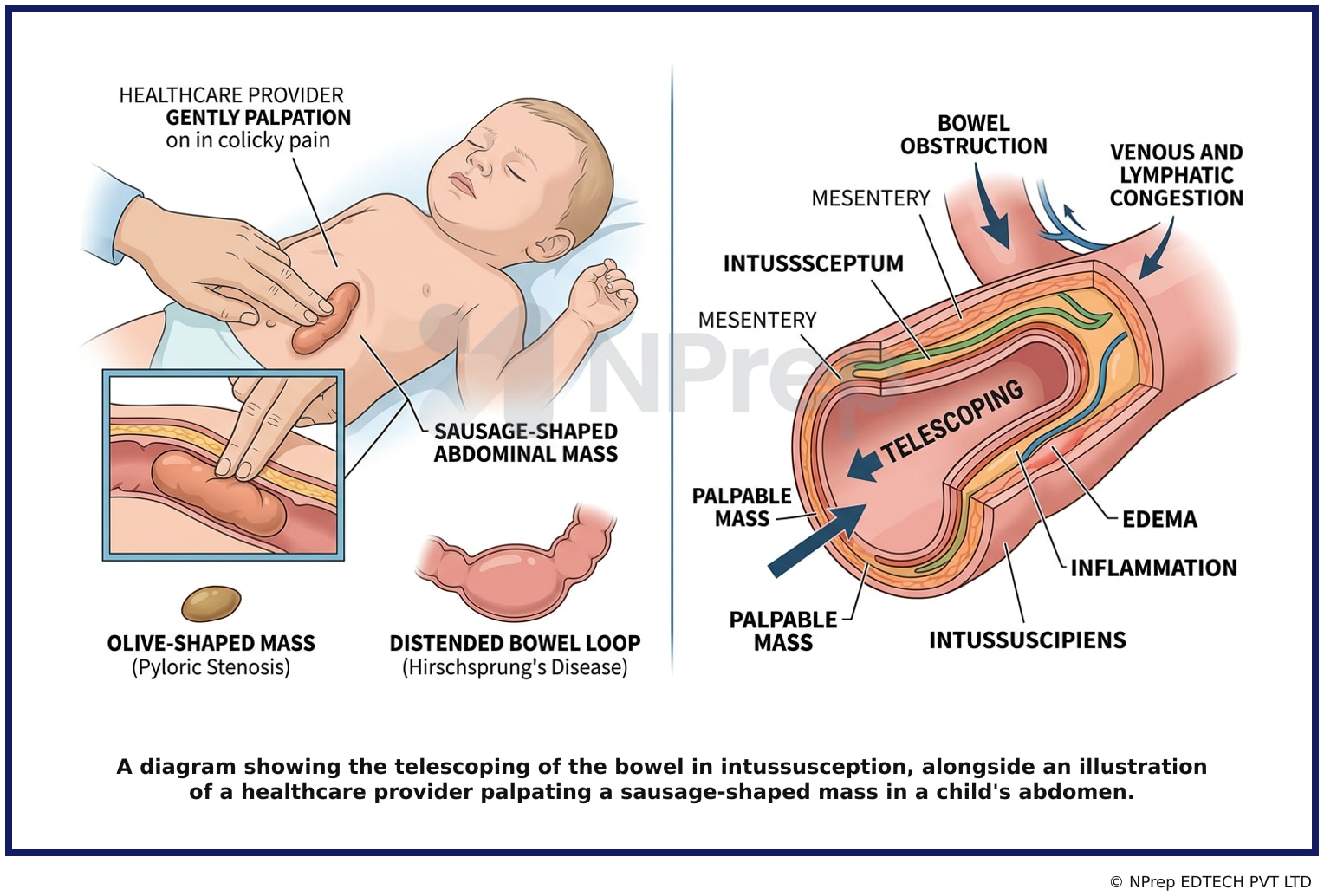
- A sausage-shaped mass in the abdomen, often located in the right upper quadrant, is a classic physical examination finding for intussusception.
- This mass is formed by the telescoping (invagination) of one segment of the intestine into another, which leads to bowel obstruction and inflammation.
- The classic triad of symptoms for intussusception includes colicky abdominal pain, a palpable sausage-shaped mass, and 'currant jelly' stools (stool mixed with blood and mucus).
- Intussusception is the most common cause of intestinal obstruction in children between 5 months and 3 years of age.
Why Other Options Were Wrong
- Option B: Hirschsprung's disease is a congenital condition involving missing nerve cells in the colon, leading to functional obstruction. It typically presents with failure to pass meconium, severe constipation, and abdominal distension, not a sausage-shaped mass.
- Option C: Pyloric stenosis is characterized by the hypertrophy of the pyloric sphincter. The classic palpable finding is a small, firm, mobile 'olive-shaped' mass in the epigastrium or right upper quadrant, not a sausage-shaped mass.
- Option D: Esophageal varices are abnormally enlarged veins in the esophagus, typically a complication of portal hypertension from liver disease. They do not cause a palpable abdominal mass and present with hematemesis (vomiting blood).
Related Visual
Clinical Relevance
- Nursing practice connection: This is primarily an exam-oriented knowledge point with limited direct bedside application, so retain Clinical signs of pediatric gastrointestinal obstructions as background academic context rather than a clinical decision trigger.
- Prompt recognition of a sausage-shaped mass is a critical nursing assessment skill, as intussusception is a pediatric emergency that can lead to bowel ischemia, perforation, and sepsis if not treated quickly.
- Nurses are responsible for monitoring the child's condition, preparing them for diagnostic and therapeutic procedures (like an air or saline enema), and providing post-procedure care, including observing for recurrence.
- What if? If the palpable mass was described as 'olive-shaped' and the primary symptom was projectile vomiting in a 4-week-old infant, the suspected diagnosis would shift from intussusception to pyloric stenosis, and the plan of care would focus on preparing for surgical correction (pyloromyotomy).
How to Approach the Question
- First, identify the key clinical sign presented in the question: a 'sausage-shaped abdominal mass'.
- Recognize this as a classic, pathognomonic sign for a specific pediatric gastrointestinal condition.
- Systematically review the options provided and recall the hallmark signs of each.
- Match the 'sausage-shaped' mass to intussusception.
- Differentiate this from the 'olive-shaped' mass of pyloric stenosis, the chronic constipation of Hirschsprung's disease, and the upper GI bleeding of esophageal varices to confirm the correct answer.
Concept Tested & Keywords
- Concept Tested: Clinical signs of pediatric gastrointestinal obstructions.
- Stem keywords: sausage shaped, abdominal mass, palpation
- Lead-in keywords: indicative of
- Negative lead-in flag: false
Question ID
QJ8d8zrJpUxJccZdMrpX4T
Reference Book
E6 Nelson Textbook of Pediatrics(2024) — Volume 2 p. 82-84
E6 Pathology- ROBBINS & COTRAN PATHOLOGIC BASIS OF DISEASE 10TH Ed p. 782-784
Practise the full NIMHANS Nursing Officer - 2019
Attempt every question from this paper in a timed mock, then review the full solution for each one.
More Pediatric Nursing Questions
More NIMHANS Nursing Officer - 2019 Questions
- Which of the following measure showing in white blood count is indicating the patient is immunosuppressive and patient need to isolation?
- A pre-eclamptic women's baby is lying with her mother, when monitoring vital sign of baby, body temperature is low, what you will do for that?
- Find the odd one out.
- Postpartum period of 72 hours a purpura developed fever, with decrease skin integrity due to fluid loss and excessive vaginal secretions may indicati…
- The technician used for sterilization of instruments in a procedures. The cidex chemical used for sterilization will change after how many days?
- Medical Records are the property of?
- What Personal Protective Equipment is used when providing wound care to a MRSA patient?
- A patient is arriving in the emergency department after severe Haemorrhage. The sister in charge told the nursing sister to perform cannulation quick…
- Which of the following are measures of dispersion?
- A 1-day puerperal woman with excessive bleeding, what type of PPH is this?