
RRB Nsg. Superintendent-20 July 2019 (Shift-3rd)
Medical & Surgical Nursing
Easy
Positive chvostek is a sign of
Appeared in: RRB Nsg. Superintendent-20 July 2019 (Shift-3rd)
Explanation
- A positive Chvostek's sign is a key clinical finding for hypocalcemia.
- It involves twitching of the facial muscles (perioral levator and zygomaticus muscles) after tapping the facial nerve just anterior to the ear.
- This response occurs because low serum calcium levels increase neuromuscular irritability, leading to involuntary muscle spasms (tetany).
- Along with Trousseau's sign, it is a classic indicator of latent tetany associated with hypocalcemia.
Why Other Options Were Wrong
- Option B: Hypercalcemia (high calcium) decreases neuromuscular excitability.
- Option C: Hypokalemia (low potassium) primarily causes generalized muscle weakness, fatigue, and cardiac ECG changes (like U waves).
- Option D: Hyperkalemia (high potassium) leads to muscle weakness, abdominal cramps, and significant cardiac arrhythmias (like peaked T waves).
Related Visual
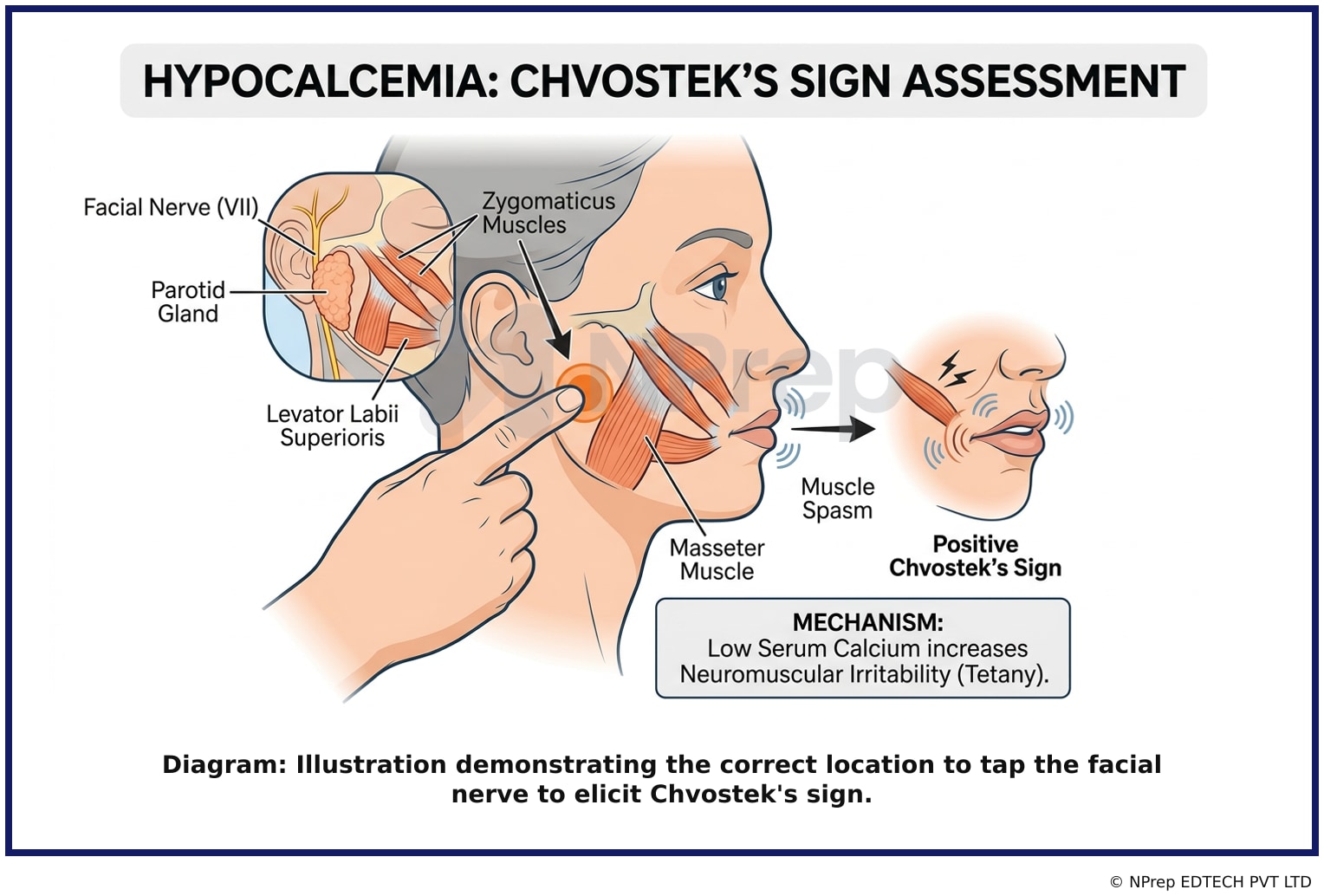
- Visual 1: Diagram: Illustration demonstrating the correct location to tap the facial nerve to elicit Chvostek's sign.
- Visual 2: Diagram: Illustration showing the characteristic carpopedal spasm seen in a positive Trousseau's sign.
Clinical Relevance
- Nursing practice connection: This is primarily an exam-oriented knowledge point with limited direct bedside application, so retain Clinical signs of electrolyte imbalances, specifically hypocalcemia as background academic context rather than a clinical decision trigger.
- Recognizing Chvostek's and Trousseau's signs is a critical nursing skill for the early detection of hypocalcemia.
- Prompt identification allows for timely intervention with calcium supplementation, preventing more severe complications such as laryngeal spasms, seizures, and cardiac arrhythmias.
- What if? If a postoperative thyroidectomy patient develops numbness and tingling around the mouth, the nurse should immediately assess for Chvostek's and Trousseau's signs, as inadvertent removal of or damage to the parathyroid glands is a common cause of acute hypocalcemia.
How to Approach the Question
- Identify the key term in the question: 'Chvostek's sign'.
- Recall the definition and clinical significance of this specific physical assessment finding.
- Associate Chvostek's sign with increased neuromuscular excitability.
- Connect increased neuromuscular excitability (tetany) with its primary electrolyte cause, which is hypocalcemia.
- Evaluate the given options and eliminate those associated with different electrolyte imbalances or opposite effects (e.g., hypercalcemia, which causes decreased excitability).
Concept Tested & Keywords
- Concept Tested: Clinical signs of electrolyte imbalances, specifically hypocalcemia.
- Stem keywords: Positive chvostek, sign
- Lead-in keywords: is a sign of
Question ID
Qlchfguo-q64JRVLEIQS29
Practise the full RRB Nsg. Superintendent-20 July 2019 (Shift-3rd)
Attempt every question from this paper in a timed mock, then review the full solution for each one.
More Fluid and Electrolytes: Balance and Distribution Questions
- All are crystalloid solution; except:
- ECG of the patient is showing ST depression, Prominent U wave and inverted T wave. Which of the electrolyte imbalance present?
- A patient reports calcium loss. What is the nursing intervention?
- The principle of hemodialysis in which the water is moving under high pressure to an area of lower pressure is:
- Measurement of arterial blood gas shows pH: 7.2, PaCO2 : 70 mm Hg, HCO3: 27 mmol/L and PaO2: 59 mm Hg. Interpret this:
- Fluid volume deficit or hypovolemia describes the loss of
- 100 mL fluid is given to patient and patient's CVP is 3 mm Hg, then what is the next intervention?
- A patient presents to the emergency department with a serum pH of 7.25, pCO2 of 40 mmHg, HCO3 of 22 mEq/L, sodium of 150 mEq/L, and chloride of 100 m…
- A 65-year-old patient is admitted to the hospital with a serum sodium level of 132 mmol/L. Despite being asymptomatic at admission, the patient begin…
- How would you most accurately assess fluid volume status in a patient with 20% total body surface area (TBSA) burns?
More RRB Nsg. Superintendent-20 July 2019 (Shift-3rd) Questions
- Where is oxytocin synthesized?
- What is the name of the muscle that extends from the sphenoid bone to the mandible?
- Complementary feeding should be initiated at the completion of \ \ \ \ \ \
- Where is kidney located?
- Psychosocial development stage for infants is \ \ \ \ \ \ \ \ \ \
- What immunization is given at birth?
- Functional nursing is a method of providing
- Which disease is the dementia associated with asymmetric atrophy of the frontal and temporal lobes?
- Thromboangiitis obliterans is also known as
- What is the other name of pyridoxine?