
RRB Nsg. Superintendent-20 July 2019 (Shift-3rd)
Medical & Surgical Nursing
Easy
Osteoporosis occurs due to the deficiency of
Appeared in: RRB Nsg. Superintendent-20 July 2019 (Shift-3rd)
Explanation
- Osteoporosis is a condition characterized by reduced bone mass and microarchitectural deterioration, leading to increased fracture risk.
- Calcium is the primary mineral responsible for bone strength and density. The skeleton stores about 99% of the body's calcium.
- A chronic deficiency in calcium intake leads the body to resorb calcium from the bones to maintain essential blood calcium levels, resulting in demineralization and osteoporosis.
- After the age of 40, calcium absorption from the gut decreases and its excretion increases, contributing to a negative calcium balance that accelerates bone loss.
Why Other Options Were Wrong
- Option A: While phosphorus is a key component of bone mineral (hydroxyapatite), isolated dietary deficiency is uncommon and not the primary cause of age-related osteoporosis. The body regulates phosphorus levels effectively.
- Option C: Zinc is a trace element that acts as a cofactor for enzymes involved in bone matrix synthesis. However, its deficiency is not considered a primary cause of osteoporosis.
- Option D: Iron's primary role is in oxygen transport as a component of hemoglobin. Iron deficiency is a leading cause of anemia, not osteoporosis.
Related Visual
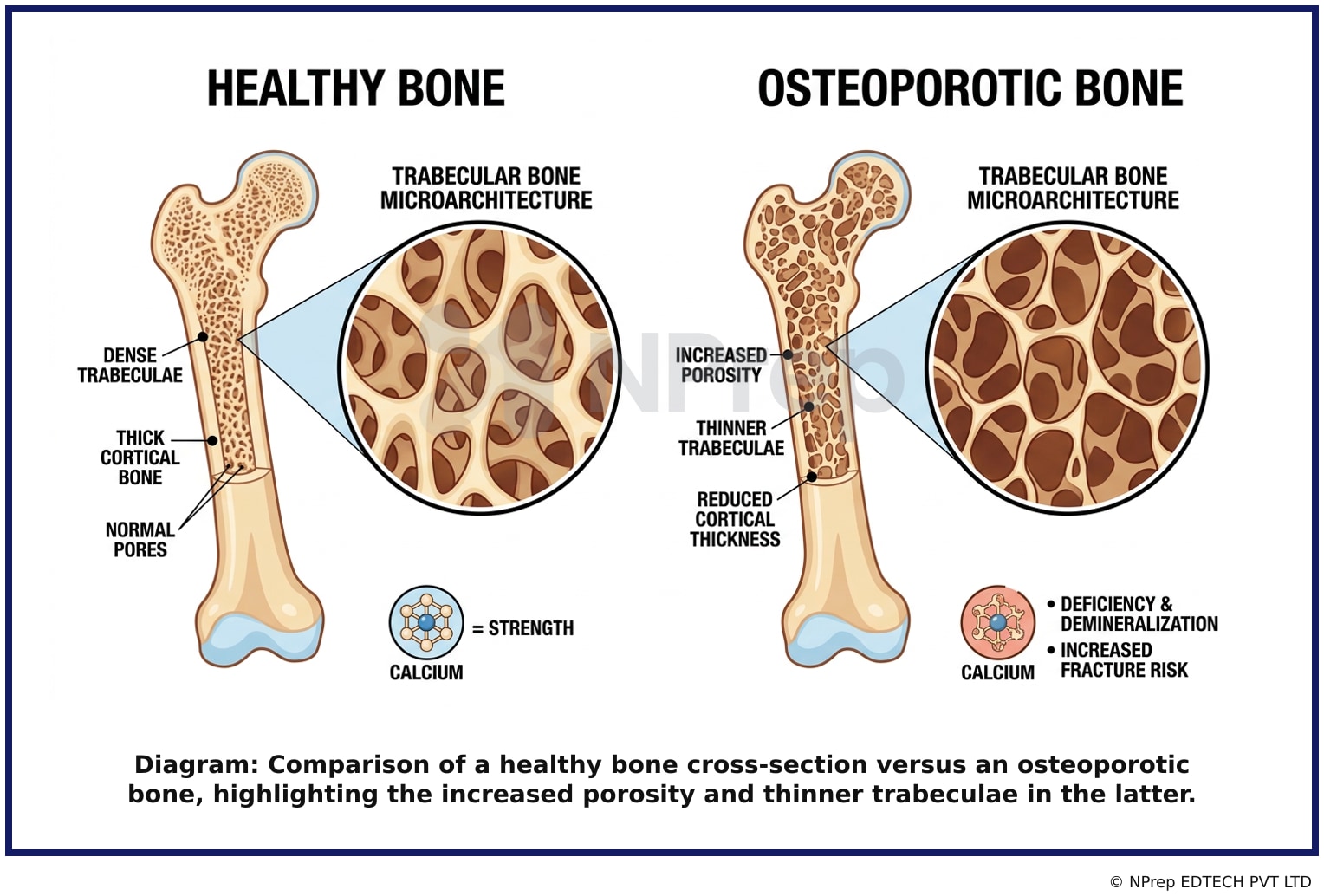
- Visual 1: Diagram: Comparison of a healthy bone cross-section versus an osteoporotic bone, highlighting the increased porosity and thinner trabeculae in the latter.
- Visual 2: Infographic: Flowchart showing how low dietary calcium and aging lead to increased bone resorption and the development of osteoporosis.
Clinical Relevance
- Nursing practice connection: This is primarily an exam-oriented knowledge point with limited direct bedside application, so retain Pathophysiology of Osteoporosis as background academic context rather than a clinical decision trigger.
- Nurses are central to preventing osteoporosis through patient education on diet (calcium and vitamin D-rich foods), the importance of weight-bearing exercise, and smoking/alcohol cessation.
- For patients diagnosed with osteoporosis, nurses administer medications (like bisphosphonates), educate on side effects, and implement fall prevention strategies to reduce fracture risk.
- What if? If the patient was post-menopausal, the answer would still be calcium, but the underlying mechanism would also strongly involve estrogen deficiency, which accelerates bone loss. This is why post-menopausal women are a primary risk group.
How to Approach the Question
- Identify the core concept: The question asks for the primary nutritional deficiency that causes osteoporosis.
- Recall the basic composition of bone. It is primarily a matrix of collagen mineralized with calcium phosphate crystals.
- Evaluate the options based on their role in bone health.
- Calcium is the most famous mineral associated with bone strength. Its deficiency is a well-known cause of weak bones.
- Phosphorus is also in bone, but deficiency is less common.
- Iron is primarily related to blood health (anemia).
Concept Tested & Keywords
- Concept Tested: Pathophysiology of Osteoporosis
- Stem keywords: Osteoporosis, deficiency
- Lead-in keywords: occurs due to
Question ID
Qb5jmKo1HhM99fLSMROr2D
Practise the full RRB Nsg. Superintendent-20 July 2019 (Shift-3rd)
Attempt every question from this paper in a timed mock, then review the full solution for each one.
More Musculoskeletal Function Questions
- The traction used for cervical spine injury:
- Pain that can occur in an amputated person is:-
- Shuffling gait is observed in:-
- Which among the following is also called otitis externa?
- A Child comes in ED with a fracture of femur. Thomson traction is applied in the emergency department. Which possible complication may occur in the f…
- A patient shows signs of "hotspots" on his leg cast. Which of following indicator recognizes by nursing officer?
- A patient shows signs of "hotspots" on his leg cast. Which of the following indicators is recognized by the a nursing officer?
- Identify the image:
- A patient with fracture of left tibia is using crutches for walking. A complication as a result of improper use of crutches for which regular assessm…
- An example of a cervical skeletal traction device is:
More RRB Nsg. Superintendent-20 July 2019 (Shift-3rd) Questions
- Where is oxytocin synthesized?
- What is the name of the muscle that extends from the sphenoid bone to the mandible?
- Complementary feeding should be initiated at the completion of \ \ \ \ \ \
- Where is kidney located?
- Psychosocial development stage for infants is \ \ \ \ \ \ \ \ \ \
- What immunization is given at birth?
- Functional nursing is a method of providing
- Which disease is the dementia associated with asymmetric atrophy of the frontal and temporal lobes?
- Thromboangiitis obliterans is also known as
- What is the other name of pyridoxine?