
RRB Nsg. Superintendent-20 July 2019 (Shift-3rd)
Non Nursing Subjects
Medium
On dividing a number by 511, we get 72 as remainder. On dividing the same number by 73, what will be the remainder?
Appeared in: RRB Nsg. Superintendent-20 July 2019 (Shift-3rd)
Explanation
- The problem is based on the division algorithm: Dividend = (Divisor × Quotient) + Remainder.
- The first statement gives the equation: Number (N) = (511 × k) + 72, where k is the quotient.
- The key is to recognize that the first divisor (511) is a direct multiple of the second divisor (73), as 511 = 73 × 7.
- Substituting this, the equation becomes N = (73 × 7 × k) + 72. This can be rewritten as N = 73 × (7k) + 72.
- When this new form of N is divided by 73, the term '73 × (7k)' is perfectly divisible, leaving the final remainder as 72.
Why Other Options Were Wrong
- Option A: A remainder must always be less than the divisor. Since the divisor is 73, a remainder of 74 is not possible.
- Option B: Similar to the previous option, a remainder of 75 is impossible when dividing by 73, as the remainder cannot be greater than the divisor.
- Option D: A remainder of 73 when dividing by 73 is not possible. If the remainder were 73, it would mean the number is perfectly divisible by 73, and the actual remainder would be 0.
Related Visual
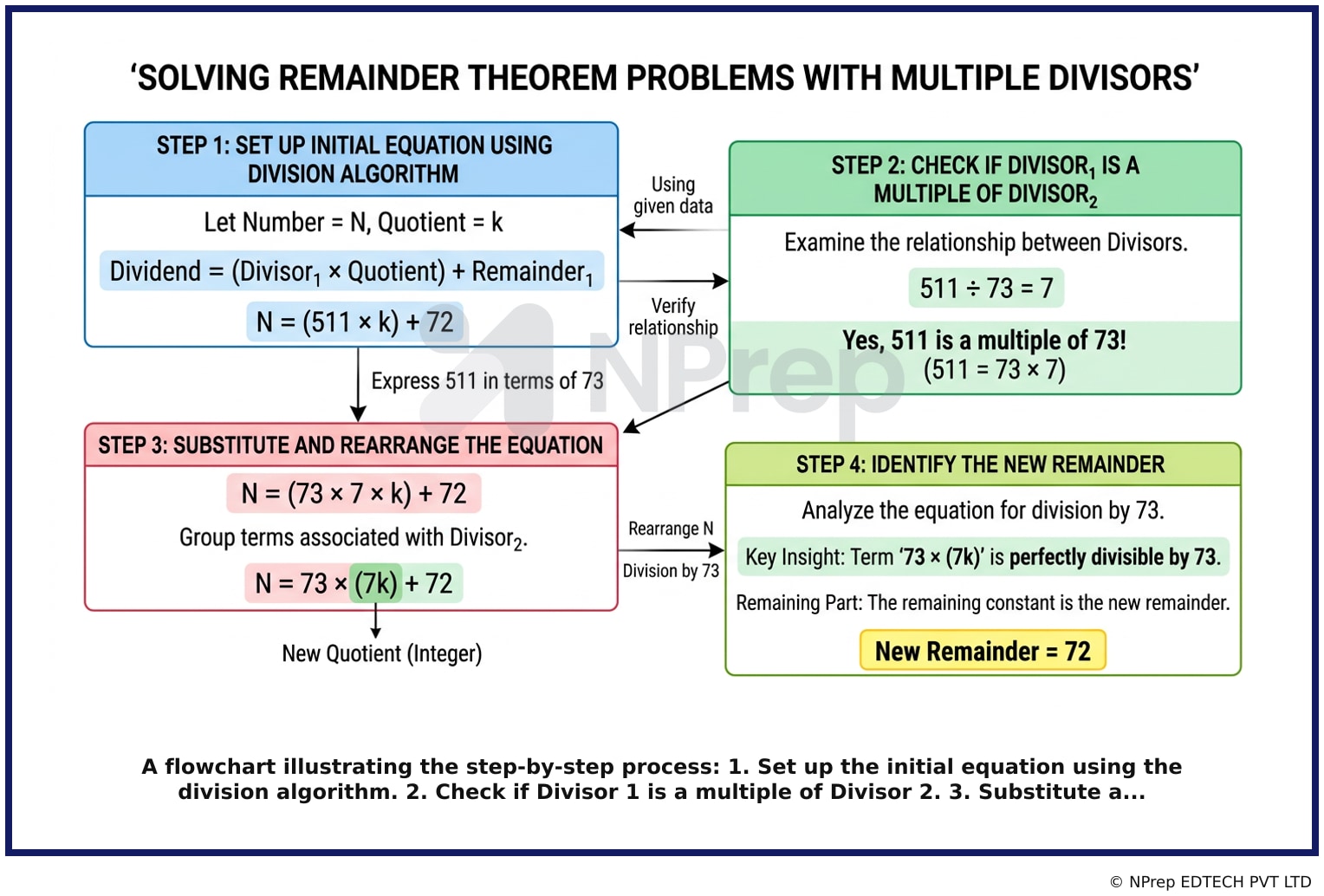
- Visual 1: Flowchart - A flowchart illustrating the step-by-step process: 1. Set up the initial equation using the division algorithm. 2. Check if Divisor 1 is a multiple of Divisor 2. 3. Substitute and rearrange the equation. 4. Identify the new remainder.
Clinical Relevance
- Nursing practice connection: This is primarily an exam-oriented knowledge point with limited direct bedside application, so retain Remainder Theorem and Divisibility as background academic context rather than a clinical decision trigger.
- This is a quantitative aptitude question and does not have direct clinical relevance.
- However, strong numerical and logical reasoning skills are essential for nurses for tasks like medication dosage calculation, IV drip rate monitoring, and interpreting patient data and lab values.
- What if the first divisor was not a multiple of the second? If 512 was the divisor instead of 511, the shortcut would not apply, and a different method (like using the Chinese Remainder Theorem or finding a general form of the number) would be needed.
How to Approach the Question
- First, represent the given information using the division algorithm formula: Dividend = (Divisor × Quotient) + Remainder.
- Let the number be N and the quotient be k. The first condition translates to N = 511k + 72.
- Next, examine the relationship between the two divisors (511 and 73). Check if the first divisor is a multiple of the second.
- Calculate 511 ÷ 73. You will find that 511 = 73 × 7.
- Substitute this relationship into the original equation and rearrange it to be in the form of division by 73.
- The resulting equation, N = 73(7k) + 72, clearly shows that when N is divided by 73, the remainder is 72.
Concept Tested & Keywords
- Concept Tested: Remainder Theorem and Divisibility
- Stem keywords: dividing a number, 511, remainder 72, dividing by 73
- Lead-in keywords: what will be the remainder
Question ID
QvUAnCoM1q0_MrziGqnhx2
Practise the full RRB Nsg. Superintendent-20 July 2019 (Shift-3rd)
Attempt every question from this paper in a timed mock, then review the full solution for each one.
More Mathematics Questions
- The ratio of number of girls to boys in a school of 2520 students is 27:29. How many more girls should be admitted to make the ratio 1:1?
- Three candidates contested an election and received 4500, 7500 and 8000 votes respectively. What percentage of votes did the winning candidates get?
- Two bells ring at intervals of 59 seconds and 70 seconds. If they both ring at 10 O'clock in the morning together, after how many seconds will they r…
- The average of four numbers is 61. The largest number among them is 85 and the smallest number is 21. What will be the larger of the remaining two nu…
- In what ratio should water be mixed with milk so that on selling the mixture at cost price a profit of 20% is made?
- A quality control analyst rejects 0.08% of the fabric produced, finding it defective. How many meters of fabric must he examine to reject 4 meters?
- A man traveled from his village to the post office at a speed of 25km/hr and returned at a speed of 4km/hr. If the entire journey took 5 hours and 48…
- A train is running at 60 km/hr. How much time will it require to cross a 2 km bridge?
- The average monthly income of R1 and R2 is Rs. 99,500. The average monthly income of R2 and R3 is Rs. 1,15,600 and the average monthly income of R1 a…
- If Rohan bought 20 books at the rate of Rs. 120 each, 30 books at the rate of Rs. 150 each, and 15 books at the rate of Rs. 100 each, then find the a…
More RRB Nsg. Superintendent-20 July 2019 (Shift-3rd) Questions
- Where is oxytocin synthesized?
- What is the name of the muscle that extends from the sphenoid bone to the mandible?
- Complementary feeding should be initiated at the completion of \ \ \ \ \ \
- Where is kidney located?
- Psychosocial development stage for infants is \ \ \ \ \ \ \ \ \ \
- What immunization is given at birth?
- Functional nursing is a method of providing
- Which disease is the dementia associated with asymmetric atrophy of the frontal and temporal lobes?
- Thromboangiitis obliterans is also known as
- What is the other name of pyridoxine?