
SCTIMST Staff Nurse - 2015 (Set-A)
Medical & Surgical Nursing
Easy
Normal serum potassium is?
Appeared in: SCTIMST Staff Nurse - 2015 (Set-A)
Explanation
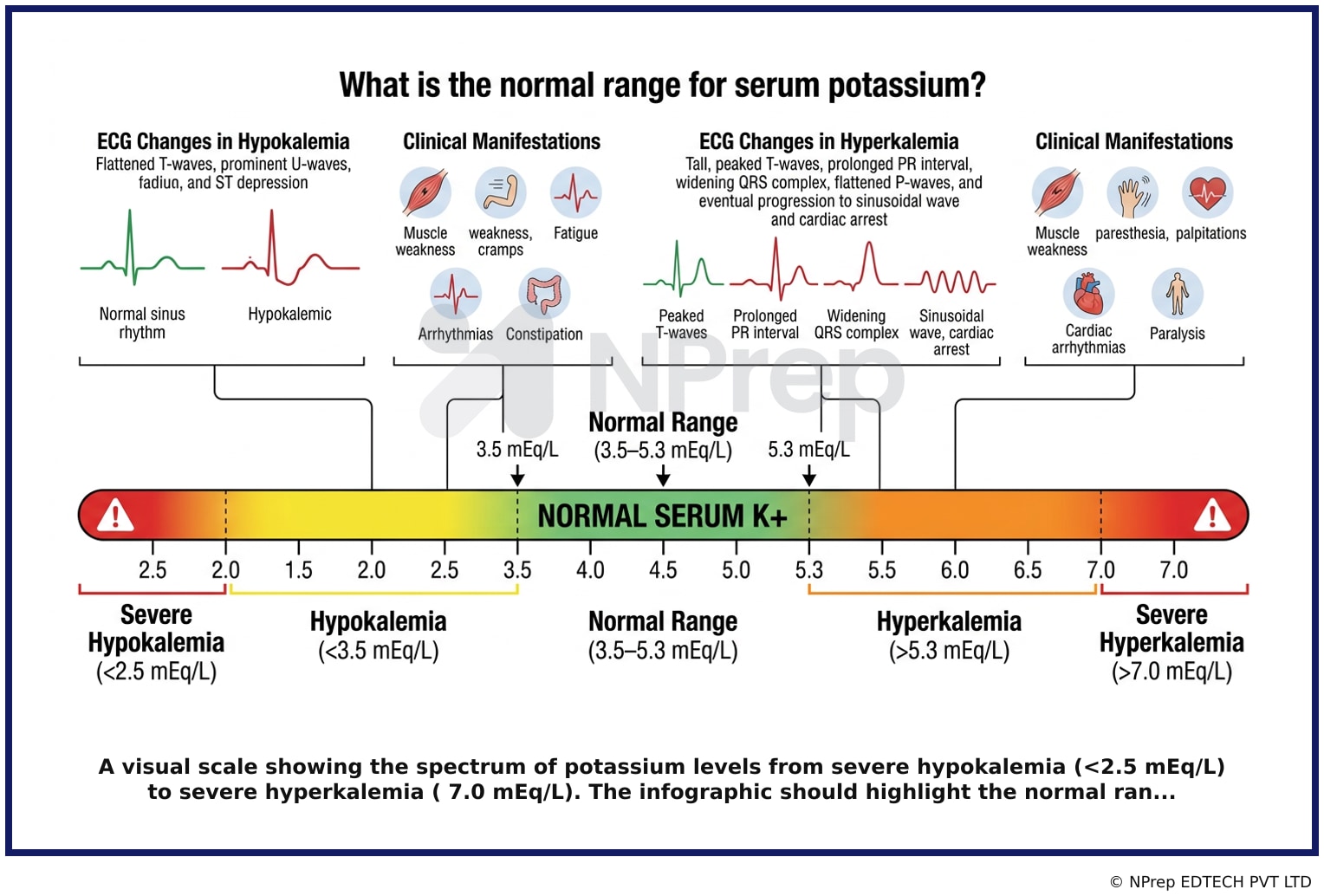
- The correct range for normal serum potassium is 3.5 to 5.3 mEq/L.
- This range can vary slightly depending on the laboratory (e.g., 3.5–5.0 mEq/L or 3.5–5.1 mEq/L), but 3.5–5.3 mEq/L is a widely accepted reference.
- Potassium is the primary intracellular cation, and maintaining this narrow extracellular range is vital for neuromuscular and cardiovascular function.
- Even minor deviations from this normal range can have significant clinical consequences, particularly on the heart muscle.
Why Other Options Were Wrong
- Option A: The range 2.3 – 3.5 mEq/L represents hypokalemia (low potassium). A level of 2.3 mEq/L is considered moderate to severe hypokalemia and can cause significant symptoms like muscle weakness and cardiac arrhythmias.
- Option C: The range 5.3 – 7.5 mEq/L represents hyperkalemia (high potassium). Levels above 5.3 mEq/L (or 5.5 mEq/L by some standards) are considered elevated and increase the risk of dangerous cardiac dysrhythmias.
- Option D: The range 7.5 – 8.9 mEq/L represents severe, life-threatening hyperkalemia. Levels this high can lead to flaccid paralysis, bradycardia, and cardiac arrest.
Related Visual
Clinical Relevance
- Nursing practice connection: This is primarily an exam-oriented knowledge point with limited direct bedside application, so retain Normal serum potassium levels as background academic context rather than a clinical decision trigger.
- Nurses must meticulously monitor serum potassium levels, especially in patients with renal disease, heart failure, or those on diuretics (like furosemide) or ACE inhibitors.
- Recognizing the signs and symptoms of both hypokalemia (muscle weakness, cramps, fatigue) and hyperkalemia (paresthesia, weakness, palpitations) is a critical nursing skill for early intervention.
- When administering IV potassium, it must be diluted and infused slowly, never given as an IV push, as this can cause immediate cardiac arrest.
How to Approach the Question
- Identify the core of the question: It asks for a specific, standard laboratory value - the normal range for serum potassium.
- This is a factual recall question. Access your memory of common lab values taught in nursing school.
- Evaluate the options. The ranges are distinct and represent hypokalemia, normal, and hyperkalemia.
- Recall that the normal potassium level is a narrow range, typically starting at 3.5 mEq/L and ending around 5.0 to 5.3 mEq/L.
- Select the option that best matches this recalled range, which is 3.5 – 5.3 mEq/L.
Concept Tested & Keywords
- Concept Tested: Normal serum potassium levels
- Stem keywords: Normal serum potassium
- Lead-in keywords: is?
- Negative lead-in flag: false
Question ID
Q4b4s95lPcmtB6ZWUckXIT
Reference Book
E6 Pharmacology Nursing Lilley 11e Part 2 p. 168-170
E6 Nursing Brunner Adult Health 3SA Vol 1 Part 1 p. 149-151
E6 Textbook of Biochemistry for medical StudentsDM Vasudevan Part 2 — Subpart A (pp 1-239 of 478) p. 94-96
Practise the full SCTIMST Staff Nurse - 2015 (Set-A)
Attempt every question from this paper in a timed mock, then review the full solution for each one.
More Fluid and Electrolytes: Balance and Distribution Questions
- All are crystalloid solution; except:
- ECG of the patient is showing ST depression, Prominent U wave and inverted T wave. Which of the electrolyte imbalance present?
- A patient reports calcium loss. What is the nursing intervention?
- The principle of hemodialysis in which the water is moving under high pressure to an area of lower pressure is:
- Measurement of arterial blood gas shows pH: 7.2, PaCO2 : 70 mm Hg, HCO3: 27 mmol/L and PaO2: 59 mm Hg. Interpret this:
- Fluid volume deficit or hypovolemia describes the loss of
- 100 mL fluid is given to patient and patient's CVP is 3 mm Hg, then what is the next intervention?
- A patient presents to the emergency department with a serum pH of 7.25, pCO2 of 40 mmHg, HCO3 of 22 mEq/L, sodium of 150 mEq/L, and chloride of 100 m…
- A 65-year-old patient is admitted to the hospital with a serum sodium level of 132 mmol/L. Despite being asymptomatic at admission, the patient begin…
- How would you most accurately assess fluid volume status in a patient with 20% total body surface area (TBSA) burns?
More SCTIMST Staff Nurse - 2015 (Set-A) Questions
- The nurse who observes projectile vomiting in a newborn suspects?
- A person with Diabetes mellitus is asking you the calories obtained from one teaspoon of sugar. what is 1 tea spoon in mL?
- Which of the following food items are rich sources of vitamin A?
- The urinary output of a client for 24 hours was 350 ml. The nurse has documented the observation as?
- Which one of the following terms indicates an increase in the size of cells without an increase in the number of cells?
- When the client can breathe only in an upright position, it is termed as?
- A client with hypoventilation is prone to develop?
- A client after pneumonectomy will be positioned on?
- A client who is sent home with an ileostomy requires dietary supplementation with?
- The hierarchy of human needs, where nurses prioritize basic physiological needs, is identified by?