
SCTIMST Staff Nurse - 2015 (Set-B)
Medical Surgical Nursing
Medium
Mr. Pawan was brought to the casualty following an accidental fall from a tree. He was transferred on a trolley. Suddenly the nurse noticed cessation of breathing and unresponsiveness. The preferred technique to open his airway is?
Appeared in: SCTIMST Staff Nurse - 2015 (Set-B)
Explanation
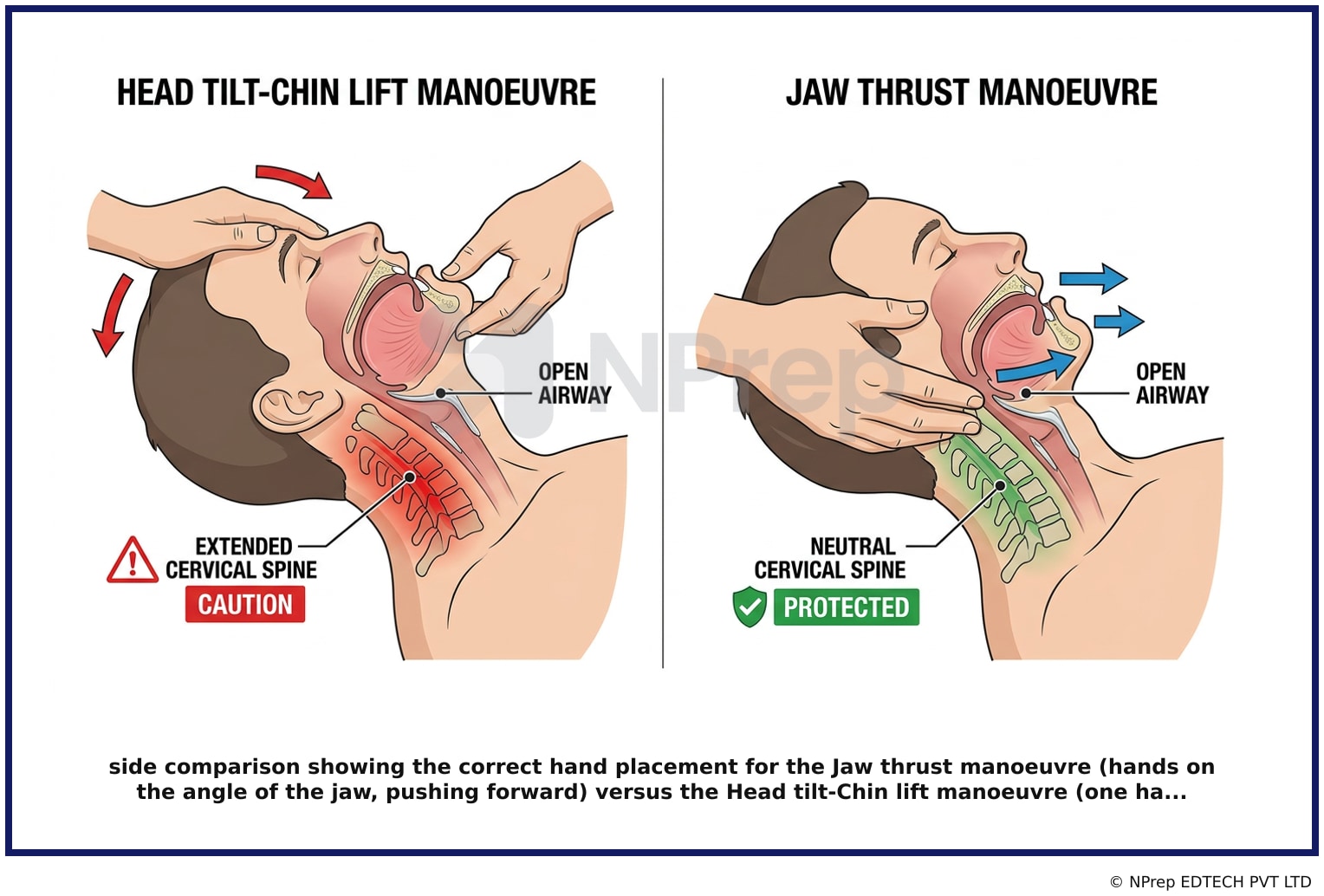
- The Jaw thrust manoeuvre is the recommended method for opening the airway in patients with a suspected cervical spine injury.
- This technique moves the jaw forward to lift the tongue off the pharynx without extending or flexing the neck, thus protecting the spinal cord.
- The mechanism of injury (fall from a tree) makes protecting the cervical spine a top priority.
- It is a critical skill in the primary survey (Airway) of the Advanced Trauma Life Support (ATLS) protocol.
Why Other Options Were Wrong
- Option A: The Head tilt-Chin lift manoeuvre involves extending the neck, which is dangerous and contraindicated in a patient with a suspected cervical spine injury as it can cause further damage.
- Option C: The Abdominal Thrust (Heimlich) manoeuvre is used to dislodge a foreign body that is causing an airway obstruction. It is not a technique for opening the airway in an unresponsive, non-choking patient.
- Option D: AMBU (bag-valve-mask) ventilation is a method for providing breaths (breathing support), not for opening the airway. The airway must be opened first before AMBU ventilation can be effective.
Related Visual
Clinical Relevance
- Nursing practice connection: Prioritize focused assessment, early escalation, and real-time monitoring when managing Airway management in trauma in acute care settings.
- In any trauma situation, always assume a cervical spine injury until it is cleared by a medical professional. This 'assume the worst' approach prevents iatrogenic (caregiver-caused) injury.
- The sequence of care is critical: first, open the airway (A), then ensure breathing (B). Applying a breathing device like an AMBU bag to a closed airway is ineffective and wastes critical time.
- What if? If the patient had fainted from a standing position with no trauma, the Head tilt-Chin lift would be the correct initial manoeuvre, as the suspicion for spinal injury would be very low.
How to Approach the Question
- First, analyze the clinical scenario. The key information is 'accidental fall from a tree', which immediately signals a high-risk trauma situation.
- Identify the core problem: the patient is unresponsive and not breathing, requiring immediate airway management.
- Connect the mechanism of injury (fall) to the primary contraindication: potential cervical spine injury. Any manoeuvre that moves the neck is dangerous.
- Evaluate the options based on this constraint. Eliminate 'Head tilt-Chin lift' because it moves the neck.
- Differentiate the purpose of the remaining options. 'Abdominal Thrust' is for choking. 'AMBU ventilation' is for breathing, not opening the airway.
- Conclude that 'Jaw thrust manoeuvre' is the only option that safely opens the airway in a patient with a suspected spinal injury.
Concept Tested & Keywords
- Concept Tested: Airway management in trauma
- Stem keywords: accidental fall, cessation of breathing, unresponsiveness, open airway
- Lead-in keywords: preferred technique
- Clinical cues: Fall from a tree suggests a high risk of cervical spine injury.
Question ID
Qa0TAvynpjgtmXKG9RuFoc
Reference Book
E6 Nelson Textbook of Pediatrics(2024) — Volume 1 p. 616-618
E6 Ghai Essential Pediatrics(pp 26-904 of 913) p. 764-766
E6 Nursing Brunner Adult Health 3SA Vol 2 Part 3 p. 115-117
Practise the full SCTIMST Staff Nurse - 2015 (Set-B)
Attempt every question from this paper in a timed mock, then review the full solution for each one.
More Critical Care Nursing Questions
- In ATLS algorithm E stands for?
- The low-pressure alarm sounds on the ventilator. The nurse checks the client and then attempts to determine the cause of the alarm but is unsuccessfu…
- Selective digestive decontamination is used to prevent?
- While giving ET tube suctioning, the patient suddenly goes on tachycardia. What will the nurse do?
- An unconscious patient admitted in ICU, what is the first priority for this patient?
- Which mnemonic is commonly used to gather a detailed patient history during the secondary survey?
- All of the following are true about care bundle EXCEPT
- Licox catheter system is used to
- A client with a cervical spine fracture at C, level has just arrived in the emergency room. The primary nursing intervention would be?
- Hyperpyrexia is temperature more than?
More SCTIMST Staff Nurse - 2015 (Set-B) Questions
- Nurse teaches the patient to rotate the site of insulin injection. Which of the following sites is inappropriate to use?
- Effects of Nicotine will increase the body's secretion of?
- The therapeutic effect of Digitalis is to?
- Significant Nursing interventions required for a patient with activity intolerance include all, except?
- The part of the brain which controls heart rate and respiration?
- Claustrophobia means?
- Which of the following features is an extrapyramidal symptom (EPS)?
- Hypernatremia is commonly detected in patients with?
- Mr. Ramu is on diuretics and Digoxin. His recent Serum Potassium value is 2.9 mEq/l. Which of the undermentioned food items is essentially required f…
- Mr. Mahesh is on a low sodium (3g) diet. Choose the most appropriate food item from the undermentioned list?