
RRB Nsg. Superintendent-20 July 2019 (Shift-3rd)
Applied Psychology
Easy
Memory traces are present in the mind in the form of
Appeared in: RRB Nsg. Superintendent-20 July 2019 (Shift-3rd)
Explanation
- An engram, also known as a memory trace, is the physical or biochemical change that occurs in the brain when a memory is formed.
- It represents the stored information of a memory, essentially the neural representation of what has been learned or experienced.
- Experiences leave a trace in the brain, and this hypothetical trace is termed an engram.
- The process of preserving these memory traces is known as retention.
Why Other Options Were Wrong
- Option A: Diagrams are external visual aids used for explaining information; they are not the biological substrate of memory within the brain.
- Option C: While the mind can recall memories in the form of mental pictures, the underlying storage mechanism is a neural pathway (the engram), not a literal image file stored in the brain.
- Option D: Neural signals (electrical and chemical impulses) are the method by which information is transmitted and processed in the brain. They are the process, not the stored memory itself.
Related Visual
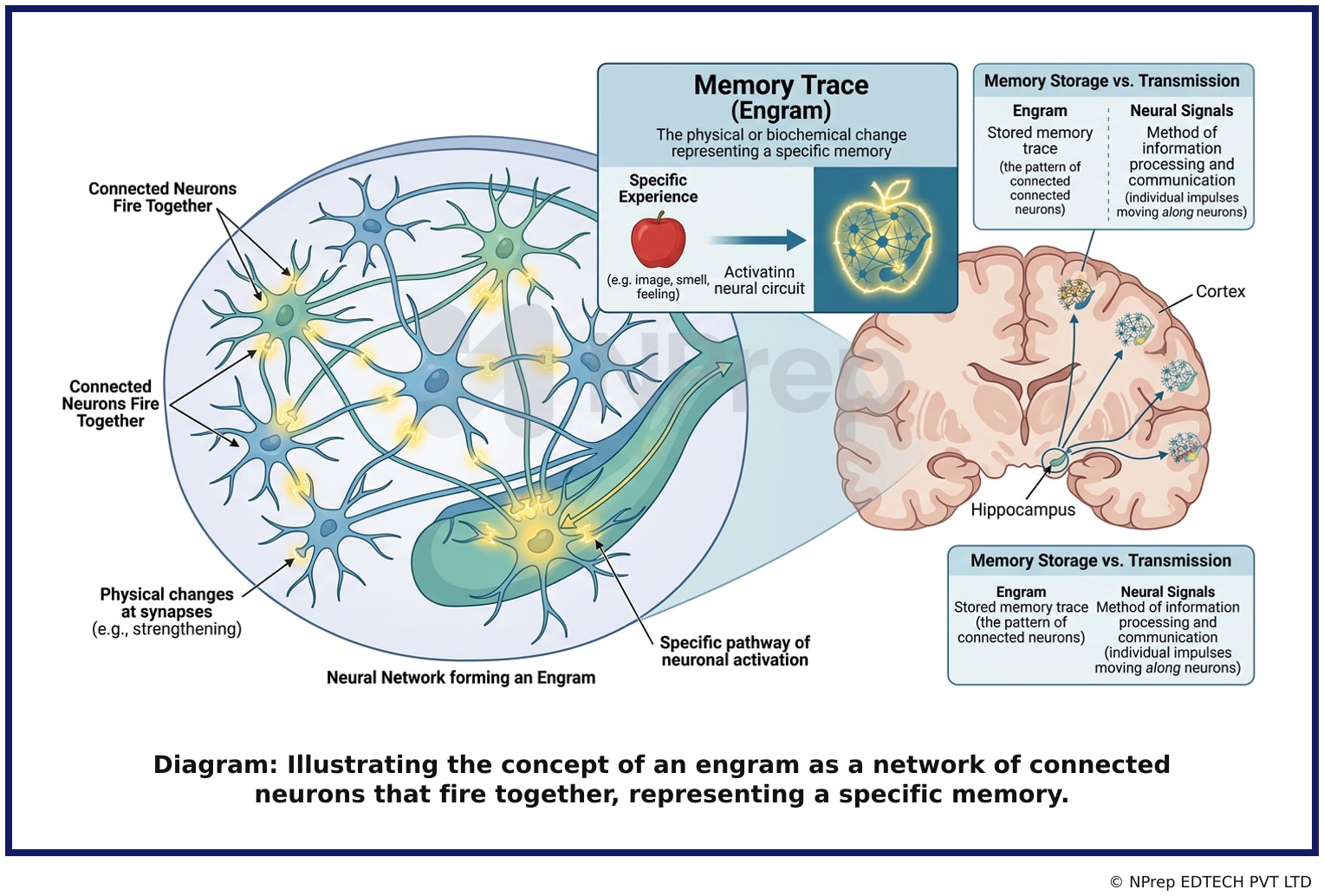
- Visual 1: Diagram: Illustrating the concept of an engram as a network of connected neurons that fire together, representing a specific memory.
- Visual 2: Flowchart: Showing the stages of memory, from sensory input to short-term memory and finally to long-term memory consolidation where engrams are formed.
Clinical Relevance
- Nursing practice connection: This is primarily an exam-oriented knowledge point with limited direct bedside application, so retain Biological basis of memory storage as background academic context rather than a clinical decision trigger.
- Understanding the concept of engrams is fundamental to research in memory disorders like Alzheimer's disease and amnesia, where the formation, storage, or retrieval of these memory traces is impaired.
- In nursing, this concept underpins patient education strategies, especially for individuals with cognitive decline. Emphasizing repetition and multi-sensory engagement can help strengthen memory traces.
- What if? a patient has anterograde amnesia? This condition means they are unable to form new engrams for long-term memories after the onset of their illness, although they can often still access memories formed before the event.
How to Approach the Question
- First, identify the key term in the question: 'memory traces'.
- Recognize this as a recall-based question testing your knowledge of psychology or neurobiology terminology.
- Evaluate each option's definition in the context of brain function and memory.
- Eliminate 'Diagrams' and 'Pictures' as they are external or mental representations, not the physical storage mechanism.
- Differentiate 'Signals' (the process of communication) from the stored memory itself.
- Recall or deduce that 'engram' is the specific scientific term for a physical memory trace in the brain.
Concept Tested & Keywords
- Concept Tested: Biological basis of memory storage
- Stem keywords: Memory traces, mind
- Lead-in keywords: form of
Question ID
QmB2IckdQ1o9Iu8owj2Xi
Practise the full RRB Nsg. Superintendent-20 July 2019 (Shift-3rd)
Attempt every question from this paper in a timed mock, then review the full solution for each one.
More Cognitive Process Questions
- Major approaches in problem solving are:
- You tell a 65 year old patient, "Listen carefully and repeat after me: Apple, Pen, Table." If he repeats these three words immediately after you in t…
- Modeling is a form of social learning and is called as?
- Punishment is effective only when it weakens?
- Which of the following is the correct statement with reference to Learning by Insight?
- Which of the following tools is commonly used to test a person's intellectual function?
- Imaginary filling of memory gaps is known as?
- Sense of unfamiliarity with a familiar situation?
- The type of reasoning that involves drawing specific conclusions from general principles is called \ \ \ \ \ \ .
- Who made valuable contributions to insightful learning?
More RRB Nsg. Superintendent-20 July 2019 (Shift-3rd) Questions
- Where is oxytocin synthesized?
- What is the name of the muscle that extends from the sphenoid bone to the mandible?
- Complementary feeding should be initiated at the completion of \ \ \ \ \ \
- Where is kidney located?
- Psychosocial development stage for infants is \ \ \ \ \ \ \ \ \ \
- What immunization is given at birth?
- Functional nursing is a method of providing
- Which disease is the dementia associated with asymmetric atrophy of the frontal and temporal lobes?
- Thromboangiitis obliterans is also known as
- What is the other name of pyridoxine?