
SCTIMST Staff Nurse - 2015 (Set-A)
Medical & Surgical Nursing
Easy
In which one of the following conditions, Kerning's sign is considered as a positive indicator?
Appeared in: SCTIMST Staff Nurse - 2015 (Set-A)
Explanation
- Kernig's sign is a test for meningeal irritation, which is a hallmark of meningitis.
- The test is performed by flexing the patient's hip and knee to a 90-degree angle and then attempting to extend the leg.
- A positive sign is characterized by pain and resistance in the hamstring muscles, preventing full extension of the leg.
- This response is caused by the stretching of inflamed meninges and nerve roots.
Why Other Options Were Wrong
- Option B: Hepatitis is an inflammation of the liver. Its signs and symptoms (like jaundice, fatigue, and abdominal pain) are related to liver dysfunction, not meningeal irritation.
- Option C: Deep vein thrombosis (DVT) is a blood clot in a deep vein. The classic, though often unreliable, sign associated with DVT is Homan's sign (calf pain on dorsiflexion of the foot), not Kernig's sign.
- Option D: Typhoid is a systemic bacterial infection (enteric fever). Its primary symptoms are high fever, abdominal pain, and weakness. It does not typically cause meningeal signs.
Related Visual
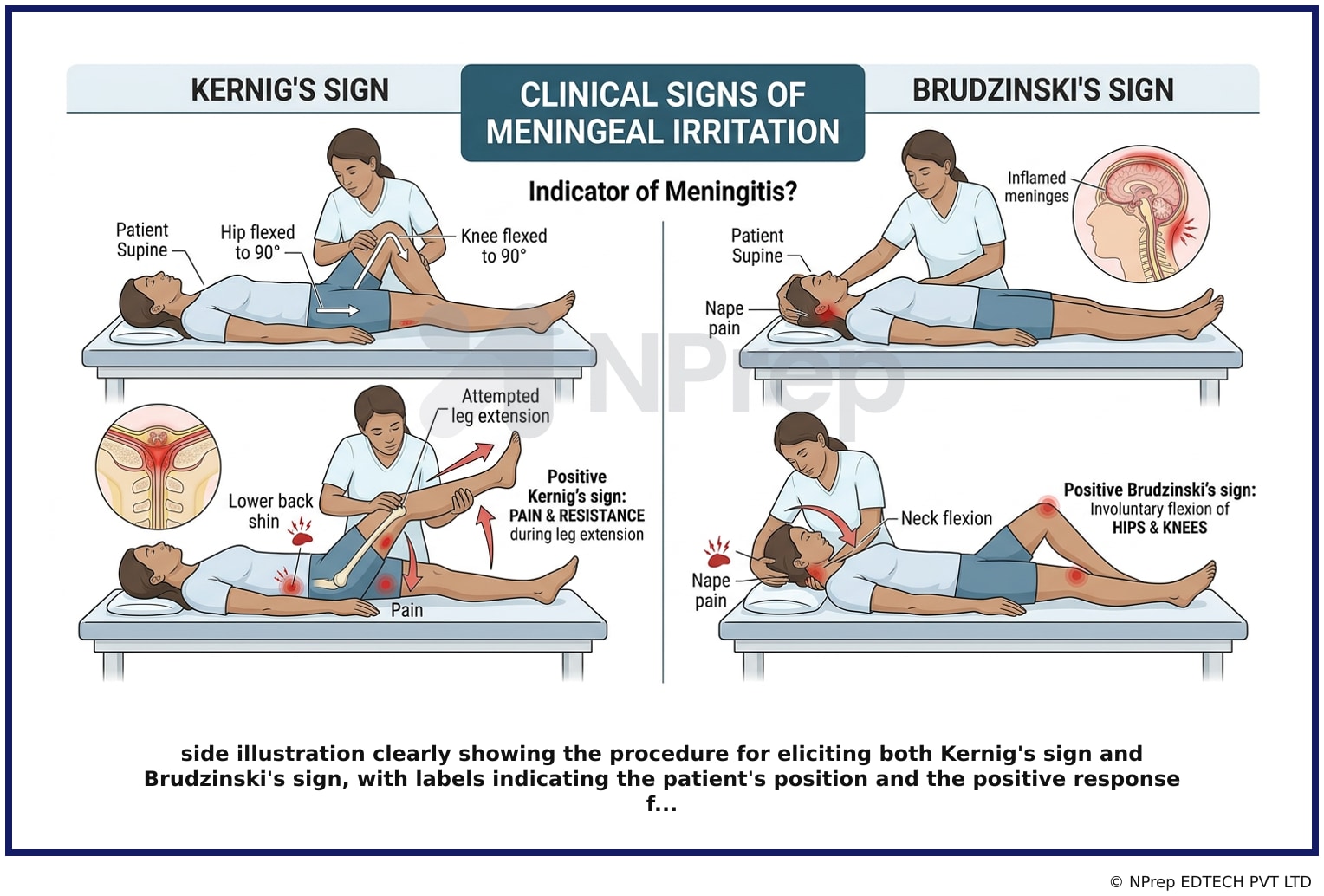
Clinical Relevance
- Nursing practice connection: This is primarily an exam-oriented knowledge point with limited direct bedside application, so retain Clinical signs of meningeal irritation (Kernig's sign) as background academic context rather than a clinical decision trigger.
- Recognizing Kernig's sign is a critical nursing skill for the early detection of meningitis, a medical emergency.
- A positive Kernig's sign, especially when accompanied by fever, headache, and neck stiffness, warrants immediate medical attention and escalation to the physician.
- What if? If a patient has a positive Kernig's sign but a normal temperature, the nurse should still suspect meningeal irritation. Other causes like a subarachnoid hemorrhage must be considered, and a full neurological assessment is crucial.
How to Approach the Question
- First, identify the key term in the question: 'Kernig's sign'.
- Recall the definition and clinical significance of this sign. It is a test for meningeal irritation.
- Analyze the options provided. Evaluate which of the conditions listed is directly associated with inflammation of the meninges.
- Meningitis is, by definition, inflammation of the meninges. Therefore, Kernig's sign is a direct indicator.
- Rule out the other options by recalling their primary pathology: Hepatitis (liver), DVT (veins), and Typhoid (systemic infection), none of which primarily involve the meninges.
Concept Tested & Keywords
- Concept Tested: Clinical signs of meningeal irritation (Kernig's sign)
- Stem keywords: Kerning's sign, positive indicator
- Lead-in keywords: In which one
- Negative lead-in flag: false
Question ID
QpUAceLKaEQaqfPZQmss-h
Reference Book
E6 Nelson Textbook of Pediatrics(2024) — Volume 2 p. 1568-1570
E6 Medicine Davidson Principles Practice 24e p. 205-207
Practise the full SCTIMST Staff Nurse - 2015 (Set-A)
Attempt every question from this paper in a timed mock, then review the full solution for each one.
More Metabolic and Endocrine Function Questions
- What is the characteristic feature of biliary colic?
- What is minimum distance between insulin injection site?
- Graves' Disease is:-
- A 45-year-old patient undergoes a total thyroidectomy and is admitted to the post-anesthesia care unit (PACU) for monitoring. Shortly after arrival,…
- Cut point of fasting blood sugar level indicates Diabetic Mellitus?
- A patient suffering from liver cirrhosis is admitted to the ward. Which of the following represents that hepatic Encephalopathy observable in patient…
- Early signs of hypoglycemia are the following?
- After liver biopsy which complication should be monitored?
- Features of hypothyroidism except?
- A client is scheduled for a subtotal Thyroidectomy. Iodine solution (Lugol solution, potassium iodide solution) is prescribed. A nurse prepares to ad…
More SCTIMST Staff Nurse - 2015 (Set-A) Questions
- The nurse who observes projectile vomiting in a newborn suspects?
- A person with Diabetes mellitus is asking you the calories obtained from one teaspoon of sugar. what is 1 tea spoon in mL?
- Which of the following food items are rich sources of vitamin A?
- The urinary output of a client for 24 hours was 350 ml. The nurse has documented the observation as?
- Which one of the following terms indicates an increase in the size of cells without an increase in the number of cells?
- When the client can breathe only in an upright position, it is termed as?
- A client with hypoventilation is prone to develop?
- A client after pneumonectomy will be positioned on?
- A client who is sent home with an ileostomy requires dietary supplementation with?
- The hierarchy of human needs, where nurses prioritize basic physiological needs, is identified by?