
NORCET 9 Mains - 2025
Obstetrics & Gynaecology
Easy
In a partograph, which line crossing indicates the need for immediate action or emergency intervention during labor?
Appeared in: NORCET 9 Mains - 2025
Explanation
- The partograph is a graphical tool used to monitor labor progress and maternal-fetal well-being.
- It includes an 'Alert Line' and an 'Action Line' to guide clinical decisions.
- Crossing the Action Line indicates that labor has been prolonged for a critical duration (4 hours past the alert threshold).
- This signifies a dangerously slow labor that requires immediate intervention to prevent complications like maternal exhaustion, fetal distress, or obstructed labor.
- Interventions may include labor augmentation (e.g., with oxytocin) or operative delivery (e.g., Cesarean section).
Why Other Options Were Wrong
- Option A: Crossing the alert line is a warning sign, not a trigger for immediate emergency intervention. It indicates that labor is slower than the expected rate of 1 cm/hour.
- Option C: Zone 1 is the area to the left of the alert line. A labor plot within this zone indicates that labor is progressing normally and within the expected timeframe.
- Option D: Zone 2 is the area between the alert line and the action line. It represents a 'warning' or 'observation' phase where labor has slowed down, but has not yet reached the critical point for mandatory intervention.
Related Visual
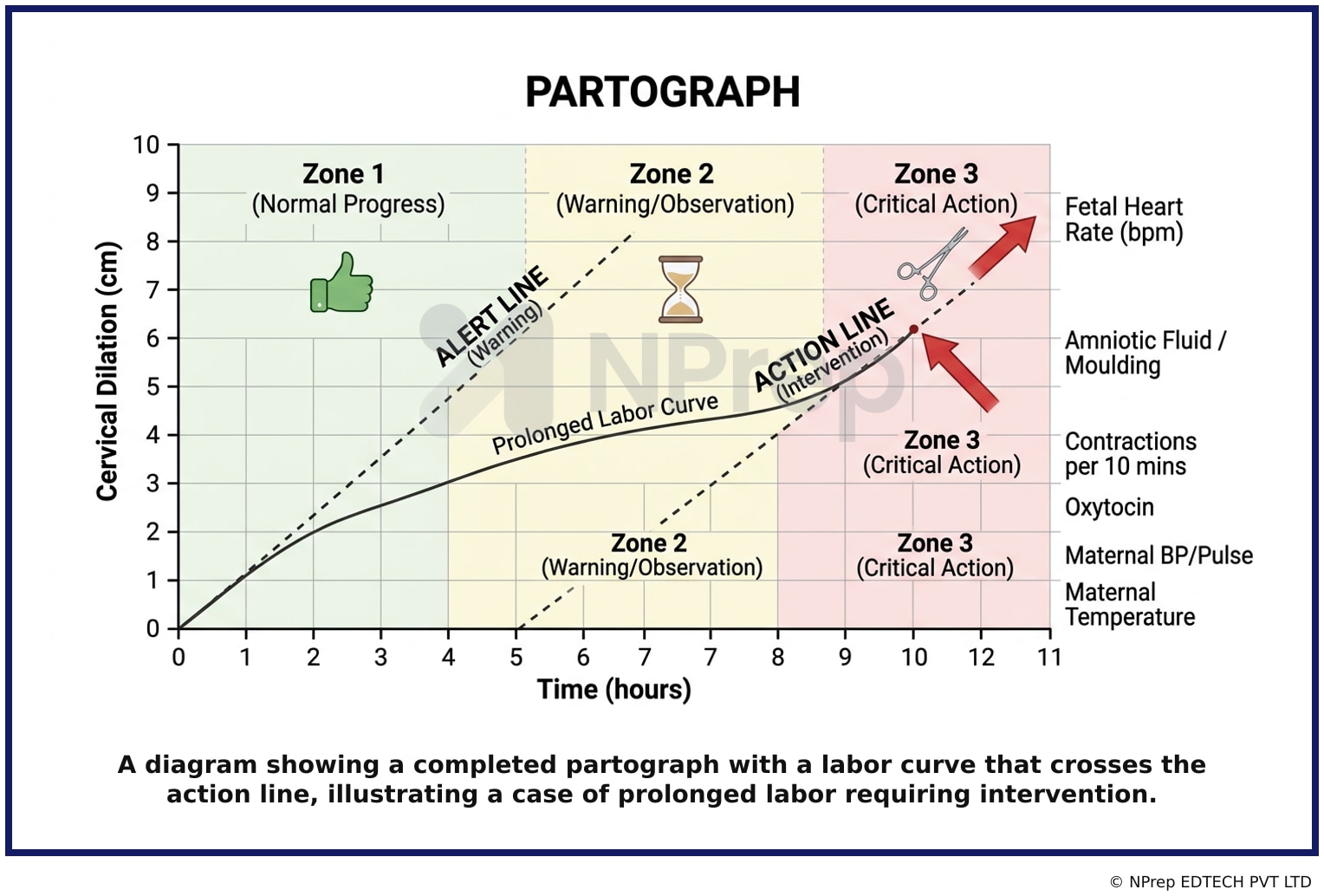
- Visual 1: Completed Partograph - A diagram showing a completed partograph with a labor curve that crosses the action line, illustrating a case of prolonged labor requiring intervention.
- Visual 2: Flowchart - A flowchart detailing the decision-making process based on partograph findings, starting from admission in active labor to actions taken when the alert and action lines are crossed.
Clinical Relevance
- Nursing practice connection: Prioritize focused assessment, early escalation, and real-time monitoring when managing Interpretation of a partograph for labor management in acute care settings.
- The partograph is a cornerstone of safe motherhood initiatives, particularly in low-resource settings, as it provides a simple, visual method to identify abnormal labor and prevent prolonged/obstructed labor, a major cause of maternal and perinatal mortality.
- A nurse's ability to accurately plot and interpret a partograph is a critical skill for timely escalation of care and collaboration with the obstetric team.
- What if? If a woman crosses the alert line but is already at a tertiary care center with full surgical capabilities, the management would focus on immediate, thorough reassessment (e.g., checking for cephalopelvic disproportion, fetal malposition) and preparation for potential intervention, rather than transfer.
How to Approach the Question
- First, identify the clinical tool shown in the image, which is a partograph.
- Recall the purpose of a partograph: to monitor the progress of labor.
- Identify the key components labeled or depicted: the Alert Line and the Action Line.
- Analyze the question's core requirement: which line indicates the need for 'immediate action or emergency intervention'.
- Differentiate the functions of the two lines. The 'Alert' line is a warning. The 'Action' line, as its name implies, demands action.
- Conclude that crossing the Action Line signifies a critical delay, thus requiring immediate intervention.
Concept Tested & Keywords
- Concept Tested: Interpretation of a partograph for labor management.
- Stem keywords: partograph, immediate action, emergency intervention, labor
- Lead-in keywords: which line
- Clinical cues: The care setting changes urgency, monitoring level, and the expected nursing action.
- Negative lead-in flag: false
Question ID
QHHNFqh3ujKyOCMRWUClRL
Practise the full NORCET 9 Mains - 2025
Attempt every question from this paper in a timed mock, then review the full solution for each one.
More Induction of Labor Questions
- The following are the contraindications of induction of labor; EXCEPT:
- A client is admitted to the hospital for an induction of labor owing to a gestation of 42 weeks confirmed by dates and ultrasound. When she is dilate…
- The contraindications of Induction of Labour include the following, EXCEPT?
- Ripeness of cervix is assessed with?
- Ripening of the cervix occurs during which stage of labor?
- Following are the methods of induction of labor EXCEPT?
- Which one of the following is used to record the labor events?
- Active management of 3rd stage of labor includes
- A nurse in a labor room should do this measure to prevent prolonged labour to a patient?
- By which graph is the progress of labor, cervical dilatation, and fetal head descent represented?
More NORCET 9 Mains - 2025 Questions
- A schizophrenia patient believes that the neighbor has installed a circuit inside his body. This is an example of which type of delusion?
- All medical test results are normal, but the patient persistently feels that something is abnormal in the body. This condition is known as:
- Bipolar I disorder is best characterized by:
- Bipolar II disorder is best characterized by:
- A patient taking antipsychotic medication develops extrapyramidal symptoms (EPS). What should be the management?
- A patient develops involuntary, continuous, restless movements after taking antipsychotics. This condition is known as:
- Which drug is the drug of choice in pre-eclampsia?
- PM POSHAN (Pradhan Mantri Poshan Shakti Nirman) scheme was started in which year?
- Which of the following is a killed vaccine?
- Family Planning Programme in India was first started in which year?