
RRB Nsg. Superintendent-20 July 2019 (Shift-3rd)
Reasoning
Hard
In a certain code language, if BELOW is coded as GDNYQ, then how is FIGHT coded in that language?
Appeared in: RRB Nsg. Superintendent-20 July 2019 (Shift-3rd)
Explanation
- The coding pattern consists of two distinct steps applied sequentially.
- First, every letter in the source word is advanced by two positions in the alphabet (e.g., F becomes H, I becomes K).
- Second, the resulting letters are rearranged: the first and second letters are swapped, the third remains in place, and the fourth and fifth letters are swapped.
- Applying this to 'FIGHT': The letters become H, K, I, J, V. After swapping, the code is 'KHIVJ'.
Why Other Options Were Wrong
- Option A: This option, HKIJV, correctly applies the +2 positional shift to each letter but fails to perform the second step of swapping the letter pairs. It keeps the letters in their original order after the shift.
- Option B: This option, WKJLI, does not follow the established +2 positional shift or the swapping pattern. The letters seem to be derived from a different, incorrect logic.
- Option D: This option, URTSG, is incorrect as it uses a completely different coding scheme. For example, F is coded as U, which does not fit the +2 pattern.
Related Visual
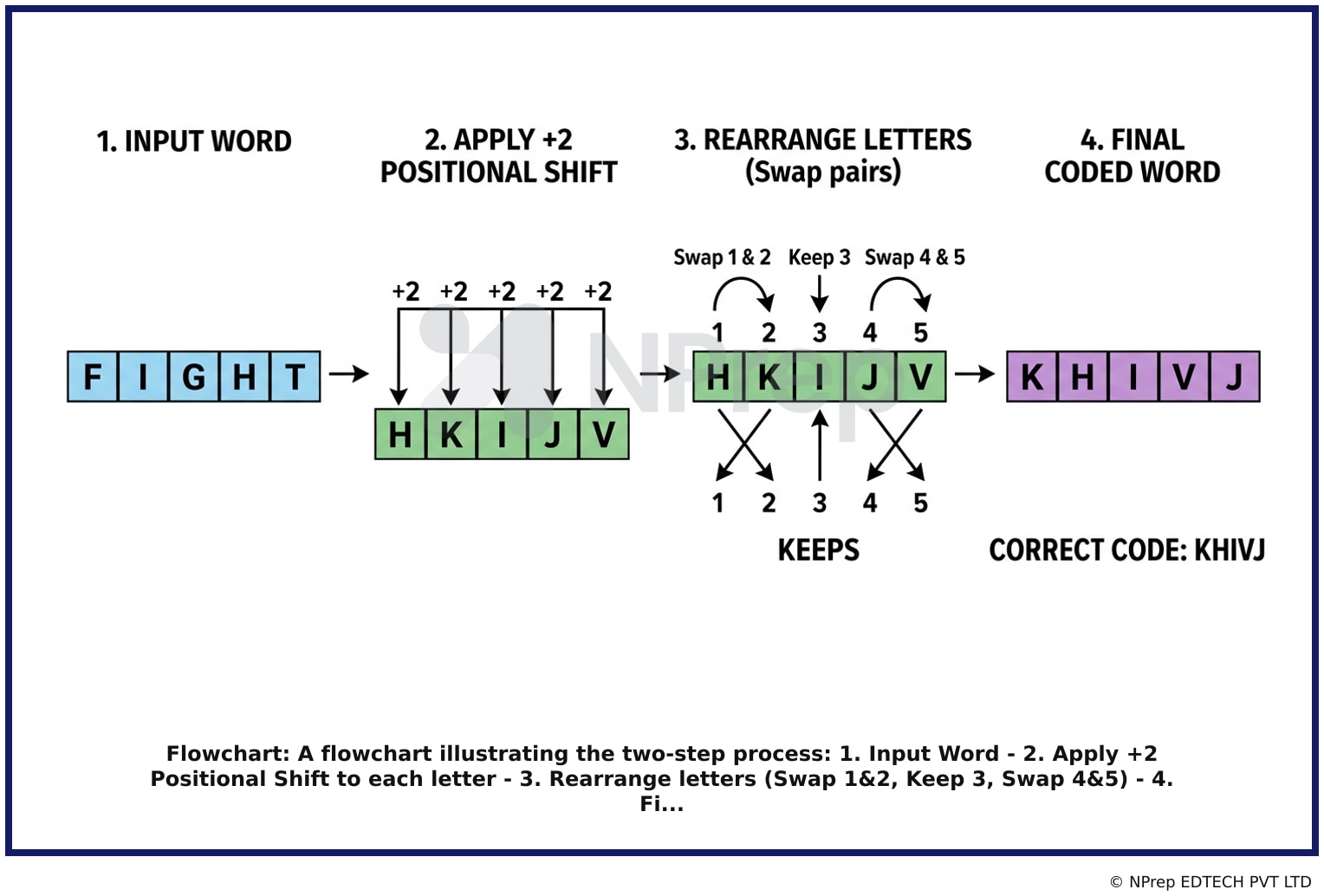
- Visual 1: Flowchart: A flowchart illustrating the two-step process: 1. Input Word -> 2. Apply +2 Positional Shift to each letter -> 3. Rearrange letters (Swap 1&2, Keep 3, Swap 4&5) -> 4. Final Coded Word. This visual would clarify the sequence of operations.
Clinical Relevance
- Nursing practice connection: This is primarily an exam-oriented knowledge point with limited direct bedside application, so retain This question tests logical reasoning, specifically coding-decoding based on alphabetical position and rearrangement as background academic context rather than a clinical decision trigger.
- This question type is not directly related to clinical nursing practice.
- It assesses logical and analytical reasoning skills, which are crucial for nurses in problem-solving, critical thinking, and making sound clinical judgments under pressure.
- What if the pattern was a -2 shift instead of +2? For 'FIGHT', the letters would become D, G, E, F, R. After swapping, the code would be 'GDEVFR'.
How to Approach the Question
- First, carefully analyze the relationship between the given word ('BELOW') and its code ('GDNYQ').
- Check for simple patterns like letter reversal, direct positional shifts (+n or -n), or opposite letters (A-Z, B-Y).
- Notice that B (+2) is D and E (+2) is G. The code starts with 'GD', which is a swap of the first two results. This suggests a multi-step pattern.
- Verify the pattern with the rest of the word. L(+2)=N (middle position, no swap). O(+2)=Q, W(+2)=Y. The code ends in 'YQ', which is a swap of the last two results.
- Confirm the rule: Shift each letter by +2, then swap the 1st and 2nd letters, and the 4th and 5th letters.
- Apply this confirmed two-step rule to the target word 'FIGHT' to find the correct answer.
Concept Tested & Keywords
- Concept Tested: This question tests logical reasoning, specifically coding-decoding based on alphabetical position and rearrangement.
- Stem keywords: code language, BELOW, GDNYQ, FIGHT
- Lead-in keywords: how is...coded
Question ID
Q26KlB-nUxZmNFh8TKDk1D
Practise the full RRB Nsg. Superintendent-20 July 2019 (Shift-3rd)
Attempt every question from this paper in a timed mock, then review the full solution for each one.
More Coding-Decoding Questions
- In a certain code language, if ADOPT is coded as GDRWS, then how is DATED coded in that language?
- If highway is sky, sky is river, river is cloud and cloud is land, then where do birds fly?
- If in a certain code, "do la ka" means "what to do", "ma ta do" means "what is this", and "ta re ka" means "this will do", then what is the code used…
- In a certain code language, if ALTER is coded as ODWUH, then how is DEPTH coded in that language?
- If blue is red, red is orange, orange is green and green is yellow then what is the color of the blood?
- Which two signs in the following equation need to be interchanged so that the equation will be mathematically correct? 4 + 3 × 4 \= 48
- If green' is called 'white', 'white' is called yellow', 'yellow' is called 'blue', 'blue' is called 'pink'and 'pink' is called 'black', then what is…
- In a certain code 'STOVE' is written as 'FNBLK' then how will 'VOTES' be written in the same code?
- The positions of the first and the sixth digit in the number 5109238674 are interchanged. Similarly the positions of the second and the seventh digit…
- Which two numbers should be interchanged to make the below equation mathematically correct? 7 + 16 / 4 \ 3 - 5 \= 10
More RRB Nsg. Superintendent-20 July 2019 (Shift-3rd) Questions
- Where is oxytocin synthesized?
- What is the name of the muscle that extends from the sphenoid bone to the mandible?
- Complementary feeding should be initiated at the completion of \ \ \ \ \ \
- Where is kidney located?
- Psychosocial development stage for infants is \ \ \ \ \ \ \ \ \ \
- What immunization is given at birth?
- Functional nursing is a method of providing
- Which disease is the dementia associated with asymmetric atrophy of the frontal and temporal lobes?
- Thromboangiitis obliterans is also known as
- What is the other name of pyridoxine?