
RRB Nsg. Superintendent-21 July 2019 (Shift-2nd)
Reasoning
Hard
In a certain code language, if BADLY is coded as CDFAN, then how is FORTY coded in that language?
Appeared in: RRB Nsg. Superintendent-21 July 2019 (Shift-2nd)
Explanation
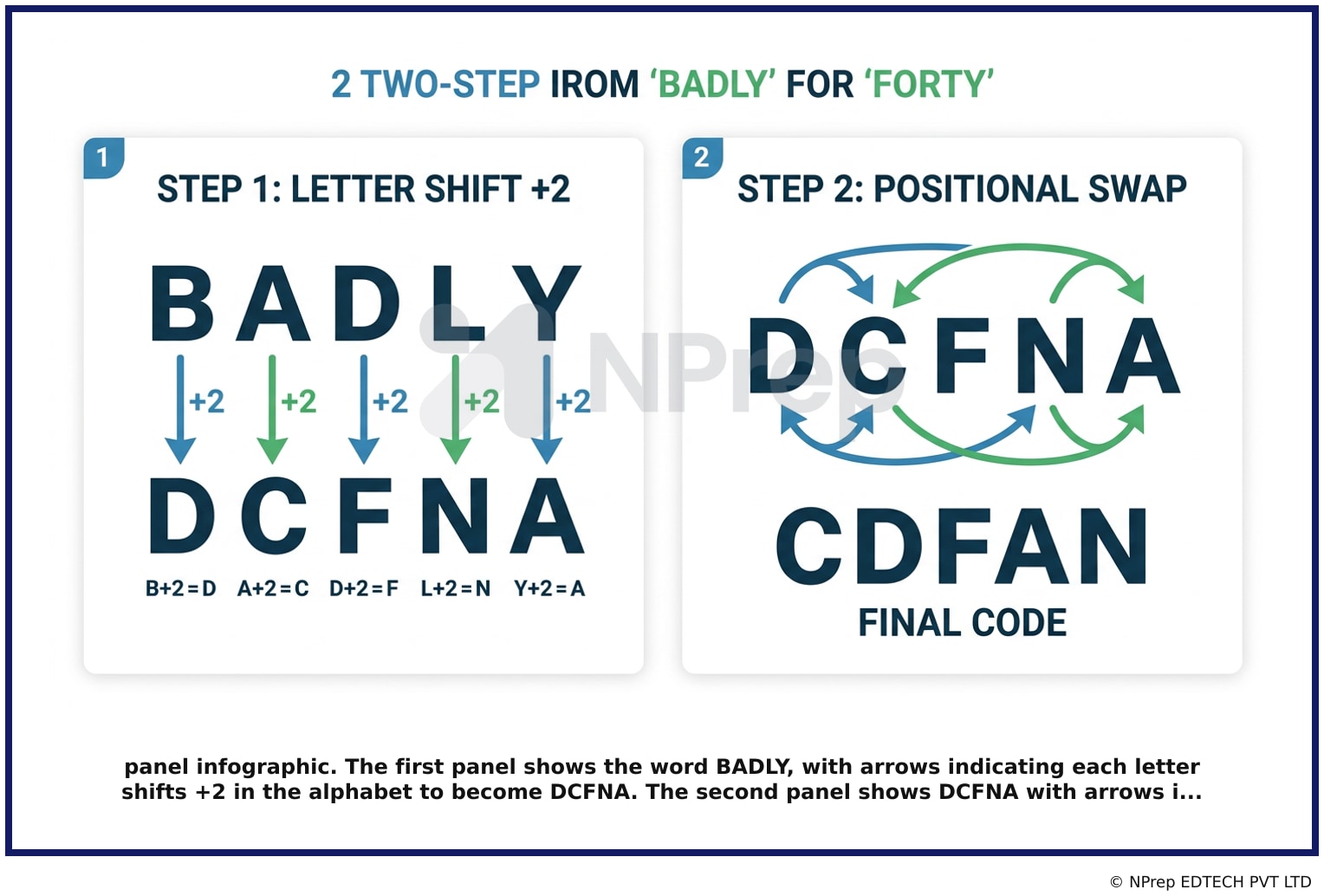
- The coding logic is a two-step process derived from the example 'BADLY' -> 'CDFAN'.
- Step 1: Each letter is shifted two positions forward in the alphabet (e.g., F+2 -> H, O+2 -> Q).
- Step 2: The resulting letters are rearranged. The first and second letters are swapped, and the fourth and fifth letters are swapped.
- Applying this to 'FORTY': The shifted letters are H, Q, T, V, A. Swapping positions (1<>2 and 4<>5) gives the final code QHTAV.
Why Other Options Were Wrong
- Option A: This is the result of applying only the first step of the logic (shifting each letter by +2) without performing the second step (swapping the letter positions).
- Option B: This code does not follow the established pattern. The letters seem to be derived from a completely different and inconsistent rule.
- Option D: This code does not follow the established +2 shift and swap pattern. There is no simple, consistent relationship between 'FORTY' and 'BWURI'.
Related Visual
Clinical Relevance
- Nursing practice connection: This is primarily an exam-oriented knowledge point with limited direct bedside application, so retain Logical Reasoning: Coding-Decoding by Letter Shifting and Positional Swapping as background academic context rather than a clinical decision trigger.
- While not a clinical question, this type of problem assesses logical and analytical reasoning, a critical skill for nurses in clinical problem-solving and decision-making.
- It tests the ability to identify patterns, form a hypothesis, and apply it systematically, which is analogous to how a nurse assesses patient symptoms and lab data to inform a plan of care.
- What if the code for BADLY was 'DCEOO'? The pattern would change. Here, B+2=D, A+2=C, but then D+1=E, L+3=O. The pattern is inconsistent, suggesting a more complex key or a flawed question, requiring careful re-evaluation—a skill also needed in clinical practice when data is ambiguous.
How to Approach the Question
- First, carefully analyze the given example pair (BADLY → CDFAN) to identify the relationship between the word and its code.
- Break down the transformation. Check for simple patterns like letter shifting (e.g., +1, +2, -1), reversal, or positional changes.
- Form a hypothesis. Notice that B is the 2nd letter and D is the 4th (+2), while A is the 1st and C is the 3rd (+2). Hypothesize that each letter is shifted forward by two places.
- Test this hypothesis on the full word 'BADLY'. This gives 'DCFNA'. Compare this to the given code 'CDFAN'.
- Identify the difference between your intermediate result ('DCFNA') and the actual code ('CDFAN'). This reveals the second step of the pattern: the first two letters are swapped, and the fourth and fifth letters are swapped.
- Apply this confirmed two-step rule (shift +2, then swap 1&2 and 4&5) to the target word 'FORTY' to find the correct answer and select the matching option.
Concept Tested & Keywords
- Concept Tested: Logical Reasoning: Coding-Decoding by Letter Shifting and Positional Swapping
- Stem keywords: code language, BADLY, CDFAN, FORTY
- Lead-in keywords: how is
Question ID
QgRzeXCjKkfIFd-PBgShzr
Practise the full RRB Nsg. Superintendent-21 July 2019 (Shift-2nd)
Attempt every question from this paper in a timed mock, then review the full solution for each one.
More Coding-Decoding Questions
- In a certain code language, if ADOPT is coded as GDRWS, then how is DATED coded in that language?
- If highway is sky, sky is river, river is cloud and cloud is land, then where do birds fly?
- If in a certain code, "do la ka" means "what to do", "ma ta do" means "what is this", and "ta re ka" means "this will do", then what is the code used…
- In a certain code language, if ALTER is coded as ODWUH, then how is DEPTH coded in that language?
- If blue is red, red is orange, orange is green and green is yellow then what is the color of the blood?
- Which two signs in the following equation need to be interchanged so that the equation will be mathematically correct? 4 + 3 × 4 \= 48
- If green' is called 'white', 'white' is called yellow', 'yellow' is called 'blue', 'blue' is called 'pink'and 'pink' is called 'black', then what is…
- In a certain code 'STOVE' is written as 'FNBLK' then how will 'VOTES' be written in the same code?
- The positions of the first and the sixth digit in the number 5109238674 are interchanged. Similarly the positions of the second and the seventh digit…
- Which two numbers should be interchanged to make the below equation mathematically correct? 7 + 16 / 4 \ 3 - 5 \= 10
More RRB Nsg. Superintendent-21 July 2019 (Shift-2nd) Questions
- The most common cause of embolism is ?
- Myopia is corrected by using?
- The normal human body temperature is maintained by& x20;
- \ \ \ \ \ \ denotes one who never completed a pregnancy to the stage of& x20;
- The process involved in the development of a mature ovum is called & x20;
- The larynx is closed during swallowing by: & x20;
- How are ECG changes presented in ischemia and myocardial infarction? & x20;
- What information the nurse should consider while collecting the history of a child with suspected rheumatic fever?& x20;
- The storage form of carbohydrates in animals is& x20;
- Paedophilia is a form of