
Bihar NHM CHO-2025
Non Nursing Subjects
Hard
If a man bought 9 sharpeners for ₹4, and sold them at 5 sharpeners for ₹8, then the gain percentage is
Appeared in: Bihar NHM CHO-2025
Explanation
- To compare cost and selling prices, a common quantity of items must be used. The Least Common Multiple (LCM) of 9 and 5 is 45.
- The cost price (CP) for 45 sharpeners is calculated as (₹4 / 9 sharpeners) × 45 sharpeners = ₹20.
- The selling price (SP) for 45 sharpeners is calculated as (₹8 / 5 sharpeners) × 45 sharpeners = ₹72.
- The total gain is the difference between the selling price and cost price: Gain = SP - CP = ₹72 - ₹20 = ₹52.
- The gain percentage is calculated using the formula (Gain / CP) × 100, which is (₹52 / ₹20) × 100 = 260%.
Why Other Options Were Wrong
- Option A: A gain of 280% on a cost price of ₹20 would mean a profit of ₹56 (2.8 × 20), leading to a selling price of ₹76. The calculated selling price is ₹72.
- Option B: A gain of 250% on a cost price of ₹20 would mean a profit of ₹50 (2.5 × 20). The actual profit is ₹52.
- Option C: A gain of 270% on a cost price of ₹20 would mean a profit of ₹54 (2.7 × 20). The actual profit is ₹52.
Related Visual
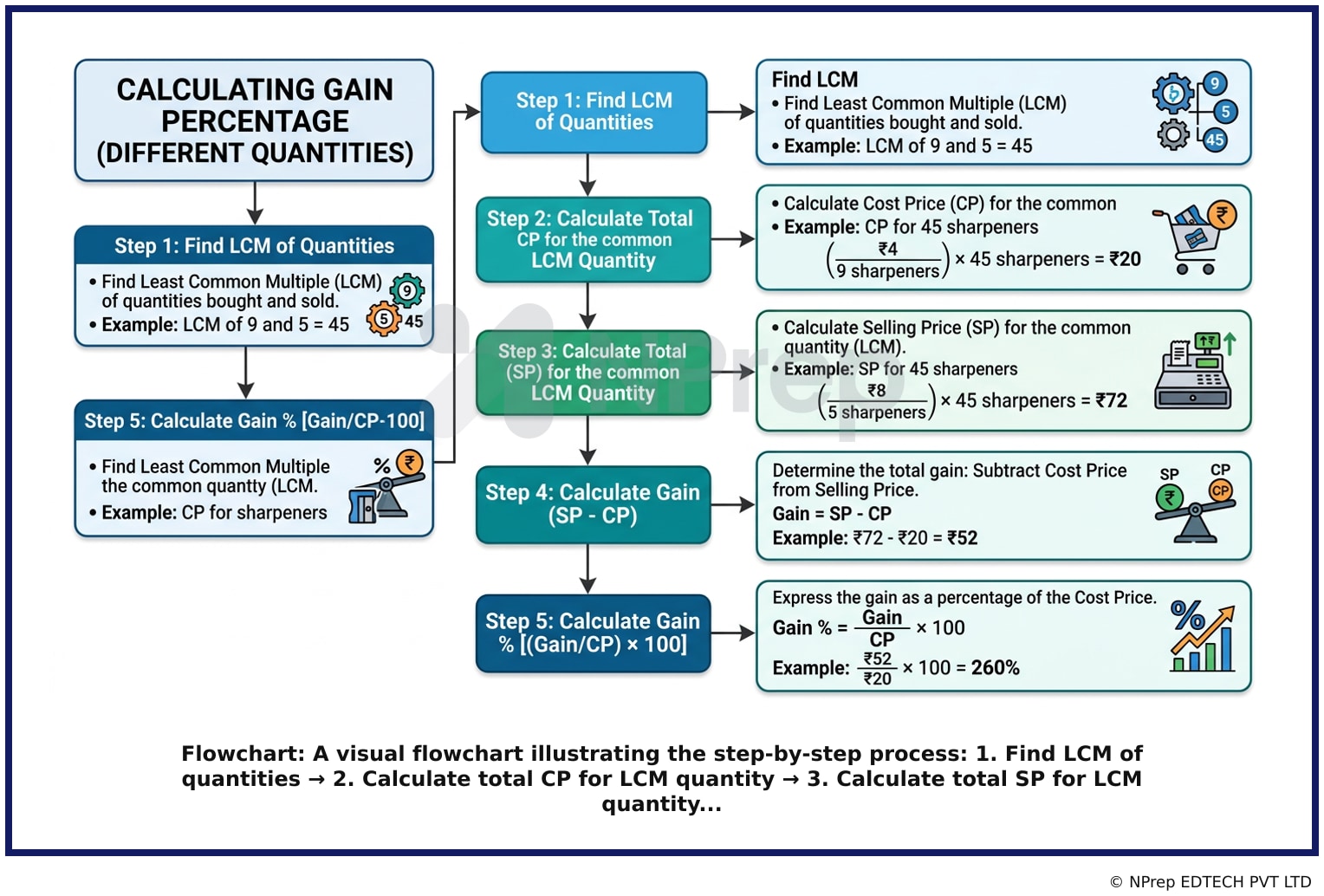
- Visual 1: Flowchart: A visual flowchart illustrating the step-by-step process: 1. Find LCM of quantities → 2. Calculate total CP for LCM quantity → 3. Calculate total SP for LCM quantity → 4. Calculate Gain (SP - CP) → 5. Calculate Gain % [(Gain/CP) * 100].
Clinical Relevance
- Nursing practice connection: This is primarily an exam-oriented knowledge point with limited direct bedside application, so retain Calculation of gain percentage in a profit and loss problem where the quantity bought and sold are different as background academic context rather than a clinical decision trigger.
- Understanding profit and loss calculations is a fundamental life skill for financial literacy, budgeting, and making informed purchasing decisions.
- This concept is foundational for anyone involved in business, sales, or entrepreneurship, including managing finances for a small clinic or pharmacy.
- What if the sharpeners were sold at a loss? If 45 sharpeners were sold for ₹15 instead of ₹72, the loss would be CP - SP = ₹20 - ₹15 = ₹5. The loss percentage would be (Loss / CP) × 100 = (5 / 20) × 100 = 25%.
How to Approach the Question
- First, read the question carefully and identify the given information: the cost price for a certain quantity and the selling price for a different quantity.
- Recognize that you cannot directly compare the prices because the quantities are different. The core task is to find the prices for an equal number of items.
- Determine a common quantity by finding the Least Common Multiple (LCM) of the number of items bought (9) and sold (5). The LCM is 45.
- Calculate the total cost price for this common quantity (45 sharpeners).
- Calculate the total selling price for the same common quantity (45 sharpeners).
- Use the standard formula for gain percentage: Gain % = [(Selling Price - Cost Price) / Cost Price] × 100.
Concept Tested & Keywords
- Concept Tested: Calculation of gain percentage in a profit and loss problem where the quantity bought and sold are different.
- Stem keywords: bought 9 sharpeners for ₹4, sold 5 sharpeners for ₹8, gain percentage
- Lead-in keywords: the gain percentage is
Question ID
Q_sPOrw4OtjuOT9bhdNkEA
Practise the full Bihar NHM CHO-2025
Attempt every question from this paper in a timed mock, then review the full solution for each one.
More Mathematics Questions
- The ratio of number of girls to boys in a school of 2520 students is 27:29. How many more girls should be admitted to make the ratio 1:1?
- Three candidates contested an election and received 4500, 7500 and 8000 votes respectively. What percentage of votes did the winning candidates get?
- Two bells ring at intervals of 59 seconds and 70 seconds. If they both ring at 10 O'clock in the morning together, after how many seconds will they r…
- The average of four numbers is 61. The largest number among them is 85 and the smallest number is 21. What will be the larger of the remaining two nu…
- In what ratio should water be mixed with milk so that on selling the mixture at cost price a profit of 20% is made?
- A quality control analyst rejects 0.08% of the fabric produced, finding it defective. How many meters of fabric must he examine to reject 4 meters?
- A man traveled from his village to the post office at a speed of 25km/hr and returned at a speed of 4km/hr. If the entire journey took 5 hours and 48…
- A train is running at 60 km/hr. How much time will it require to cross a 2 km bridge?
- The average monthly income of R1 and R2 is Rs. 99,500. The average monthly income of R2 and R3 is Rs. 1,15,600 and the average monthly income of R1 a…
- If Rohan bought 20 books at the rate of Rs. 120 each, 30 books at the rate of Rs. 150 each, and 15 books at the rate of Rs. 100 each, then find the a…
More Bihar NHM CHO-2025 Questions
- Why is prime agricultural land typically excluded from energy project developments in India?
- The Schedule of the Constitution contains provisions regarding the recognition of official languages.
- Which major policy change regarding Foreign Direct Investment (FDI) in India's insurance sector was proposed in the 2025 Union Budget?
- Which phenomenon causes the deflection of southwest monsoon winds after they cross the equator and approach India?
- Which pH indicator acts as a Bronsted-Lowry base, accepting protons in acidic solutions and changing colour from yellow to red?
- Who among the following founded the Arya Samaj in 1875 in Bombay (now Mumbai)?
- Solar panels, which are responsible for generating electricity, are made of a special layer of which element?
- As per the 2025 Census, which Indian state now hosts 891 Asiatic lions, marking a 32% increase from 2020 numbers?
- What is the purpose of the Quantum Valley Tech Park, established in Amaravati, Andhra Pradesh in 2025?
- Which intellectual founded the Tattvabodhini Sabha to promote Vedantism and oppose Christianity?