
AIIMS Jodhpur SNO-2023
Nursing Research & Statistics (E5)
Medium
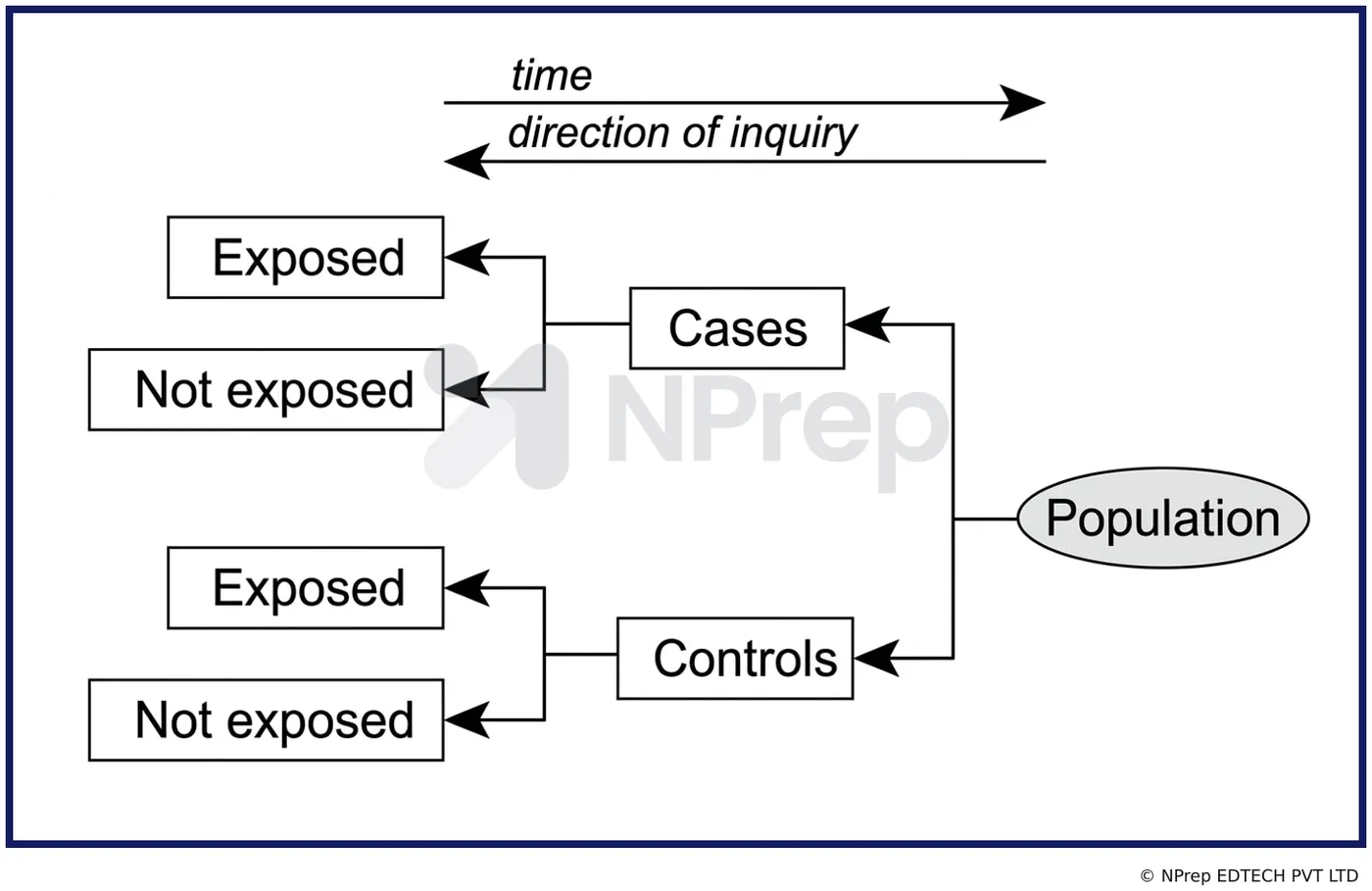 Identify the study design given in the picture.
Appeared in: AIIMS Jodhpur SNO-2023
Explanation
- The diagram shows that the study begins by identifying 'Cases' (with the outcome) and 'Controls' (without the outcome) from a population.
- The 'direction of inquiry' arrow points backward in time, from the outcome status to determine past exposure.
- This process of starting with the outcome and looking retrospectively for exposure is the defining characteristic of a case-control study.
- This design is particularly useful for studying rare diseases or conditions with a long latency period.
Why Other Options Were Wrong
- Option A: A nested case-control study is a specific type of case-control study conducted within an existing cohort. The diagram shows the general principle of a case-control study starting from a general population, not a pre-defined cohort.
- Option B: In a retrospective cohort study, the investigator starts with an exposure status from the past and follows subjects forward (through records) to the present to determine outcome. The direction of inquiry is still forward (exposure → outcome), which is the opposite of what is shown.
- Option D: A prospective cohort study starts with exposed and unexposed groups and follows them forward in time to observe the development of the outcome. The direction of inquiry is forward, which is contrary to the backward-pointing arrow in the diagram.
Related Visual

- Visual 1: Flowchart - A comparative flowchart showing the direction of inquiry for both Case-Control (backward: Outcome → Exposure) and Cohort (forward: Exposure → Outcome) studies side-by-side to highlight the key difference.
- Visual 2: Diagram - An illustration of a nested case-control study, showing how cases and controls are sampled from a larger, established cohort study population.
Clinical Relevance
- Nursing practice connection: This is primarily an exam-oriented knowledge point with limited direct bedside application, so retain Identification of epidemiological study designs as background academic context rather than a clinical decision trigger.
- Understanding study designs is crucial for nurses to critically appraise research evidence and apply it to practice (Evidence-Based Practice).
- A nurse researcher might choose a case-control design to investigate the cause of a rare hospital-acquired infection, as it is efficient for rare outcomes.
- A key limitation nurses must consider when reading a case-control study is recall bias, where cases may remember past exposures differently than controls, potentially skewing the results.
How to Approach the Question
- First, analyze the starting point of the study shown in the diagram. Here, the study begins by grouping individuals into 'Cases' and 'Controls', which means the starting point is the health outcome or disease.
- Next, identify the 'direction of inquiry'. The arrow explicitly points backward from the outcome (Cases/Controls) to the past exposure status (Exposed/Not Exposed).
- Recall the definitions of major study designs. A study that starts with the outcome and looks backward for the cause/exposure is a case-control study.
- Contrast this with cohort studies, which always start with the exposure and look forward for the outcome, regardless of whether they are prospective or retrospective in terms of data collection.
- Based on this analysis, conclude that the diagram represents a case-control study.
Concept Tested & Keywords
- Concept Tested: Identification of epidemiological study designs
- Stem keywords: study design, picture, identify
- Lead-in keywords: Identify
Question ID
Qflkibqz_I21pbe3oYU607
Practise the full AIIMS Jodhpur SNO-2023
Attempt every question from this paper in a timed mock, then review the full solution for each one.
More Epidemiology – Epidemiological Approaches and Processes Questions
- Which test is used to monitor vaccine potency?
- Which vaccine should be stored in the freezer compartment of the refrigerator?
- The two main approaches used in epidemiology are?
- Which of the following is not a observational study design used in epidemiology?
- Which of the following is not a method of epidemiological measurement?
- The comprehensive community health nursing includes? (a) Health Promotion & x20; (b) Disease Prevention & x20; (c) Treatment & x20; (d) Rehabilitatio…
- The constant presence of a disease or infection within a given geographic area is called?
- In the occurrence of SARS and other pandemics, which of the following is the most important role of a nurse in epidemiology?
- A pandemic disease condition which occurs every 5 years. Which trend is reflected here?
- In the following questions, out of four alternatives, select the alternative which is the best substitute of the words/sentences. A disease which att…
More AIIMS Jodhpur SNO-2023 Questions
- A short-term goal for a patient with Alzheimer's disease is:
- The primary fever in malaria corresponding to the development of the parasites in the red blood cells comprise all of the following EXCEPT:
- Second component (other than NST) in Modified Biophysical Profile is:
- What is the best position for a patient in anaphylactic shock?
- The year 2023 has been declared as The International Year of:
- Low molecular weight heparin should be administered:
- Epigenic factors play an important role in schizophrenia. In genetically vulnerable people, environmental factors may increase the risk and trigger s…
- Identify the contraceptive device shown in the given picture.
- A nurse posted in a paediatric cardiology unit noted that the assessment findings of an infant reveal a continuous machinery murmur on the auscultati…
- At the Central level, the Union Ministry of Health and Welfare is headed by a Cabinet Minister, a Minister of State and a Deputy Health Minister. The…