
DSSSB 12 August 2024
Community Health Nursing
Easy
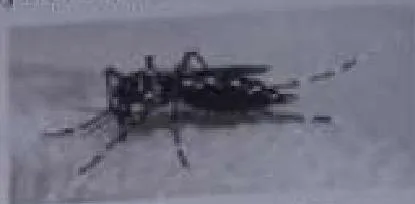
Identify the mosquito from the following image.
Appeared in: DSSSB 12 August 2024
Explanation
- The mosquito in the image is identified as Aedes based on its key visual characteristics.
- It displays a dark (black) body with prominent white stripes on its legs, a hallmark feature of the Aedes genus, often called the 'tiger mosquito'.
- Its resting posture is parallel to the surface, which is consistent with the Culicini tribe (to which Aedes belongs) and helps differentiate it from the Anopheles mosquito.
Why Other Options Were Wrong
- Option A: Kimia is not a recognized genus of medically important mosquitoes in standard entomology or public health literature.
- Option C: While Culex mosquitoes also rest parallel to the surface, they typically have a dull, brownish-grey body and lack the distinct black-and-white stripes seen in the image.
- Option D: Anopheles mosquitoes are characterized by their unique resting posture, where the body is inclined at a 45-degree angle to the surface. The mosquito in the image is resting parallel to the surface. Anopheles also typically have spotted wings.
Related Visual

Clinical Relevance
- Nursing practice connection: This is primarily an exam-oriented knowledge point with limited direct bedside application, so retain Identification of mosquito vectors based on morphological features as background academic context rather than a clinical decision trigger.
- Accurate identification of mosquito vectors is critical for public health surveillance and implementing targeted control measures.
- Identifying an Aedes mosquito in a community immediately raises concern for outbreaks of Dengue, Chikungunya, and Zika virus. Control efforts would then focus on eliminating artificial water containers (e.g., tires, flower pots, water coolers) where Aedes mosquitoes breed.
- What if? If the mosquito were identified as Anopheles, the primary public health concern would be Malaria. Vector control strategies would shift to managing clean water bodies (like ponds and puddles) and using methods like indoor residual spraying (IRS) and insecticide-treated bed nets, as Anopheles often bite at night and rest indoors.
How to Approach the Question
- First, carefully examine the mosquito in the provided image.
- Focus on two key identifying features: body/leg markings and resting posture.
- Note the distinct black and white stripes on the legs and body. This is a strong indicator.
- Observe the angle of the mosquito's body relative to the surface it's on. It is parallel.
- Compare these observations to the known characteristics of the options. The combination of white stripes and a parallel resting posture is unique to the Aedes mosquito among the choices.
- Eliminate other options based on their differing characteristics: Anopheles rests at an angle, and Culex lacks the prominent stripes.
Concept Tested & Keywords
- Concept Tested: Identification of mosquito vectors based on morphological features.
- Stem keywords: Identify, mosquito, image
- Lead-in keywords: BEST, MOST RELEVANT CLUE
Question ID
QEXw_OeNp_JvnexOFgrCyj
Reference Book
E6 Parks TextBook of Preventive & Social Medicine part 2 — Subpart B (pp 233-449 of 464) p. 87-89
Practise the full DSSSB 12 August 2024
Attempt every question from this paper in a timed mock, then review the full solution for each one.
More Environmental Science, Environmental Health, and Sanitation Questions
- Which form of chlorine preparation is used to reduce the bacterial residue in water?
- ICDS (Integrated Child Development Services) program was launched in the year;
- Match the greenhouse gases with their sources: Greenhouse gases Source a. Methane 1. Landfills b. Carbon dioxide 2. Fossil fuel burning c. Nitrous ox…
- If the earth had no atmosphere, the sky would have appeared:
- What is the main cause of noncommunicable diseases?
- What is the dictionary definition of 'Sanitation' according to the National Sanitation Foundation of the USA?
- Temporary hardness of water is removed by?
- The optimum fluoride concentration in drinking water in India is recommended to be?
- Hardness of water is expressed as?
- What is the minimum contact time required for the chlorination of water to take place?
More DSSSB 12 August 2024 Questions
- What is the meaning of conation?
- All of the following are selective serotonin inhibitors, EXCEPT:
- Which of the following is NOT a parameter of the Braden scale?
- Which of the following is a way of dealing with or remembering information by separating it into small groups?
- A common measure of the severity of a disease, based on current physiological parameters, age and previous health conditions, is the
- The formation of sequestrum and involucrum is seen in the pathogenesis of:
- An adult patient was diagnosed with paranoid schizophrenia, and the doctor prescribed him chlorpromazine. After three weeks, the patient developed a…
- World Anti-Tobacco Day is observed on:
- Which of the following pubertal changes is characterised by breast budding in females?
- What is the inability to recognize familiar inanimate objects called?