
NORCET 3 - 2022 (Shift-1)
Medical Surgical Nursing
Easy
Identify the following non-absorbable suture? 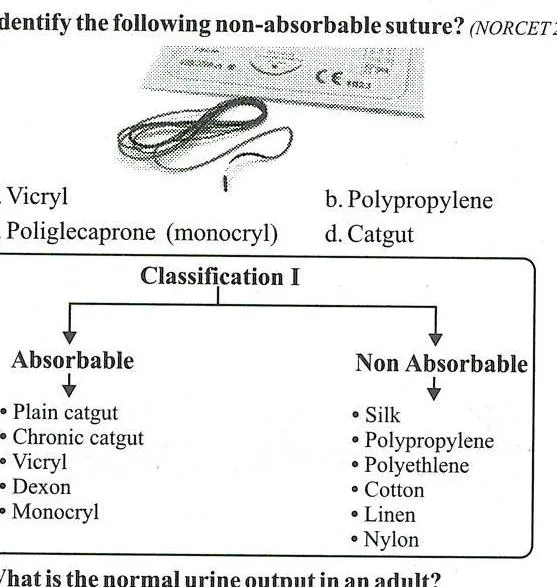
Appeared in: NORCET 3 - 2022 (Shift-1)
Explanation
- Polypropylene, commercially known as Prolene, is a synthetic monofilament suture.
- It is classified as non-absorbable because it is not broken down by the body and provides permanent tensile strength.
- Due to its inert nature and strength, it is used for tissues that require long-term support, such as in vascular anastomoses or hernia repair.
- The flowchart provided in the image correctly lists Polypropylene under the 'Non Absorbable' category.
Why Other Options Were Wrong
- Option A: Vicryl (Polyglactin 910) is an absorbable suture. It is designed to be broken down and absorbed by the body over several weeks.
- Option C: Poliglecaprone, with the brand name Monocryl, is an absorbable suture. It is known for its rapid absorption.
- Option D: Catgut is a natural absorbable suture. It is digested by the body's enzymes and has a shorter duration of tensile strength.
Related Visual

Clinical Relevance
- Nursing practice connection: This is primarily an exam-oriented knowledge point with limited direct bedside application, so retain Classification of Surgical Sutures as background academic context rather than a clinical decision trigger.
- Understanding the difference between absorbable and non-absorbable sutures is critical for patient safety and proper wound healing. Using the wrong type can lead to wound dehiscence, infection, or unnecessary foreign body reaction.
- A nurse's role includes monitoring the wound post-operatively for signs of infection or healing complications. For non-absorbable skin sutures, the nurse is often responsible for their timely removal.
- What if the patient had a history of keloid scarring? The surgeon might prefer to use absorbable subcuticular sutures (like Monocryl) instead of non-absorbable skin sutures to minimize skin trauma and the inflammatory response that can contribute to keloids.
How to Approach the Question
- First, carefully read the question and identify the key term: 'non-absorbable suture'.
- Examine the provided image, which includes a helpful flowchart classifying sutures. This is a direct clue.
- Locate the 'Non Absorbable' column in the flowchart.
- Scan the list under 'Non Absorbable': Silk, Polypropylene, Polyethylene, etc.
- Now, review the multiple-choice options: Vicryl, Polypropylene, Poliglecaprone (monocryl), Catgut.
- Compare the options to the 'Non Absorbable' list in the flowchart. You will find 'Polypropylene' is listed there, making it the correct answer.
Concept Tested & Keywords
- Concept Tested: Classification of Surgical Sutures
- Stem keywords: non-absorbable, suture
- Lead-in keywords: Identify
- Negative lead-in flag: false
Question ID
Q3xNnwW14oKeHRw9gXYCY3
Reference Book
E6 Nursing Brunner Adult Health 3SA Vol 1 Part 1 p. 81-83
E6 Gynecology Williams p. 430-440
Practise the full NORCET 3 - 2022 (Shift-1)
Attempt every question from this paper in a timed mock, then review the full solution for each one.
More Peri-operative Nursing Questions
- A patient planned for surgery advised to remove Jewellery because:
- A surgeon is going to give a skin incision on patient. Which of the following is to be done?
- How many items are included in the WHO surgical safety checklist: SITOSO?
- Which position is given to a client by nursing officer, who has been brought from OT after craniotomy surgery?
- A patient returning from abdominal surgery abdominal binder is applied. What is the purpose of abdominal binder?
- Which is the example of Monofilament suture
- What is the responsibility of scrubs nurses in OT?
- A female patient has a laparoscopic cholecystectomy this morning she is now complaining of right shoulder pain. The nurse would explain to the patien…
- The suture shown in the image is:
- A patient has just returned from the post anesthesia care unit (PACU) after hemorrhoidectomy. His postoperative orders include sitz bath every mornin…
More NORCET 3 - 2022 (Shift-1) Questions
- A patient is getting IV fluid through peripheral cannula, shows redness, cool, oedema and decreased flow rate. The possible diagnosis is?
- The Endemic Disease that occurs every 4 years of interval is called?
- The nurse witnesses a neighbour's husband sustain a fall from the roof of his house. The nurse rushes to the victim and determines the need to open t…
- Which of the following is NOT included in the National Vector borne disease control Programme?
- In a patient IV site shows redness, heat, tenderness, decrease flow rate, are the classical sign of?
- Which measure is used for growth monitoring at Anganwadi centre?
- Which of the following muscles should always be avoided for IM Injection to prevent sciatic nerve injury?
- The doses of Elemental Iron and folic acid in Anaemia Mukht Bharat (AMB) program for pregnant women?
- When is the world patient safety day observed?
- A child is suffering from diarrhoea with restlessness, agitation and irritability. Which of the following clinical sign is not indicating to severe d…