
NORCET-7 Mains-2024
Obstetrics & Gynaecology
Easy
Identify the following maneuver which is used in shoulder dystocia? 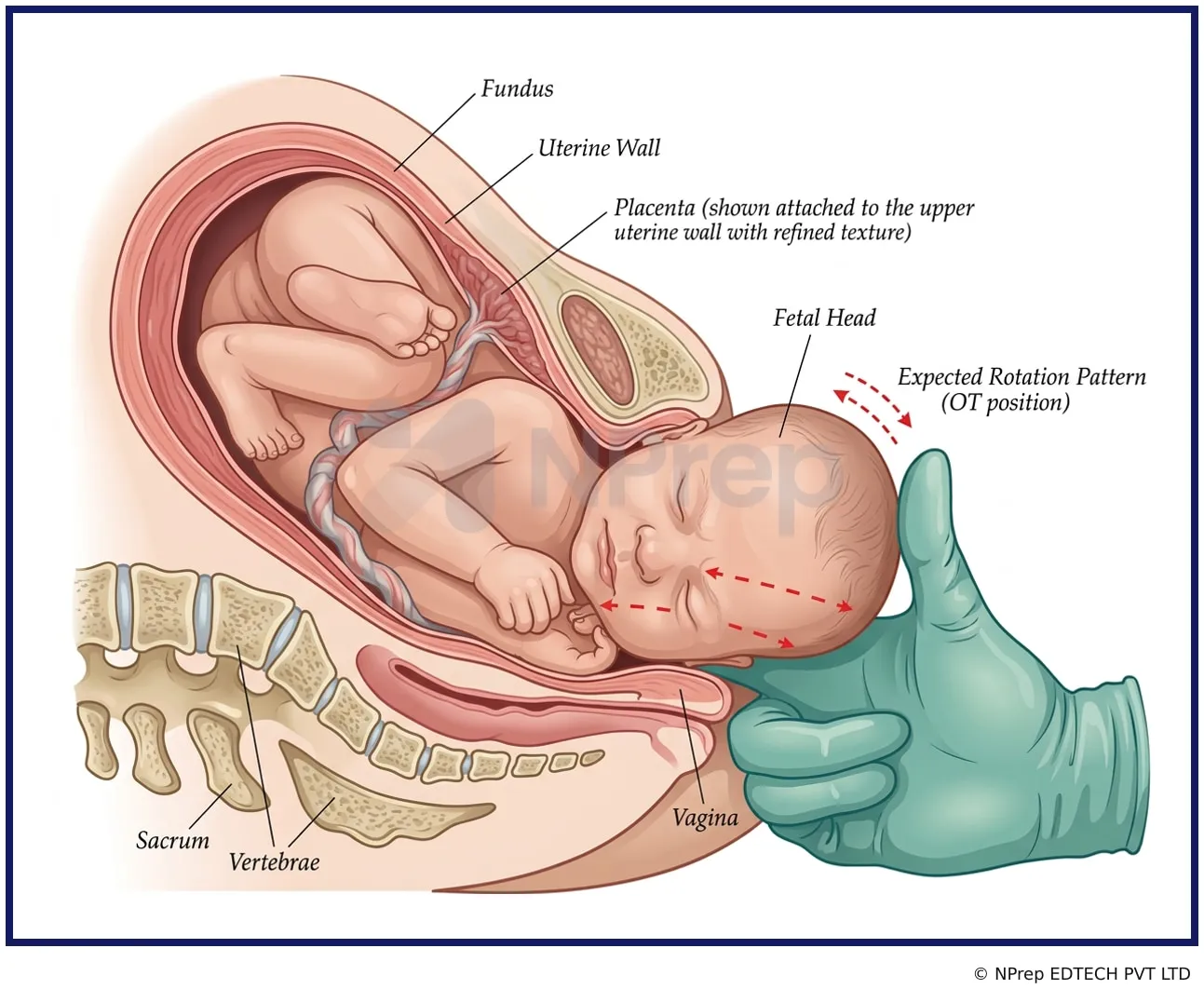
Appeared in: NORCET-7 Mains-2024
Explanation
- The second image illustrates the Rubin maneuver, a key internal rotational technique for resolving shoulder dystocia.
- In this maneuver, pressure is applied to the posterior aspect of the most accessible shoulder (usually the anterior one) to push it toward the fetal chest.
- This action adducts the shoulder, reducing the bisacromial (shoulder-to-shoulder) diameter.
- By reducing this diameter, the impacted shoulder can be dislodged from behind the maternal pubic symphysis, allowing for delivery.
Why Other Options Were Wrong
- Option A: The Ritgen maneuver, shown in the first image, is used to control the delivery of the fetal head and protect the perineum from tearing. It is not a maneuver for shoulder dystocia.
- Option B: The McRobert's maneuver is an external maneuver that involves hyperflexing the mother's legs onto her abdomen. The image shows an internal maneuver with a hand inside the vagina.
- Option D: The Leopold maneuvers are a series of four abdominal palpations performed during pregnancy to determine the position, presentation, and lie of the fetus. They are a diagnostic tool, not a delivery intervention.
Related Visual

- Visual 1: Diagram - A step-by-step illustration of the HELPERR mnemonic for shoulder dystocia, showing the McRobert's maneuver, suprapubic pressure, and internal rotational maneuvers like Rubin and Wood's screw.
- Visual 2: Animation - A 3D animation showing how the McRobert's maneuver changes the pelvic angle to release the impacted anterior shoulder.
- Visual 3: Infographic - A comparison table of different internal maneuvers (Rubin, Wood's screw, posterior arm delivery) with illustrations and key actions for each.
Clinical Relevance
- Nursing practice connection: This is primarily an exam-oriented knowledge point with limited direct bedside application, so retain Identification of obstetric maneuvers for managing shoulder dystocia as background academic context rather than a clinical decision trigger.
- Shoulder dystocia is an unpredictable obstetric emergency that requires a swift, coordinated team response to prevent fetal hypoxia, brachial plexus injury, or death.
- Nurses play a critical role in recognizing the 'turtle sign' (retraction of the fetal head against the perineum), calling for help, assisting with maternal positioning (McRobert's maneuver), and applying suprapubic pressure.
- The HELPERR mnemonic provides a standardized, evidence-based sequence of actions that improves team communication and patient outcomes during this high-stress event.
How to Approach the Question
- First, carefully analyze the images provided. Identify the specific actions being performed in each illustration.
- Read the question stem and identify the key clinical condition: 'shoulder dystocia'.
- Evaluate each image in the context of the question. Image 1 shows head delivery control (Ritgen). Image 2 shows an internal shoulder rotation (a dystocia maneuver). The question is asking about the maneuver for shoulder dystocia.
- Review the options. Match the maneuver depicted in Image 2 with its correct name from the options.
- Eliminate the other options by recalling their definitions: Ritgen is for head delivery, McRobert's is external leg flexion, and Leopold's is for antenatal assessment.
- Confirm your choice by recalling that the Rubin maneuver is an internal rotational technique used to resolve shoulder dystocia.
Concept Tested & Keywords
- Concept Tested: Identification of obstetric maneuvers for managing shoulder dystocia.
- Stem keywords: maneuver, shoulder dystocia, identify
- Lead-in keywords: Identify
- Clinical cues: The image shows an internal rotation of the fetal shoulder, a key technique for shoulder dystocia.
Question ID
QehRRCYRrfb40NpJNn9Au2
Practise the full NORCET-7 Mains-2024
Attempt every question from this paper in a timed mock, then review the full solution for each one.
More Prolonged Labor, Obstructed Labor, Dystocia Caused by Fetal Anomalies Questions
- Dystocia is:-
- The manoeuver commonly used to manage shoulder dystocia is?
- An image shows a nurse applying pressure to the mother's lower abdomen during the third stage of labor. What is the nurse doing?
- During a delivery, after the emergence of the fetal head, the nurse notes that it retracts back against the perineum (turtle sign), indicating should…
- Which of the following defines obstructed labour?
- An image shows a healthcare provider applying firm, downward pressure on the uterine fundus. What is the procedure here:
- The measure which is done to manage shoulder dystocia?
- When the first and second stages of Labour last longer than what duration, is it called prolonged labor?
- What is the cause of a Pathological Bandl's ring?
- Shoulder dystocia is managed by?
More NORCET-7 Mains-2024 Questions
- What is the correct statement regarding pre-oxygenation in children before intubation?
- A pregnant woman is ready for caesarean section and transferred to labor room. Which is the best position for the woman during caesarean section?
- A woman comes in labor room with 3 cm cervical dilation, 80% effacement and energetic and excited. The women in which phase of labor?
- The ambient temperature of the labor room should maintain?
- The recommended dose of iron and folic acid for adolescent girls under Weekly Iron & Folic Acid Supplementation (WIFS) program?
- A 14-week Rh-negative pregnant woman presents with mild vaginal bleeding and abdominal pain. Ultrasound shows a viable intrauterine pregnancy. Her hu…
- A new newborn care unit is inaugurated in the hospital. The child health nurse known about iKMC. What mean I in iKMC?
- A nurse teaching to a woman regarding breast feeding. Which statement is incorrect about breast feeding?
- Swenson and Duhamel procedure used to correction of?
- Cohort study also known as?