
UPUMS Nsg.Officer-2024
Easy
Florence Nightingale is most noted for which of the following contributions to nursing research?
Appeared in: UPUMS Nsg.Officer-2024
Explanation
- Florence Nightingale is recognized as the first nurse researcher and a pioneer in the field of epidemiology.
- During the Crimean War, she systematically collected and recorded detailed data on the morbidity and mortality rates of soldiers.
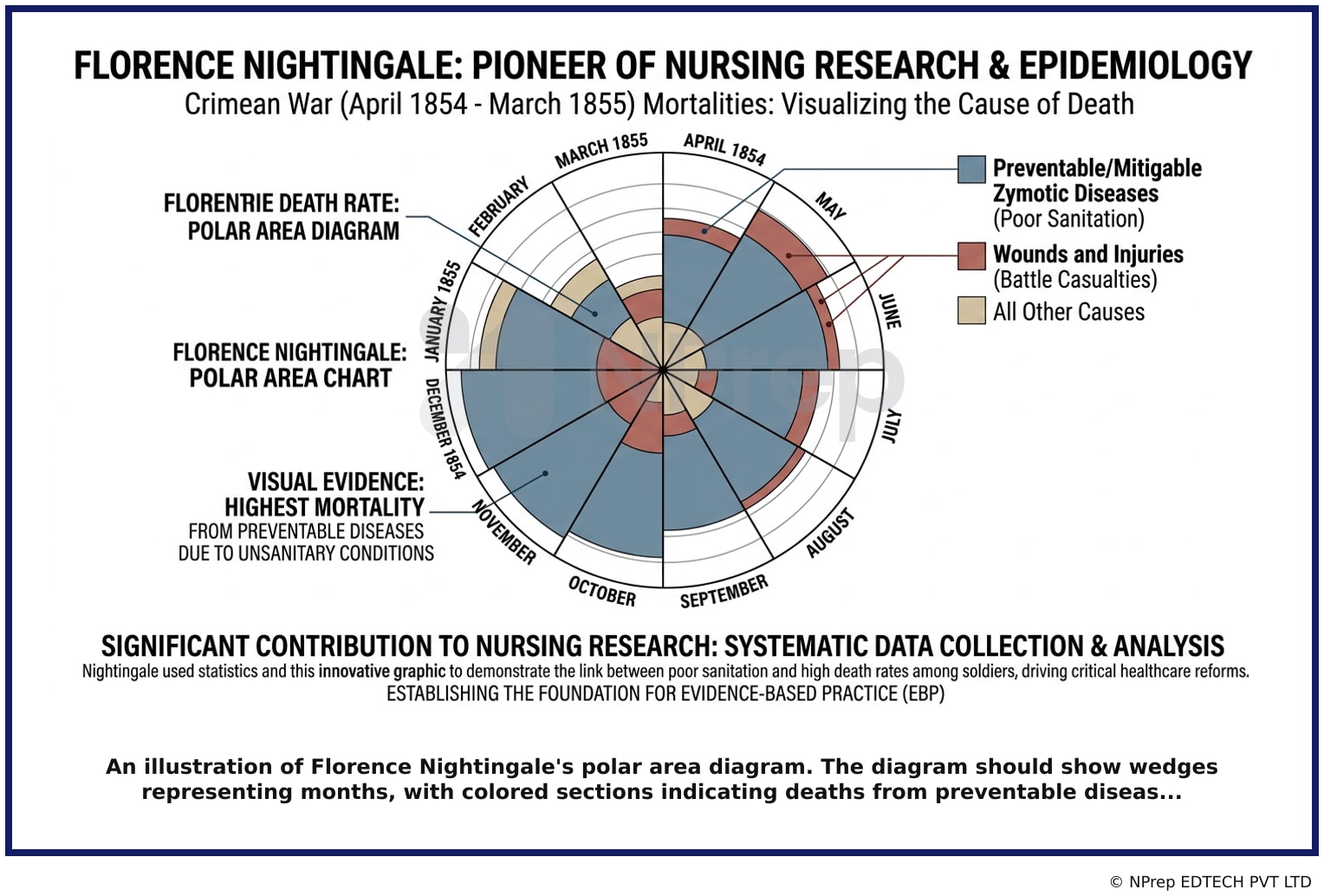
- She used statistical analysis and innovative graphical displays, like the polar area diagram, to demonstrate a clear link between unsanitary conditions and high death rates.
- This evidence-based approach was instrumental in driving significant reforms in military and civilian healthcare systems, establishing the foundation for modern evidence-based practice.
Why Other Options Were Wrong
- Option A: This is a formal research design developed in the 20th century, long after Nightingale's era. Her work was observational and did not use the structured interventions and control groups characteristic of quasi-experimental studies.
- Option B: The case study approach involves an in-depth analysis of a single case or a small group. Nightingale's work was the opposite; it was a large-scale epidemiological study involving thousands of soldiers to identify population-level trends.
- Option D: While Nightingale did develop the Environmental Theory, which is a conceptual framework for nursing, her most significant and revolutionary contribution to the methodology of research was her use of data and statistics.
Related Visual
Clinical Relevance
- Nursing practice connection: Knowing Historical foundations of nursing research and Florence Nightingale's contributions helps nurses interpret findings accurately and avoid errors in routine assessment, medication administration, and patient teaching.
- Nightingale's work is the historical foundation of Evidence-Based Practice (EBP) in nursing. It established the principle that clinical decisions and healthcare policies should be based on data and evidence, not just tradition or anecdote.
- Modern nursing leaders use the same principles of data collection and analysis to track patient outcomes, identify quality improvement opportunities (e.g., reducing infection rates), and advocate for resources.
- This historical example empowers nurses to understand their role as scientists and advocates who can use data to improve patient safety and quality of care.
How to Approach the Question
- Identify the key figure in the question: Florence Nightingale.
- Identify the specific domain of her contribution being asked about: 'nursing research'.
- Recall the most famous aspect of Nightingale's work: her service during the Crimean War.
- Connect her Crimean War work to research principles. Remember she is known as the 'lady with the lamp' but also the 'lady with the data'. Her primary tool for reform was statistics.
- Evaluate the options based on this core knowledge. 'Data collection and analysis' directly describes her use of statistics to track mortality and prove the need for sanitation.
- Rule out other options by placing them in their correct context. Frameworks relate to nursing theory, and case studies and quasi-experimental designs are different research methods she did not pioneer.
Concept Tested & Keywords
- Concept Tested: Historical foundations of nursing research and Florence Nightingale's contributions.
- Stem keywords: Florence Nightingale, nursing research, contributions
- Lead-in keywords: most noted for
- Negative lead-in flag: false
Question ID
Q82i4hLYHgQnzNwTk1tog_
Reference Book
E6 NursingResearch Suresh Sharma 5e Part 1 p. 23-25
E6 NursingResearch Sukhpal Kaur pp. 34-36, 51-53
Practise the full UPUMS Nsg.Officer-2024
Attempt every question from this paper in a timed mock, then review the full solution for each one.
More UPUMS Nsg.Officer-2024 Questions
- Any event that is not consistent with routine patient care and is used when patient care is not consistent with facility or national standards of exp…
- How many compressions and breaths should you do for each cycle of CPR?
- A 23-year-old white male who is otherwise in good health noted a sudden shower of flashing lights before his left eye a few hours ago. He has never h…
- The nurse asked the client to read the Snellen chart. Which of the following is tested?
- All India Institute of Speech and Hearing (AIISH), recently seen in the news, is inaugurated at which city of Uttar Pradesh?
- The nurse is checking the placement of a nasogastric tube prior to giving medication and a feeding. Which of the following is the preferred and most…
- A dynamic and purposeful relationship between two people who approaches a mutually defined problems with mutual consideration of each other, is known…
- How do you recognize the signs of a heart attack?
- A client complains of difficulty of swallowing, when the nurse try to administer capsule medication. Which of the following measures the nurse should…
- What should you do when someone suffers swelling from a head injury?