
RRB Nsg. Superintendent-20 July 2019 (Shift-3rd)
Obstetrics & Gynecology
Easy
First active fetal movement perceived by the mother is known as
Appeared in: RRB Nsg. Superintendent-20 July 2019 (Shift-3rd)
Explanation
- Quickening is the specific term for the first time a pregnant woman feels her baby move.
- This is a subjective sensation, often described as a gentle flutter or bubbling feeling.
- It typically occurs between 16 and 20 weeks of gestation.
- For first-time mothers (primigravidas), it may be felt closer to 20 weeks, while for mothers who have been pregnant before (multigravidas), it can be as early as 16 weeks.
Why Other Options Were Wrong
- Option A: Internal ballottement is not a sensation felt by the mother. It is an objective clinical sign elicited by a healthcare provider during a pelvic examination to check for a floating fetus.
- Option B: Lightening refers to the sensation a mother feels when the fetus drops lower into the pelvis, which happens late in the third trimester, not the first perception of movement.
- Option C: Engagement is a clinical determination made by a healthcare provider, not a feeling perceived by the mother. It signifies that the widest part of the baby's presenting part has passed through the pelvic inlet.
Related Visual
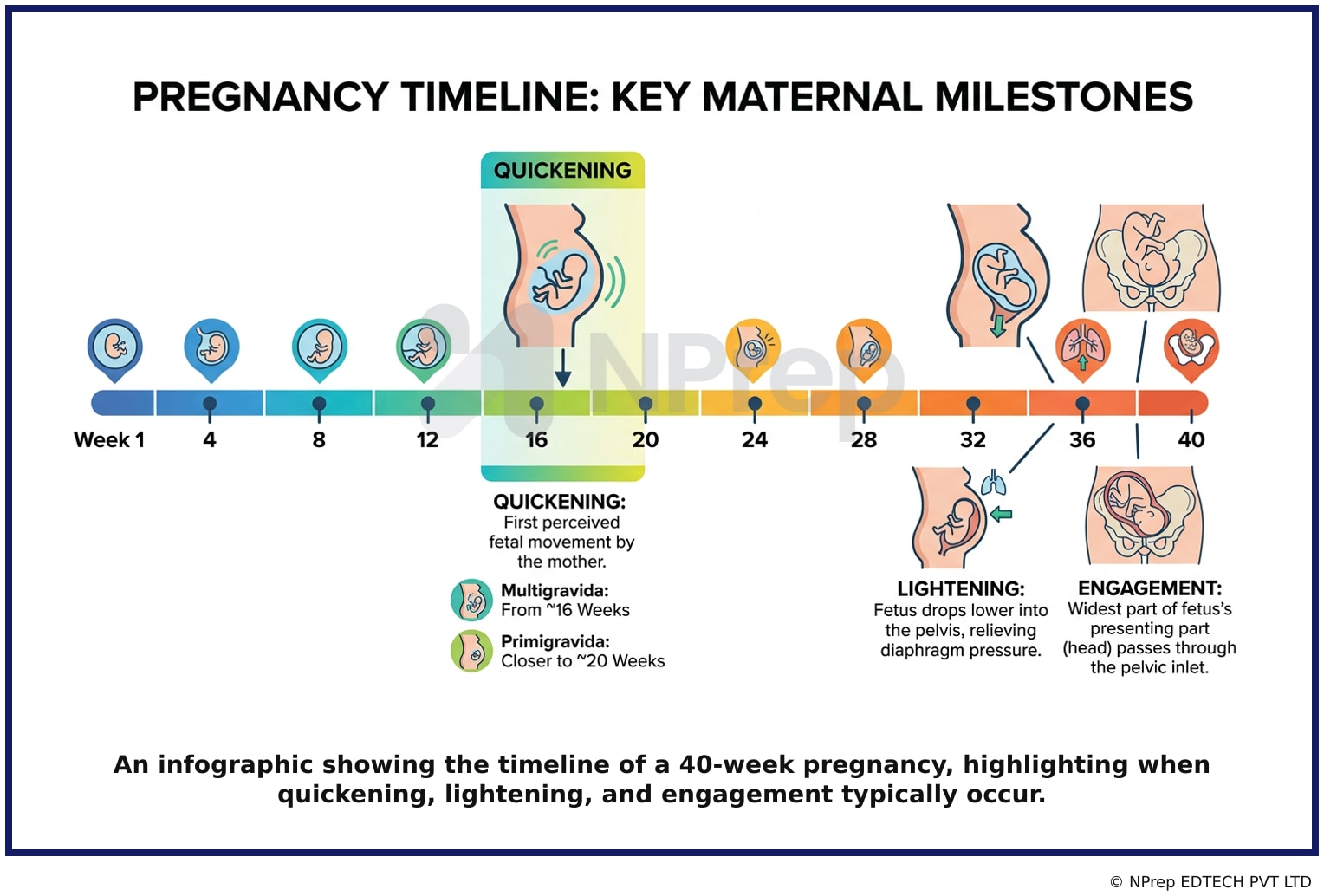
- Visual 1: Timeline Diagram - An infographic showing the timeline of a 40-week pregnancy, highlighting when quickening, lightening, and engagement typically occur.
- Visual 2: Illustration - A simple drawing comparing the fetal position before and after lightening to help visualize the concept.
Clinical Relevance
- Nursing practice connection: This is primarily an exam-oriented knowledge point with limited direct bedside application, so retain Terminology of pregnancy milestones as background academic context rather than a clinical decision trigger.
- Educating expectant mothers about quickening is a crucial part of antenatal care. It reassures them of the baby's well-being and helps them bond with the fetus.
- Nurses should instruct mothers to start monitoring fetal movements (kick counts) daily from around 28 weeks. A significant decrease in fetal movement can be an early sign of fetal distress and requires immediate medical evaluation.
- It's important to differentiate between subjective symptoms like quickening and objective signs like engagement, as they have different clinical implications and are assessed differently.
How to Approach the Question
- First, identify the key phrase in the question: "first active fetal movement perceived by the mother."
- Recognize that the question is asking for a specific obstetrical term for a subjective maternal experience.
- Evaluate each option based on its definition.
- Internal ballottement and Engagement are objective signs assessed by a healthcare provider, so they can be eliminated.
- Lightening is a sensation felt by the mother, but it relates to the baby dropping into the pelvis late in pregnancy, not the first movement.
- Quickening is the precise term for the first perception of fetal movement. Therefore, it is the correct answer.
Concept Tested & Keywords
- Concept Tested: Terminology of pregnancy milestones
- Stem keywords: first active fetal movement, perceived by the mother
- Lead-in keywords: known as
Question ID
Qn0cihyagJVVeNeyApe0ua
Practise the full RRB Nsg. Superintendent-20 July 2019 (Shift-3rd)
Attempt every question from this paper in a timed mock, then review the full solution for each one.
More Physiological Changes During Pregnancy Questions
- The uterine fundus height of a pregnant patient is at the level of the umbilicus. Her pregnancy is about
- A pregnant client continues to visit the clinic regularly during her pregnancy. During one of her visits while lying supine on the examining table, s…
- The approximate weight gain of the fetus between 32 and 40 weeks of gestation is?
- The darkening of the skin over the forehead, bridge of nose or cheekbones during pregnancy is called?
- Normal weight gain during pregnancy is?
- The brownish black pigmented area in the midline stretching from xiphisternum to symphysis pubis during pregnancy is?
- Additional calories required during pregnancy?
- During Pregnancy the average weight gain is:
- What is the pigmentation of the face during pregnancy called?
- The characteristic feature of Braxton-Hicks contraction?
More RRB Nsg. Superintendent-20 July 2019 (Shift-3rd) Questions
- Where is oxytocin synthesized?
- What is the name of the muscle that extends from the sphenoid bone to the mandible?
- Complementary feeding should be initiated at the completion of \ \ \ \ \ \
- Where is kidney located?
- Psychosocial development stage for infants is \ \ \ \ \ \ \ \ \ \
- What immunization is given at birth?
- Functional nursing is a method of providing
- Which disease is the dementia associated with asymmetric atrophy of the frontal and temporal lobes?
- Thromboangiitis obliterans is also known as
- What is the other name of pyridoxine?