
RRB Nsg. Superintendent-20 July 2019 (Shift-3rd)
Mental Health Nursing
Easy
False perception with stimuli is known as
Appeared in: RRB Nsg. Superintendent-20 July 2019 (Shift-3rd)
Explanation
- An illusion is defined as a misinterpretation or misperception of a real, external sensory stimulus.
- The defining characteristic that matches the question is the presence of a stimulus that is perceived incorrectly.
- A classic example is seeing a monster in the shadows of a dark room; the shadows are the real stimulus, but they are misinterpreted.
Why Other Options Were Wrong
- Option A: A hallucination is a false sensory perception that occurs in the complete absence of an external stimulus.
- Option B: A delusion is a disorder of thought content, not perception. It is a false, fixed belief that is held firmly despite evidence to the contrary.
- Option D: Mania is a mood disorder characterized by an elevated or irritable mood, increased energy, and hyperactivity. While individuals in a manic state may experience perceptual disturbances like hallucinations, mania itself is not a type of false perception.
Related Visual
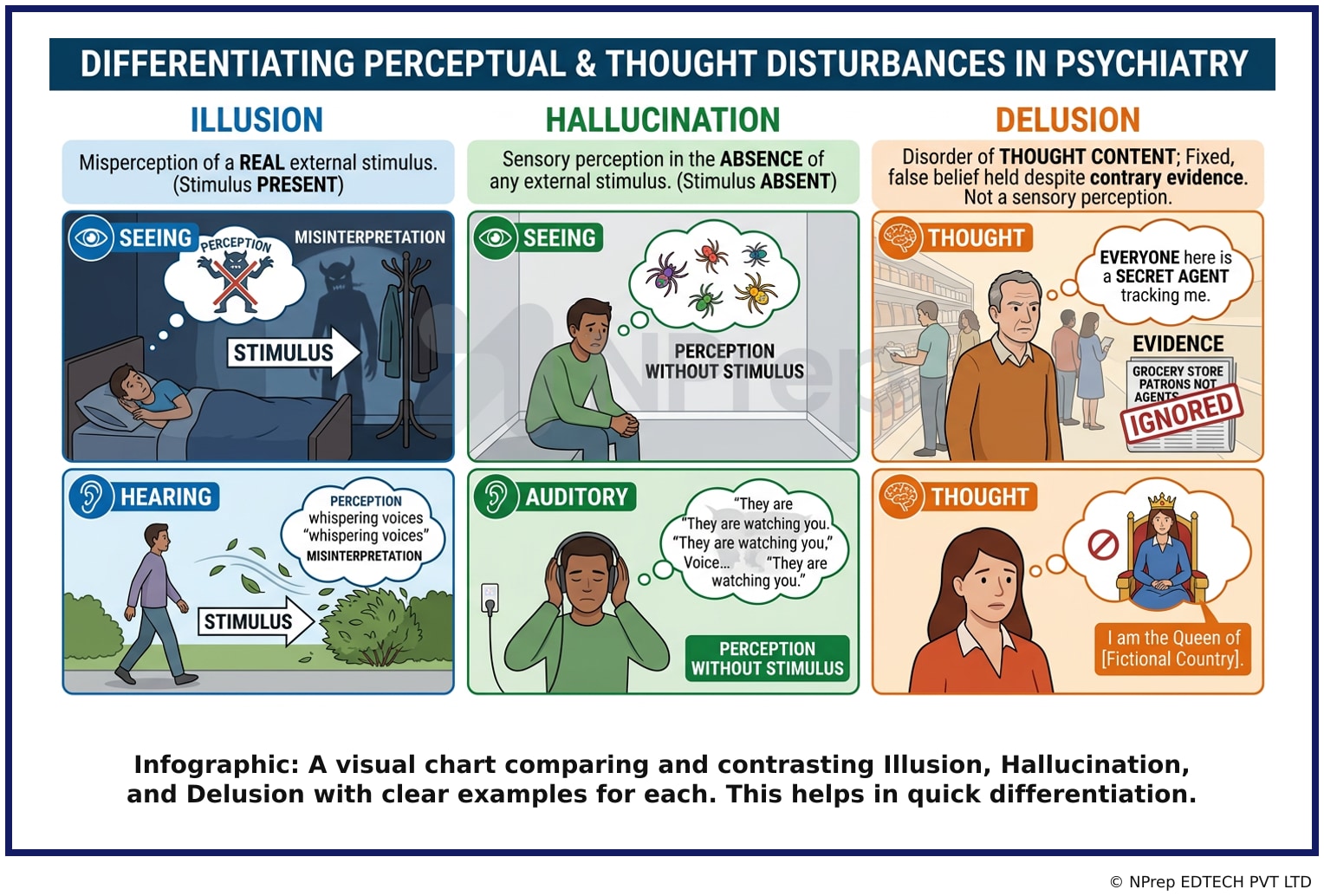
- Visual 1: Infographic: A visual chart comparing and contrasting Illusion, Hallucination, and Delusion with clear examples for each. This helps in quick differentiation.
- Visual 2: Illustration: An image depicting a classic illusion, such as a rope appearing as a snake in the dark, to visually reinforce the concept.
Clinical Relevance
- Nursing practice connection: This is primarily an exam-oriented knowledge point with limited direct bedside application, so retain Disturbances of Perception in Psychiatry as background academic context rather than a clinical decision trigger.
- For a nurse, accurately differentiating between illusion, hallucination, and delusion is critical for a precise mental status examination (MSE).
- Correctly identifying the type of perceptual disturbance helps in diagnosing the underlying condition (e.g., schizophrenia, delirium, substance withdrawal) and planning appropriate care.
- What if? If a patient reports seeing spiders on the wall, the nurse's first action is to check if there are any real stimuli (like cracks or patterns on the wall) that could be causing an illusion. If no stimulus is present, it is likely a hallucination, which requires a different intervention and indicates a more severe level of psychosis.
How to Approach the Question
- First, identify the key terms in the question: 'False perception' and 'with stimuli'.
- The term 'perception' points towards sensory experiences (seeing, hearing, etc.), which helps narrow down the options.
- The crucial qualifier is 'with stimuli'. This means a real object or sensory input is present.
- Evaluate each option against this definition: A hallucination has no stimulus. A delusion is a belief, not a perception. Mania is a mood state.
- An illusion is the only option that fits the definition of a misinterpretation of a present stimulus.
Concept Tested & Keywords
- Concept Tested: Disturbances of Perception in Psychiatry
- Stem keywords: False perception, stimuli
- Lead-in keywords: known as
- Negative lead-in flag: false
Question ID
QHIshSTPK5KPjS49rSm-dG
Practise the full RRB Nsg. Superintendent-20 July 2019 (Shift-3rd)
Attempt every question from this paper in a timed mock, then review the full solution for each one.
More Schizophrenia Questions
- Social skill training for Schizophrenia patient is done for which symptom?
- What is true about schizophrenia?
- A patient may report hearing voices criticizing him every time he hears the sound of a rotating fan and it stops when the fan is not running. Which t…
- According to Schneider, which of the following symptoms in schizophrenia patients are known as first rank, except?
- What are the 4 A's symptoms of schizophrenia?
- Which of the following are positive signs and symptoms of schizophrenia?
- A schizophrenic patient is stating that I am coming from other Planet and I have power to change the world. Patient may suffer from?
- Dementia praecox, a term for schizophrenia, was given by?
- False sensory perception in the absence of real external stimuli is called?
- A person seeing a design on the floor thought it was a fossil. It is an example of?
More RRB Nsg. Superintendent-20 July 2019 (Shift-3rd) Questions
- Where is oxytocin synthesized?
- What is the name of the muscle that extends from the sphenoid bone to the mandible?
- Complementary feeding should be initiated at the completion of \ \ \ \ \ \
- Where is kidney located?
- Psychosocial development stage for infants is \ \ \ \ \ \ \ \ \ \
- What immunization is given at birth?
- Functional nursing is a method of providing
- Which disease is the dementia associated with asymmetric atrophy of the frontal and temporal lobes?
- Thromboangiitis obliterans is also known as
- What is the other name of pyridoxine?