
RRB Nsg. Superintendent-20 July 2019 (Shift-3rd)
Applied Physiology
Easy
Difference between systolic and diastolic blood pressure is known as
Appeared in: RRB Nsg. Superintendent-20 July 2019 (Shift-3rd)
Explanation
- Pulse pressure is the specific medical term for the difference between the systolic and diastolic blood pressure readings.
- It is calculated by subtracting the diastolic pressure from the systolic pressure (Formula: Systolic BP - Diastolic BP = Pulse Pressure).
- This value represents the force the heart generates with each contraction. A normal pulse pressure is generally considered to be between 40 and 60 mmHg.
Why Other Options Were Wrong
- Option A: High blood pressure, or hypertension, is a diagnosis for a condition where the overall force of blood against artery walls is consistently too high. It is not the term for the difference between systolic and diastolic pressures.
- Option B: Low blood pressure, or hypotension, is a condition where blood pressure is below the normal range, potentially causing symptoms like dizziness. It does not describe the difference between the two pressure measurements.
- Option D: Hydrostatic pressure is the pressure exerted by a fluid at rest due to gravity. In the circulatory system, it contributes to overall blood pressure but is not the specific term for the difference between systolic and diastolic readings.
Related Visual
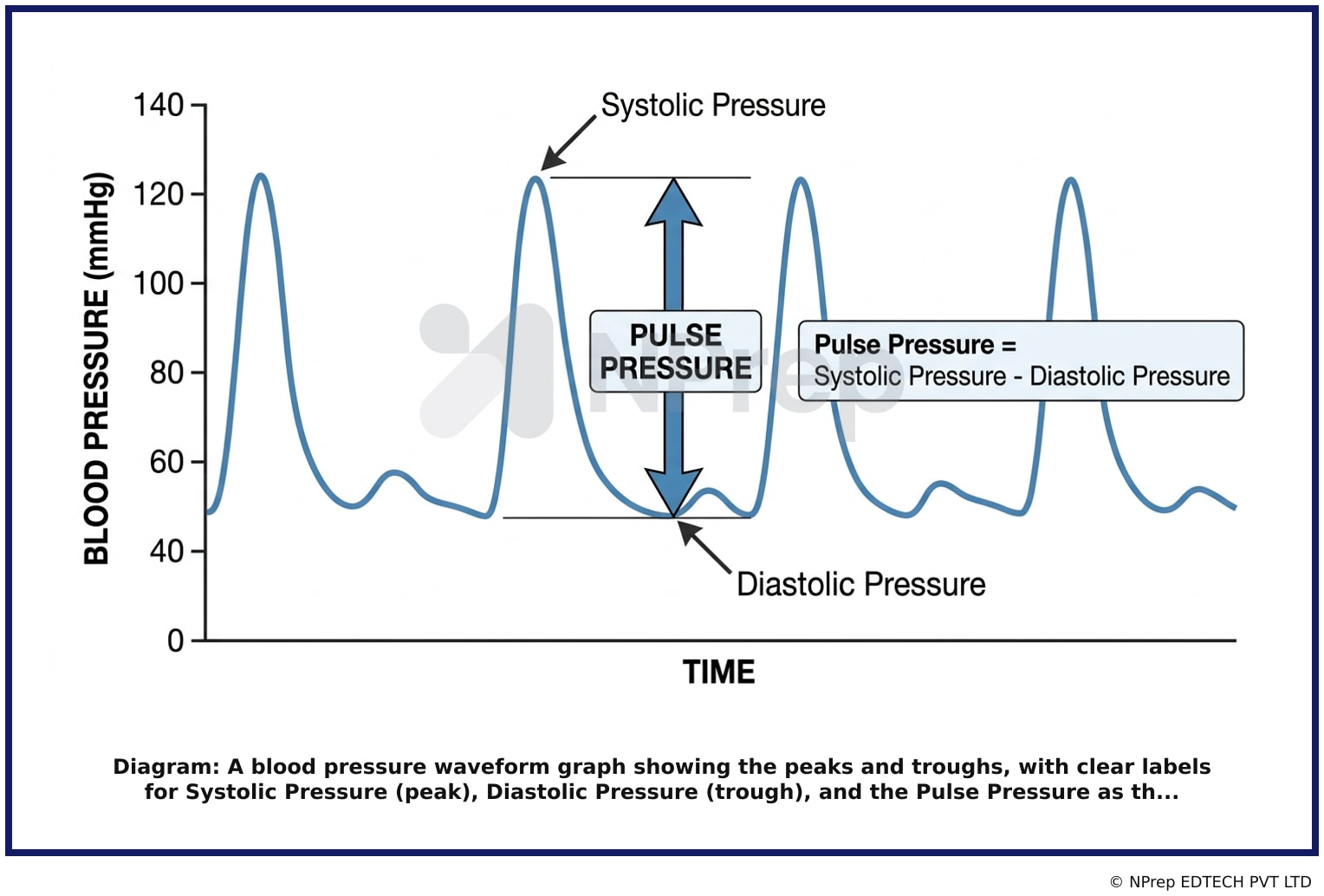
- Visual 1: Diagram: A blood pressure waveform graph showing the peaks and troughs, with clear labels for Systolic Pressure (peak), Diastolic Pressure (trough), and the Pulse Pressure as the vertical distance between them.
Clinical Relevance
- Nursing practice connection: Knowing Definition of Pulse Pressure helps nurses interpret findings accurately and avoid errors in routine assessment, medication administration, and patient teaching.
- Nurses monitor pulse pressure as it provides valuable clues about a patient's cardiovascular health and hemodynamic stability. It reflects the heart's stroke volume and arterial stiffness.
- A consistently wide pulse pressure (greater than 60 mmHg) can indicate stiff arteries (arteriosclerosis), while a narrow pulse pressure (less than 40 mmHg) can suggest poor heart function or low blood volume.
- What if? If a patient's blood pressure is 90/75 mmHg, the pulse pressure is very narrow (15 mmHg). This is a critical finding, often seen in conditions like cardiac tamponade or cardiogenic shock, and requires immediate escalation as it indicates the heart is failing to pump an adequate amount of blood with each beat.
How to Approach the Question
- Step 1: Identify the core keywords in the question: 'difference', 'systolic', and 'diastolic blood pressure'.
- Step 2: Recognize that the question is asking for the specific medical term for this calculated value, not a description of a condition.
- Step 3: Systematically evaluate the options based on their definitions.
- Step 4: Recall that 'High blood pressure' and 'Low blood pressure' are conditions, not calculated differences.
- Step 5: Recall that 'Hydrostatic pressure' is a related but different physiological concept.
- Step 6: Conclude that 'Pulse pressure' is the precise term for the mathematical difference between systolic and diastolic pressures.
Concept Tested & Keywords
- Concept Tested: Definition of Pulse Pressure
- Stem keywords: systolic blood pressure, diastolic blood pressure, difference
- Lead-in keywords: is known as
Question ID
QRr2T_PuNufZQOOQxTCl4
Practise the full RRB Nsg. Superintendent-20 July 2019 (Shift-3rd)
Attempt every question from this paper in a timed mock, then review the full solution for each one.
More Circulatory & Lymphatic system Questions
- Symptoms of acute blood loss are:
- Which among the following statements is correct regarding first heart sound?
- What is the action of vagus nerve stimulation on heart rate?
- Excessively high heart rate ( 170) can ?
- Difference between systolic and diastolic blood pressure is called?
- Difference between systolic and diastolic blood pressure is called?
- In a healthy individual, weighing 70 kg at rest, the stroke volume is about?
- The site of pulse in the neck is called?
- Pulse rate more than 100 bpm is called as?
- ECG is used for the assessment/functioning of .... Organ?
More RRB Nsg. Superintendent-20 July 2019 (Shift-3rd) Questions
- Where is oxytocin synthesized?
- What is the name of the muscle that extends from the sphenoid bone to the mandible?
- Complementary feeding should be initiated at the completion of \ \ \ \ \ \
- Where is kidney located?
- Psychosocial development stage for infants is \ \ \ \ \ \ \ \ \ \
- What immunization is given at birth?
- Functional nursing is a method of providing
- Which disease is the dementia associated with asymmetric atrophy of the frontal and temporal lobes?
- Thromboangiitis obliterans is also known as
- What is the other name of pyridoxine?