
KGMU 2023
General Knowledge
Easy
Dalchini (Cinnamon), an Indian spice, is obtained from which part of the plant?
Appeared in: KGMU 2023
Explanation
- Dalchini, or Cinnamon, is a spice obtained specifically from the inner bark of trees belonging to the Cinnamomum genus.
- The harvesting process involves peeling the inner bark, which curls into the familiar cinnamon sticks (quills) upon drying.
- It is widely used as a flavoring agent in cuisine and also valued in traditional medicine systems for its health properties.
Why Other Options Were Wrong
- Option B: Cinnamon is not derived from the root of the plant. The root's primary function is anchorage and absorption of water and nutrients.
- Option C: While the leaves of the same tree are used as a spice, they are known as 'Tejpatta' or Indian bay leaf, which is different from 'Dalchini' (Cinnamon).
- Option D: This is too general. The bark is the outer protective layer of the stem, but the spice is not the entire woody stem. 'Bark' is the more specific and accurate answer.
Related Visual
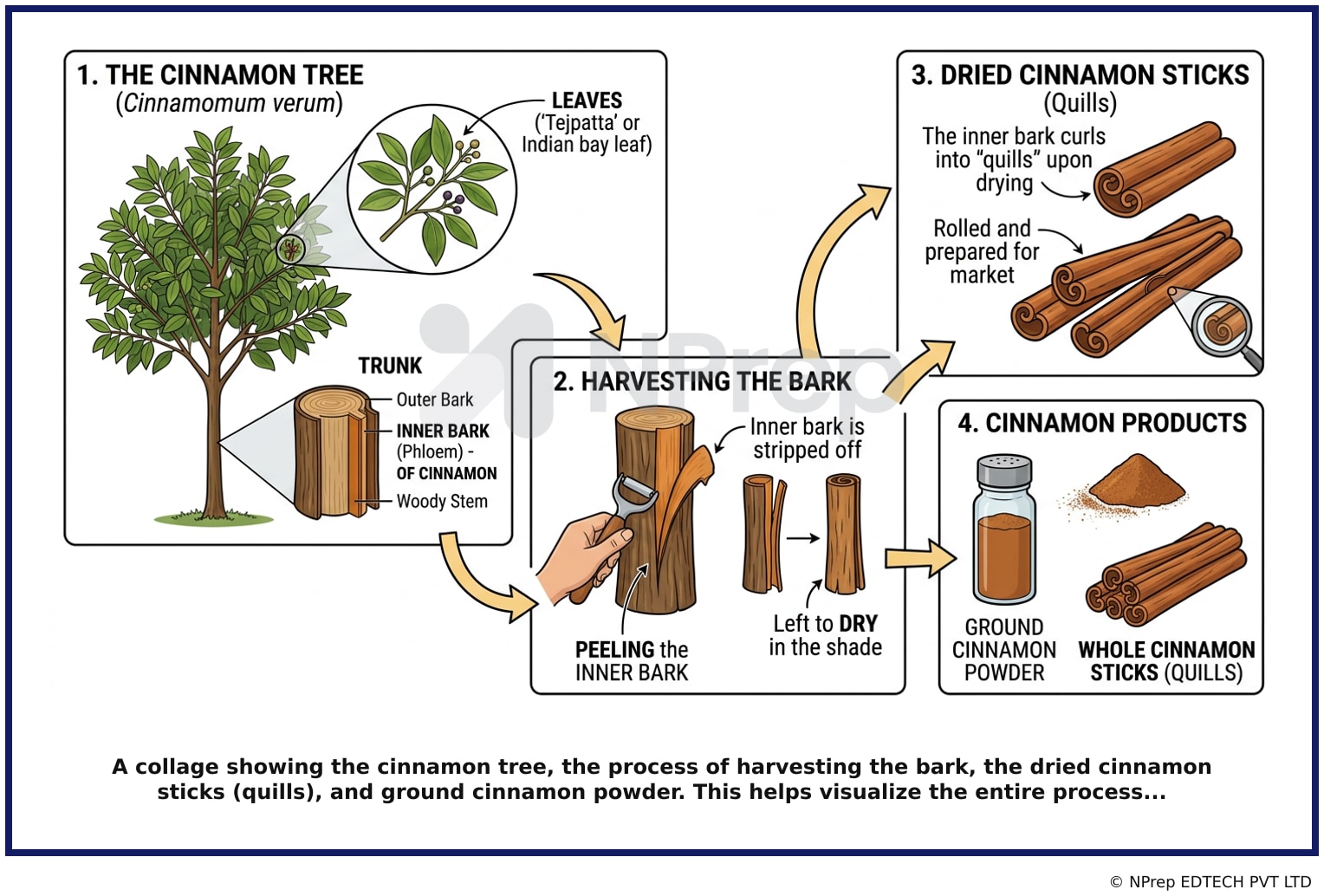
- Visual 1: Image - A collage showing the cinnamon tree, the process of harvesting the bark, the dried cinnamon sticks (quills), and ground cinnamon powder. This helps visualize the entire process from plant to spice.
- Visual 2: Diagram - A simple diagram illustrating different parts of a plant (root, stem, leaf, flower, fruit, bark) with examples of spices derived from each part. This provides a clear comparative overview.
Clinical Relevance
- Nursing practice connection: This is primarily an exam-oriented knowledge point with limited direct bedside application, so retain Botanical source of common spices as background academic context rather than a clinical decision trigger.
- Nurses should be aware of the properties of common dietary substances like cinnamon, as patients often ask about their use for health benefits.
- Cinnamon is frequently discussed for its potential role in blood glucose regulation, which is highly relevant for patient education in diabetes management. However, it is not a substitute for prescribed medical treatment.
- What if? If a patient on anticoagulant therapy (e.g., warfarin) asks about taking cinnamon supplements, the nurse should advise caution. Cinnamon contains coumarin, which can have blood-thinning effects, potentially increasing the risk of bleeding when combined with such medications. The patient should consult their doctor.
How to Approach the Question
- This is a factual recall question based on general knowledge about common foods and spices.
- First, identify the keywords in the question: 'Dalchini (Cinnamon)' and 'part of the plant'.
- Recall or visualize what cinnamon sticks look like. They are hard, curled, and resemble pieces of tree bark.
- Evaluate the given options: 'Bark', 'Root', 'Leaves', and 'Stem'.
- Based on the visual memory and general knowledge, 'Bark' is the most plausible source.
- Differentiate between 'Stem' and 'Bark'. Recognize that bark is a specific layer of the stem, making it the more precise and correct answer for cinnamon.
Concept Tested & Keywords
- Concept Tested: Botanical source of common spices
- Stem keywords: Dalchini, Cinnamon, Indian spice, part of the plant
- Lead-in keywords: obtained from which part
Question ID
QdO0LoG2_PpzqfJLVv8xly
Practise the full KGMU 2023
Attempt every question from this paper in a timed mock, then review the full solution for each one.
More Everyday science Questions
- Which of the following terms describes species that are found only in a specific geographic location? (Choose the most appropriate option from below)
- Which is the nearest planet to the Sun?
- Which is the third nearest planet to the sun?
- A weather forecast in which the details about the current weather and forecasts up to a few hours ahead (but less than 24 hours) are given is known a…
- Which of the following describes the process by which the concentration of toxic substances, such as pesticides, increases in organisms at higher lev…
- Full Moon occurs?
- The Higgs-boson particle which was discovered by scientists, is also known as?
- GPS is an abbreviation for?
- Alexander Fleming discovered?
- Flowering response of plants towards the period of light exposure is termed as?
More KGMU 2023 Questions
- The teacher scalded Aruna in front of her classmates during Project submission. Conclusion I: Aruna was not as popular as her other classmates. Concl…
- Aruna leaves and goes 8 meters in the North direction from a certain point. Then she turns right and travels for 12 meters. She again turns right and…
- Kiran is Sister of Raj. Raj is Son of Suresh and Vinita is Mother of Suresh then what is relation between Vinita and Kiran?
- A person who lives at the same time with another?
- Select the most appropriate meaning of the below idiom. A black sheep?
- The train has arrived...the station.
- A vendor sold 20 kg of potato at 18 Rs. per kg. He bought 2-liter milk at the rate of 46 Rs./liter, 2 kg sugar at the rate of 35 Rs./kg and 10 packet…
- Which one is the perfect square?
- A is the smallest. C is taller than B and D. E is neither the tallest nor the smallest. Find which one is the tallest?
- From an entrance, a person walks 28 meters left, then turns right and walks 13 meters. They turn right again and walk 12 meters, and then walk 16 met…