
SCTIMST Staff Nurse - 2016
Obstetrics & Gynecology
Easy
Contraindications for using oral contraceptives?
Appeared in: SCTIMST Staff Nurse - 2016
Explanation
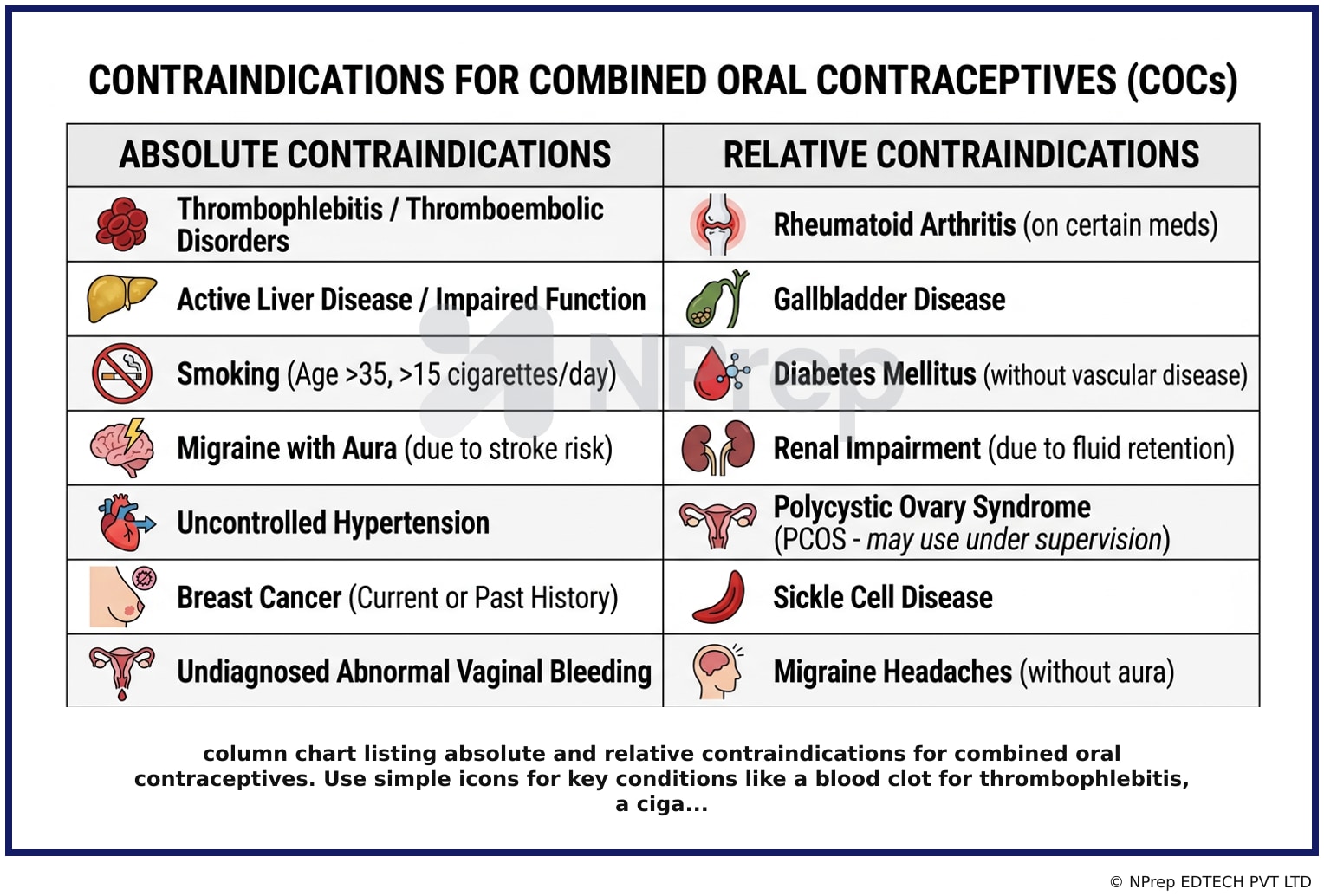
- Thrombophlebitis, an inflammation of a vein due to a blood clot, is an absolute contraindication for using combined oral contraceptives (COCs).
- The estrogen component in COCs increases the liver's production of clotting factors and decreases natural anticoagulants, creating a hypercoagulable (pro-clotting) state.
- This state significantly elevates the risk for serious thromboembolic events, including deep vein thrombosis (DVT) and pulmonary embolism (PE).
- Therefore, women with a current or past history of thrombophlebitis or other thromboembolic disorders should not use estrogen-containing contraceptives.
Why Other Options Were Wrong
- Option B: Urinary tract infections (UTIs) are not a contraindication for the use of oral contraceptives. While some studies note a higher frequency of bacteriuria in OCP users, it does not prevent their use.
- Option C: Ulcerative colitis is an inflammatory bowel disease and is not considered a standard contraindication for the use of oral contraceptives.
- Option D: Menorrhagia, or heavy menstrual bleeding, is a common reason to prescribe oral contraceptives. OCPs help regulate the menstrual cycle and reduce the amount of bleeding, making it an indication for use, not a contraindication.
Related Visual
Clinical Relevance
- Nursing practice connection: This is primarily an exam-oriented knowledge point with limited direct bedside application, so retain Contraindications for Oral Contraceptive Pills (OCPs) as background academic context rather than a clinical decision trigger.
- A nurse's primary responsibility before administering or educating about OCPs is to conduct a thorough health history. This includes screening for personal or family history of blood clots, stroke, heart disease, uncontrolled hypertension, liver disease, and smoking status, especially in women over 35.
- Patient education is critical. The nurse must teach the patient the warning signs of a blood clot, using the acronym ACHES: Abdominal pain, Chest pain, Headaches (severe), Eye problems (blurred vision), and Severe leg pain.
- What if? If a patient has a history of migraines with aura, this would also be an absolute contraindication due to an increased risk of stroke. The nurse would need to educate the patient on safer, non-estrogen-containing alternatives like progestin-only pills, an IUD, or barrier methods.
How to Approach the Question
- Identify the core of the question: The question asks to identify a contraindication for using oral contraceptives.
- Recall the primary mechanism and major risks associated with combined oral contraceptives (OCPs). The most significant risk is related to the estrogen component's effect on blood coagulation.
- Remember that estrogen increases the risk of venous thromboembolism (VTE).
- Evaluate each option based on this knowledge. Thrombophlebitis is inflammation of a vein associated with a blood clot, which directly relates to the VTE risk.
- Analyze the other options. Menorrhagia (heavy bleeding) is a condition often treated with OCPs, making it an indication. Urinary tract infections and ulcerative colitis are not established contraindications.
- Conclude that thrombophlebitis is the only valid contraindication among the choices provided.
Concept Tested & Keywords
- Concept Tested: Contraindications for Oral Contraceptive Pills (OCPs)
- Stem keywords: Contraindications, oral contraceptives
- Lead-in keywords: BEST, MOST RELEVANT CLUE
- Negative lead-in flag: false
Question ID
QVb0YxKFqqM5U1uxTpkHLs
Reference Book
E6 Obstetrics Williams p. 82-94
E6 Pharmacology Katzung 16e p. 1143-1145
E6 Pharmacology Nursing Lilley 11e Part 2 p. 244-246
Practise the full SCTIMST Staff Nurse - 2016
Attempt every question from this paper in a timed mock, then review the full solution for each one.
More Gynecology & Contraception Questions
- Dose of levonorgestrel to be given as emergency contraceptive?
- For how long are Sub-Dermal Implants effective?
- When is an IUD (Intrauterine Contraceptive Device) ideally inserted?
- Insertion of PPIUCD is done after delivery?
- Which is the commonest side effect of copper-T among the following?
- Which of the following is an important complication for copper intrauterine device?
- The best time for IUD insertion is between which days of menstrual cycle?
- Commonest complication of IUD insertion is?
- Most common complication of intra uterine device (IUD)?
- The item shown in the picture below is effective for how many years?
More SCTIMST Staff Nurse - 2016 Questions
- An ABG analysis report shows: pH - 7.20; PCO₂ - 35 mmHg; HCO₃ - 20 mEq/L. These findings are suggestive of?
- Comprehensive, individualized care provided by the same nurse throughout the period of care refers to?
- A nurse inadvertently infuses an IV solution containing potassium chloride too rapidly. Which of the following is an appropriate intervention advised…
- Which one of the following principles guides nurses' priorities at a disaster caused by a collapsed building in an earthquake?
- Which of the following ethical principles refers to the duty not to harm?
- Skin breaks, abrasion, blister, or shallow crater, oedema, and infection are characteristics of?
- ECMO is contraindicated in?
- Principle of Surgery for CHD is?
- Social responsibility is high in?
- Norwood procedure is performed for?