
KGMU 2023
Community Health Nursing
Easy
Contaminated water and food cause which disease?
Appeared in: KGMU 2023
Explanation
- Typhoid fever is caused by the bacterium Salmonella Typhi.
- The primary mode of transmission is the fecal-oral route.
- This occurs through the ingestion of food or water that has been contaminated with the feces or urine of an infected person or a chronic carrier.
- Poor sanitation and hygiene are major contributing factors to the spread of typhoid.
Why Other Options Were Wrong
- Option B: Measles is a viral disease transmitted through the respiratory route, not through contaminated food or water.
- Option C: Dengue is a viral infection transmitted by the bite of an infected Aedes mosquito.
- Option D: Malaria is a parasitic disease transmitted by the bite of an infected female Anopheles mosquito.
Related Visual
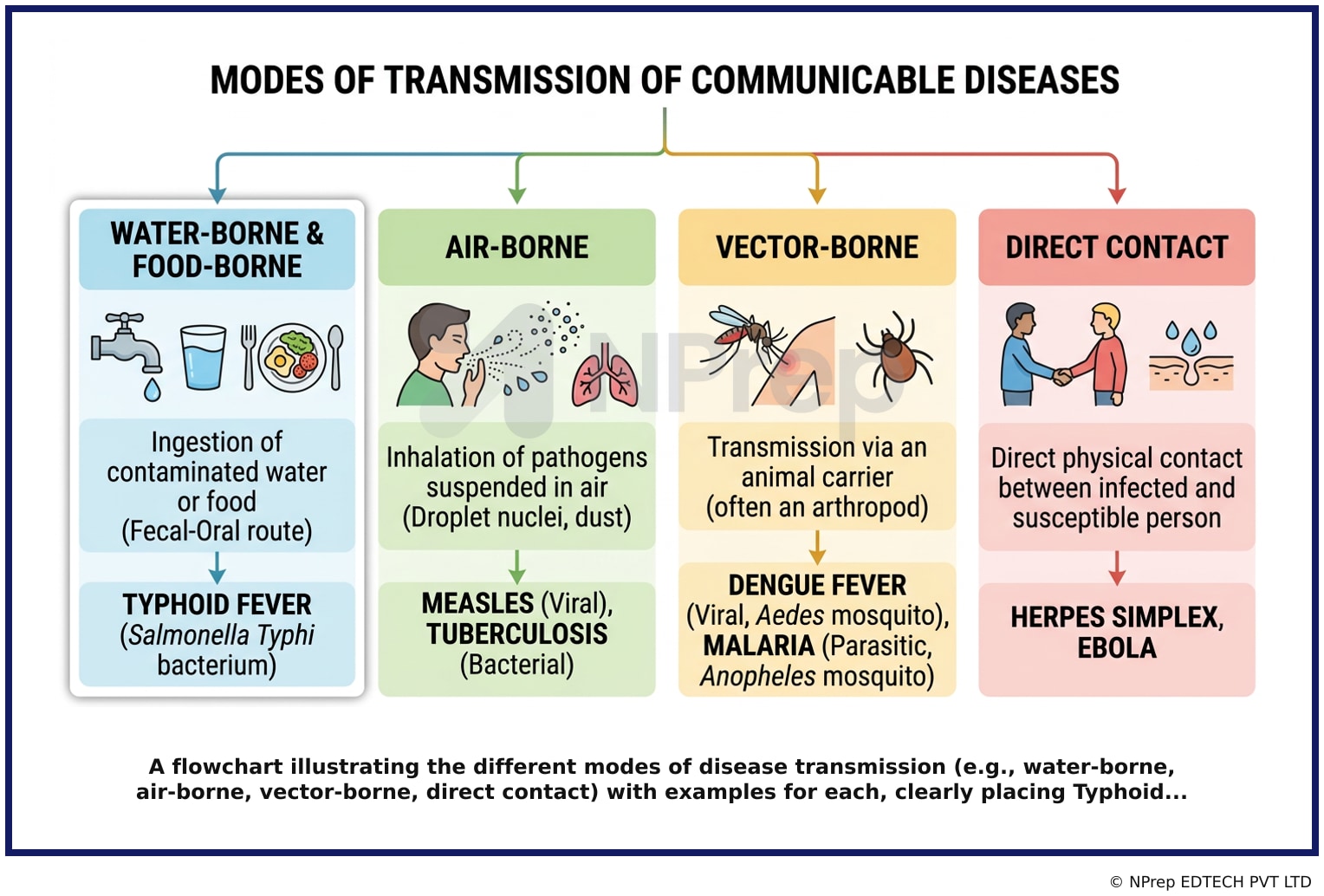
- Visual 1: Flowchart - A flowchart illustrating the different modes of disease transmission (e.g., water-borne, air-borne, vector-borne, direct contact) with examples for each, clearly placing Typhoid under the water-borne category.
- Visual 2: Infographic - An infographic showing the cycle of Typhoid transmission, from an infected person to contamination of water/food sources and then to a new host.
Clinical Relevance
- Nursing practice connection: Knowing Modes of transmission of communicable diseases helps nurses interpret findings accurately and avoid errors in routine assessment, medication administration, and patient teaching.
- Understanding the mode of transmission is the first step in preventing and controlling the spread of infectious diseases. For a nurse, this knowledge is crucial for implementing the correct type of isolation precautions (e.g., contact, droplet, airborne).
- For a patient with Typhoid, a nurse would implement enteric precautions, which involve strict hand hygiene, safe disposal of feces and urine, and ensuring the patient does not handle food for others.
- What if? If a patient presents with high fever and respiratory symptoms like a cough and runny nose, the nurse should suspect an airborne illness like Measles (if the patient is un-vaccinated) and initiate airborne precautions, not enteric precautions. This highlights how knowing the transmission route guides immediate nursing action.
How to Approach the Question
- First, read the question carefully to identify the key information: 'Contaminated water and food'.
- This is a direct recall question that tests your knowledge of epidemiology.
- Go through each option and recall its primary mode of transmission.
- Option A (Typhoid): Recall that it's a classic water-borne/food-borne disease (enteric fever).
- Option B (Measles): Recall that it's an airborne viral infection.
- Option C (Dengue) and D (Malaria): Recall that both are vector-borne diseases transmitted by mosquitoes.
Concept Tested & Keywords
- Concept Tested: Modes of transmission of communicable diseases.
- Stem keywords: Contaminated water, Contaminated food, Disease
- Lead-in keywords: cause which
Question ID
QO96Ry--ZJmkPwEj7xbVcc
Practise the full KGMU 2023
Attempt every question from this paper in a timed mock, then review the full solution for each one.
More Intestinal Infections Questions
- Oral Polio Vaccine under Pulse Polio Immunisation Programme is given to children of what age?
- Which hepatitis is often seen as outbreaks in camps and institutions?
- Who found the link between cholera and contaminated water?
- Characteristics of stool like pea soup are seen in which disease?
- In the context of hepatitis, what is the full form of HBsAg?
- Pentavalent vaccine prevents?
- Under the Pulse Polio Immunization program, up to what age is polio medicine administered?
- All of the following are symptoms of typhoid except which option?
- What is true about Hepatitis A?
- What is Cholera?
More KGMU 2023 Questions
- The teacher scalded Aruna in front of her classmates during Project submission. Conclusion I: Aruna was not as popular as her other classmates. Concl…
- Aruna leaves and goes 8 meters in the North direction from a certain point. Then she turns right and travels for 12 meters. She again turns right and…
- Kiran is Sister of Raj. Raj is Son of Suresh and Vinita is Mother of Suresh then what is relation between Vinita and Kiran?
- A person who lives at the same time with another?
- Select the most appropriate meaning of the below idiom. A black sheep?
- The train has arrived...the station.
- A vendor sold 20 kg of potato at 18 Rs. per kg. He bought 2-liter milk at the rate of 46 Rs./liter, 2 kg sugar at the rate of 35 Rs./kg and 10 packet…
- Which one is the perfect square?
- A is the smallest. C is taller than B and D. E is neither the tallest nor the smallest. Find which one is the tallest?
- From an entrance, a person walks 28 meters left, then turns right and walks 13 meters. They turn right again and walk 12 meters, and then walk 16 met…