
DSSSB 14 August 2024
English
Medium
Complete the sentence by choosing the correct option: वह ___________ अलग रहता है। (He lives separately ___________.)
Appeared in: DSSSB 14 August 2024
Explanation
- The sentence requires a word to indicate what the subject, 'वह' (he), is separate from.
- The Hindi word 'अलग' (separate) is always followed by the postposition 'से' (from) to denote separation.
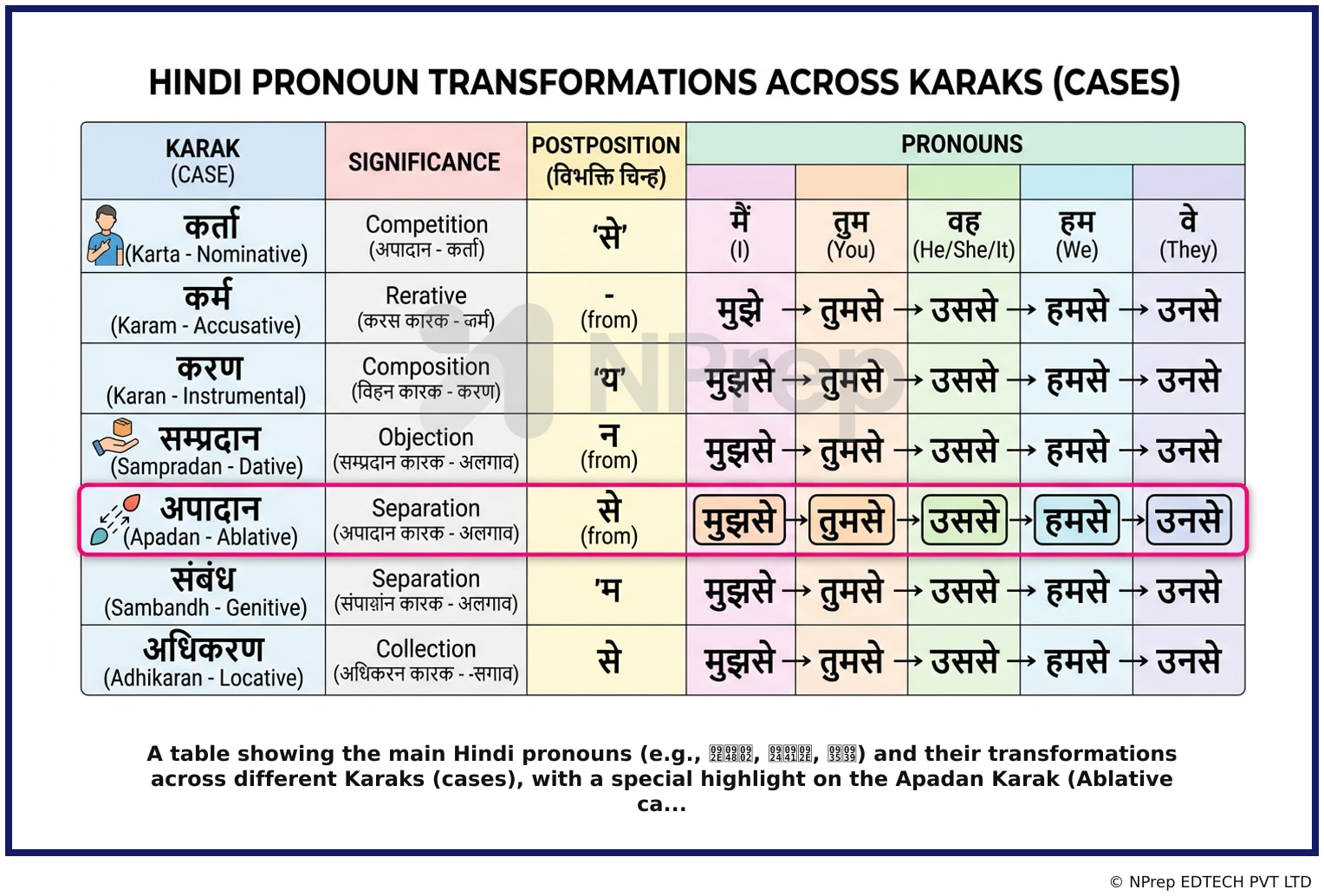
- This usage corresponds to the Apadan Karak (Ablative case) in Hindi grammar.
- The option 'मुझसे' is the correct form, as it combines 'मुझ' (the oblique form of 'मैं' - I) with the required postposition 'से'.
- Therefore, 'मुझसे' correctly translates to 'from me', completing the sentence meaningfully and grammatically.
Why Other Options Were Wrong
- Option A: 'तुझे' (to you) is in the dative/accusative case. It indicates something being given to or done to a person, which is the opposite of separation.
- Option B: 'तुम' (you) is a nominative pronoun. It lacks the necessary postposition 'से' (from) to show the relationship of separation with the word 'अलग' (separate).
- Option C: 'तेरे को' is considered grammatically incorrect in standard written Hindi, although it is common in some spoken dialects. It also represents the dative case, not the ablative case needed for separation.
Related Visual
Clinical Relevance
- Nursing practice connection: This is primarily an exam-oriented knowledge point with limited direct bedside application, so retain Hindi Grammar: Use of Postpositions (Karak) with Pronouns as background academic context rather than a clinical decision trigger.
- Understanding Karaks (postpositional cases) is fundamental to constructing grammatically correct and meaningful sentences in Hindi.
- Mistaking one Karak for another (e.g., using a dative 'को' instead of an ablative 'से') completely changes the meaning of a sentence from 'separation from' to 'direction towards'.
- What if the sentence intended to say 'He lives with me' instead of 'separate from me'?
How to Approach the Question
- First, read the sentence and identify the key word that governs the blank: 'अलग' (separate).
- Recognize that 'अलग' implies separation from something or someone.
- Recall the grammatical rule in Hindi for showing separation. The Apadan Karak (Ablative case), marked by the postposition 'से' (from), is used for this purpose.
- Examine each option to see which one correctly incorporates the 'से' postposition or its equivalent form.
- Option A, 'तुझे', means 'to you'. Option B, 'तुम', means 'you'. Option C, 'तेरे को', is an incorrect form for 'to you'. None of these indicate 'from'.
- Option D, 'मुझसे', is a combination of 'मुझ' + 'से', meaning 'from me'. This perfectly fits the grammatical requirement, making it the correct choice.
Concept Tested & Keywords
- Concept Tested: Hindi Grammar: Use of Postpositions (Karak) with Pronouns
- Stem keywords: वह, अलग रहता है
- Lead-in keywords: Complete the sentence, choosing the correct option
Question ID
Qmg1v74W-6orpKXZ5S68e8
Practise the full DSSSB 14 August 2024
Attempt every question from this paper in a timed mock, then review the full solution for each one.
More Sentence Structure Questions
- Select the most appropriate order of jumbled sentence: have / met / never / such / people / rude / I
- You are writing a personal letter to your father whose name is Suresh Chand. You will begin the letter with the salutation?
- Change the following compound sentence into simple sentence. We must eat, or we cannot live
- Ram searched a hotel in booking site which have: (A) posh, air-conditioned, (B) the guest, (C) are available for, (D) fully furnished rooms
- Fill in the blanks: Shivkumar where are you?......up this tree
- Choose the correct word that fills in all the sentences given below- A. Himalaya is the.....of the Ganges. B. The reporter had a valid.....for the st…
- Fill in the blanks with the appropriate option. "Will you please buy \ \ \ \ \ \ bread? You needn't buy \ \ \ \ \ \ butter."
- The questions below consist of a set of labeled parts of a sentence. Out of four options given, select the most logical order of the parts which form…
- In the following question, out of four options, select the option that correctly identifies the type of sentence. Deepa lives there.
- In the following question, from the four alternatives, select the option that is the best plural word for the blank space. Seeing the suitable \ \ \…
More DSSSB 14 August 2024 Questions
- Seven boxes A, B, C, D, R, S and T are kept one over the other but not necessarily in the same order. Only three boxes are kept below B. Only two box…
- Read the given statements and conclusions carefully. Assuming that the information given in the statements is true, even if it appears to be at varia…
- Identify the figure given in the options which when put in place of '?' will logically complete the series.
- If the water source is placed along A-B, as shown in the figure, which of the given options will be the water reflection of the given figure?
- Based on the English alphabetical order, three of the following four letter-cluster pairs are alike in a certain way and thus form a group. Which let…
- In a certain code language, 'time to study' is coded as 'mh cy sp' and 'study the case' is coded as 'bg km cy'. How is 'study' coded in that language?
- Ehmran ranked $62^{\text{nd}}$ from the bottom and $11^{\text{th}}$ from the top in his class. How many students are there in his class?
- A, B, C, D, Q and R live on six different floors of the same building. The lowermost floor in the building is numbered 1, the floor above it is numbe…
- Select the set in which the numbers are related in the same way as are the numbers of the following sets. (NOTE: Operations should be performed on th…
- What should come in place of '?' in the given series? 18 39 67 102 144 ?