
MP NHM CHO-2024 (Shift-2)
Nursing Foundation
Hard
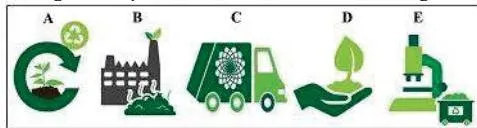
Arrange the steps in the correct order for the management of biomedical waste.
Appeared in: MP NHM CHO-2024 (Shift-2)
Explanation
- The correct sequence for managing biomedical waste follows a logical flow from creation to disposal: Generation → Collection → Transportation → Treatment → Final Disposal.
- Icon E represents Generation and Segregation, the first step, which occurs at the source (e.g., a laboratory, symbolized by the microscope).
- Icon D symbolizes the careful Collection and Handling of the segregated waste.
- Icon C (truck) clearly depicts the Transportation of waste to a dedicated facility.
- Icon B (factory/incinerator) represents the Treatment process to neutralize hazardous materials.
- Icon A (recycling symbol and plant) signifies the final step of Disposal and/or Recycling of the treated, safe material.
Why Other Options Were Wrong
- Option A: This sequence is the exact reverse of the correct process. It incorrectly suggests that waste management starts with disposal (A) and ends with generation (E).
- Option B: This sequence is illogical as it starts with Treatment (B) and Transportation (C) before the waste has been generated (E) or collected (D).
- Option C: This sequence is incorrect because it starts with Treatment (B) and places Generation (E) as the second step. Waste must be generated before it can be treated.
Related Visual

- Visual 1: Flowchart: A step-by-step flowchart illustrating the complete cycle of biomedical waste management from generation to final disposal.
- Visual 2: Infographic: Color-coded bins used for biomedical waste segregation, showing which type of waste goes into yellow, red, blue, and white/translucent containers as per BMW Management Rules, 2016.
Clinical Relevance
- Nursing practice connection: This is primarily an exam-oriented knowledge point with limited direct bedside application, so retain Biomedical Waste Management Steps as background academic context rather than a clinical decision trigger.
- Proper biomedical waste management is a critical nursing responsibility to prevent nosocomial (hospital-acquired) infections and protect healthcare workers, patients, and the community from infectious diseases like HIV and Hepatitis.
- Adherence to the correct sequence ensures compliance with legal frameworks (like the BMW Management Rules, 2016 in India) and prevents environmental pollution from hazardous and infectious materials.
- What if? If segregation (Step E) is done incorrectly and sharps are mixed with general waste, it poses a high risk of needle-stick injury and infection to sanitation staff during collection (Step D) and transportation (Step C).
How to Approach the Question
- First, carefully analyze each icon (A-E) to understand the specific process it represents in the context of waste management.
- Identify the logical starting point of the entire process. Waste management must begin where waste is created (Generation).
- Identify the logical endpoint of the process, which is the final disposition of the waste (Disposal/Recycling).
- Arrange the intermediate steps (Collection, Transportation, Treatment) in a chronological sequence between the start and end points.
- Construct the sequence of letters based on your logical arrangement.
- Finally, match your derived sequence of letters with the given options to find the correct answer.
Concept Tested & Keywords
- Concept Tested: Biomedical Waste Management Steps
- Stem keywords: biomedical waste, management, correct order, steps
- Lead-in keywords: Arrange
- Negative lead-in flag: false
Question ID
QP-NrddC4eGpCvxlKNQ1zc
Reference Book
Potter & Perry Fundamentals of Nursing 9th Edition — Part 2 p. 569-573
Practise the full MP NHM CHO-2024 (Shift-2)
Attempt every question from this paper in a timed mock, then review the full solution for each one.
More Infection control & BMW management Questions
- Disposal of expired and cytotoxic drugs is by:
- Patient with MRSA admitted in MICU, the nurse has to provide colostomy care to patient. Which PPE should the nurse use?
- Sharp blades and needle to be discarded in which of following?
- Which of the following glove is of largest size?
- Which of the following are the correct steps of handwashing?
- As per BMW management and according to WHO, infected cotton sponge is discarded into which colour-coded bag?
- After discontinuing an intravenous infusion, the nurse should dispose of the used plastic IV tubing set in which color-coded bag?
- According to WHO protocols, time required for hand washing with soap & water?
- In the delivery room, the placenta should be discarded in which color-coded bag?
- A patient gets an infection from an indwelling catheter. It is an example of?
More MP NHM CHO-2024 (Shift-2) Questions
- \ \ \ \ \ \ fluid represents the 2/3 of Total Body Weight.
- The \ \ \ \ cavity contains the urinary bladder, uterus/ prostate and rectum.
- Where are lymphocytes formed?
- During muscle relaxation, the \ \ \ \ covers the active site on actin.
- Which of the following occurs when small defects in the muscle of the wall of the large intestine or colon allow small pockets or pouches to form?
- Which of the following body system is primarily responsible for maintaining homeostasis?
- How much time does a heartbeat last?
- Which equation is correct for stroke volume (SV)?
- \ \ \ \ type of nephrons have short loops of Henle that do not dip far beyond the cortex.
- What does the ciliary body in the eye do?