
KGMU 2023
Applied Anatomy
Easy
Ape hand deformity, characterized by an inability to oppose the thumb, is caused by compression or injury to which nerve?
Appeared in: KGMU 2023
Explanation
- The median nerve is responsible for the motor innervation of the thenar muscles, which include the opponens pollicis, abductor pollicis brevis, and flexor pollicis brevis.
- These muscles are essential for the opposition of the thumb, a movement that allows the thumb to touch the tips of the other fingers.
- Injury or compression of the median nerve leads to paralysis and subsequent atrophy (wasting) of the thenar muscles.
- This muscle wasting causes the thenar eminence to flatten, and the thumb falls back in line with the other fingers, losing its ability to oppose. This clinical sign is known as 'Ape Hand Deformity'.
Why Other Options Were Wrong
- Option A: Injury to the radial nerve affects the extensor muscles of the forearm, not the thenar muscles responsible for thumb opposition.
- Option C: Ulnar nerve injury affects the intrinsic muscles of the hand, particularly those controlling the 4th and 5th digits, leading to a different type of deformity.
- Option D: The axillary nerve innervates muscles around the shoulder joint, and its injury does not cause hand deformities.
Related Visual
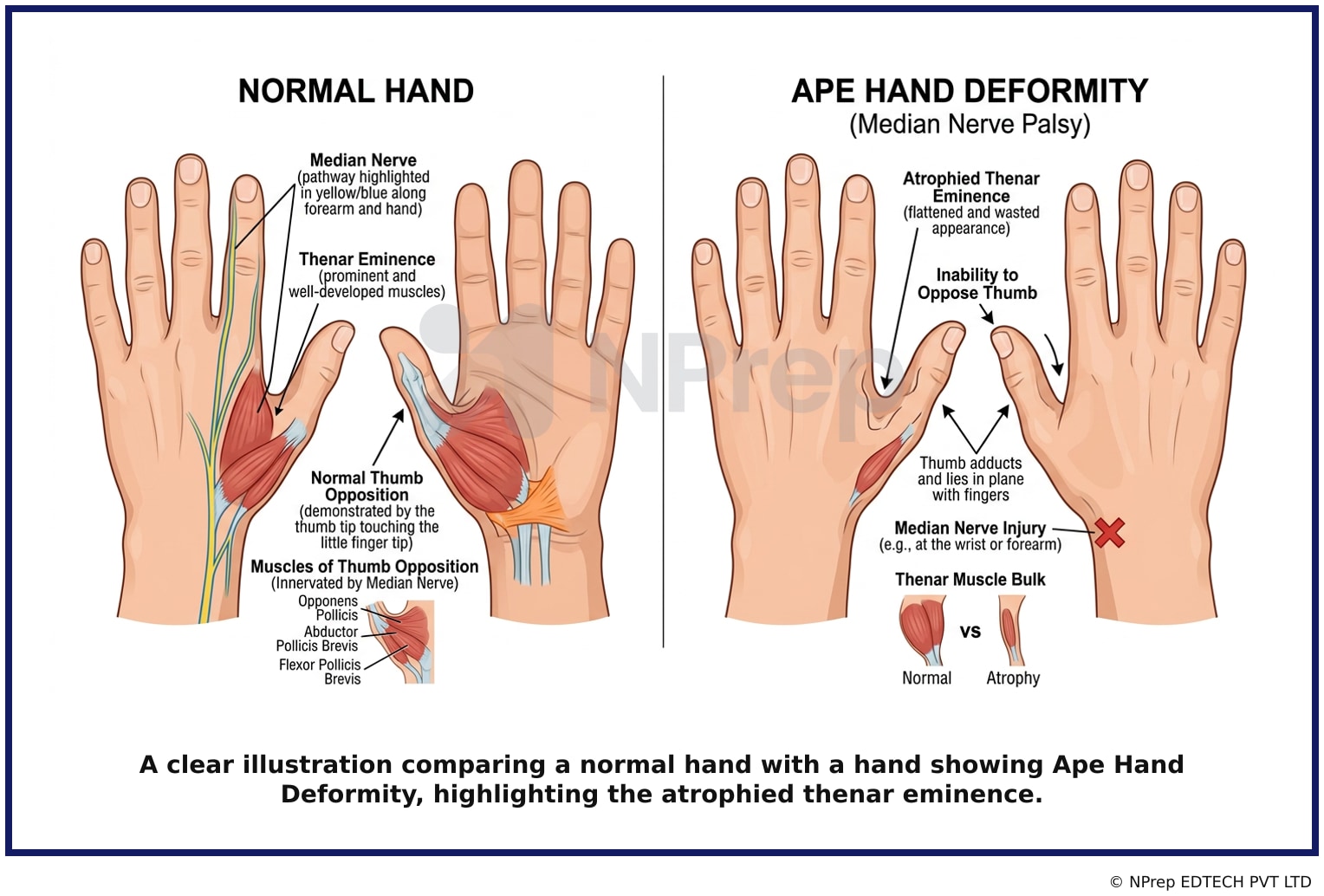
- Visual 1: Diagram - A clear illustration comparing a normal hand with a hand showing Ape Hand Deformity, highlighting the atrophied thenar eminence.
- Visual 2: Anatomical Chart - A chart showing the pathway of the median, ulnar, and radial nerves in the arm and hand, with the muscles they innervate clearly labeled.
- Visual 3: Comparative Table - An infographic visually comparing the classic hand deformities associated with major nerve injuries: Ape Hand (Median), Claw Hand (Ulnar), and Wrist Drop (Radial).
Clinical Relevance
- Nursing practice connection: Knowing Peripheral Nerve Injury and Associated Deformities helps nurses interpret findings accurately and avoid errors in routine assessment, medication administration, and patient teaching.
- Nurses must be able to recognize specific hand deformities like Ape Hand as it points directly to a significant neurological deficit (median nerve palsy), requiring prompt assessment and physician notification.
- A thorough neurological assessment for a patient with suspected median nerve injury includes testing motor function (thumb opposition), sensory function (sensation in the thumb, index, middle, and half of the ring finger), and observing for thenar muscle wasting.
- What if? If a patient with a wrist fracture develops an Ape Hand deformity and also complains of numbness and tingling in the little finger, it suggests a more complex injury involving both the median and ulnar nerves, which requires urgent and comprehensive evaluation.
How to Approach the Question
- First, identify the key clinical sign described in the question stem: 'Ape hand deformity' and 'inability to oppose the thumb'.
- Recall the anatomy and function of the hand muscles. The movement of thumb opposition is primarily controlled by the thenar muscles.
- Connect the muscles to their nerve supply. Remember that the median nerve innervates the thenar muscle group.
- Therefore, a deficit in thumb opposition (Ape Hand) points directly to an injury of the median nerve.
- Eliminate the other options by recalling the classic signs of their injury: Radial nerve -> Wrist drop, Ulnar nerve -> Claw hand, Axillary nerve -> Shoulder abduction weakness.
Concept Tested & Keywords
- Concept Tested: Peripheral Nerve Injury and Associated Deformities
- Stem keywords: Ape hand deformity, inability to oppose the thumb, nerve compression, nerve injury
- Lead-in keywords: which nerve
- Negative lead-in flag: false
Question ID
QE823aPdZGH2bZRI22SOQN
Practise the full KGMU 2023
Attempt every question from this paper in a timed mock, then review the full solution for each one.
More Nervous System Questions
- Which one of the following is the third cranial nerve?
- Identify the procedure done by the health care professional in the image below:
- Connection between right and left hemisphere is known as?
- A young adult who was hit by a car was fortunate because the level of his injury did not interrupt his respiratory function. The cord segment involve…
- Auditory area located in which lobe of the brain?
- A patient is unable to see downward and lateral movement of the eyes. Which of the following cranial nerve primarily would be affected?
- Pressure by the upper end of a crutch may cause injury to the?
- Which of the following is the largest cranial nerve?
- How many cervical nerves are there in the spinal cord?
- An injury to the upper brachial plexus results in?
More KGMU 2023 Questions
- The teacher scalded Aruna in front of her classmates during Project submission. Conclusion I: Aruna was not as popular as her other classmates. Concl…
- Aruna leaves and goes 8 meters in the North direction from a certain point. Then she turns right and travels for 12 meters. She again turns right and…
- Kiran is Sister of Raj. Raj is Son of Suresh and Vinita is Mother of Suresh then what is relation between Vinita and Kiran?
- A person who lives at the same time with another?
- Select the most appropriate meaning of the below idiom. A black sheep?
- The train has arrived...the station.
- A vendor sold 20 kg of potato at 18 Rs. per kg. He bought 2-liter milk at the rate of 46 Rs./liter, 2 kg sugar at the rate of 35 Rs./kg and 10 packet…
- Which one is the perfect square?
- A is the smallest. C is taller than B and D. E is neither the tallest nor the smallest. Find which one is the tallest?
- From an entrance, a person walks 28 meters left, then turns right and walks 13 meters. They turn right again and walk 12 meters, and then walk 16 met…