
NIMHANS Nursing Officer - 2019
Obstetrics and Midwifery Nursing
Medium
An Rh-Ve Mother delivered a Rh -Ve Baby, What is the dose of Anti-D? 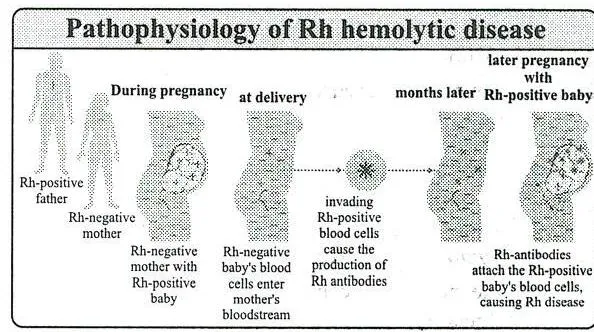
Appeared in: NIMHANS Nursing Officer - 2019
Explanation
- Anti-D immunoglobulin is a medication given to prevent an Rh-negative mother from developing an immune response (sensitization) to Rh-positive blood cells.
- This immune response is only triggered if the mother is exposed to the Rh(D) antigen, which is present on Rh-positive red blood cells.
- In the given scenario, both the mother and the baby are Rh-negative. This means the baby's blood does not contain the Rh(D) antigen.
- Since there is no exposure to the Rh antigen, there is no risk of the mother becoming sensitized.
- Therefore, the administration of Anti-D immunoglobulin is not clinically indicated or required.
Why Other Options Were Wrong
- Option B: This dose is not required because the baby is Rh-negative, meaning there is no risk of maternal sensitization.
- Option C: This is not a standard dose for routine postpartum prophylaxis against Rh sensitization.
- Option D: The unit 'mg' (milligram) is incorrect; the standard dose is in 'mcg' (micrograms). 300 mg is 1000 times the standard dose and would represent a massive and dangerous overdose.
Related Visual

Clinical Relevance
- Nursing practice connection: Knowing Indications and contraindications for postpartum Anti-D immunoglobulin (RhoGAM) administration helps nurses interpret findings accurately and avoid errors in routine assessment, medication administration, and patient teaching.
- A critical nursing responsibility is to verify both the mother's and the newborn's blood type and Rh factor before administering Anti-D immunoglobulin. Administering it when not needed is an unnecessary medical intervention, while failing to administer it when indicated can have severe consequences for future pregnancies.
- The principle 'When in doubt, give the shot' applies when the baby's Rh status is unknown, not when it is confirmed to be negative. If the baby's blood type cannot be determined, it is safer to administer Anti-D to prevent potential sensitization.
- What if? If the baby had been Rh-positive, the nurse's priority action would be to administer the standard 300 mcg dose of Anti-D immunoglobulin intramuscularly to the mother within 72 hours of delivery to prevent sensitization.
How to Approach the Question
- First, identify the key clinical information from the question: the mother's blood type (Rh-negative) and the baby's blood type (Rh-negative).
- Recall the purpose of Anti-D immunoglobulin (RhoGAM): to prevent an Rh-negative mother from developing antibodies against Rh-positive blood.
- Analyze the situation for Rh incompatibility. Since both mother and baby are Rh-negative, there is no incompatibility and no risk of sensitization.
- Conclude that Anti-D administration is not necessary in this specific clinical scenario.
- Review the given options. Recognize that the question is designed to test your understanding of the indication for Anti-D, not just the dose. The correct action is to give no dose.
Concept Tested & Keywords
- Concept Tested: Indications and contraindications for postpartum Anti-D immunoglobulin (RhoGAM) administration.
- Stem keywords: Rh-Ve Mother, Rh -Ve Baby, Anti-D, dose
- Lead-in keywords: What is
- Clinical cues: Mother is Rh-negative
- Clinical cues: Baby is Rh-negative
Question ID
QEzymfSdorMKrbyyqUKe1O
Reference Book
E6 Obstetrics Williams p. 48-68
Practise the full NIMHANS Nursing Officer - 2019
Attempt every question from this paper in a timed mock, then review the full solution for each one.
More Antenatal Care & Diagnostics Questions
- The reference value for a glucose challenge test is?
- The following is not included in the common laboratory tests for pregnant women
- A 4-week pregnant woman comes to the Gynae OPD and her blood report shows a hemoglobin of 12.5 gm/dL. According to the Anemia Mukt Bharat program, wh…
- Fundal height at the 24th week of pregnancy is ?
More NIMHANS Nursing Officer - 2019 Questions
- Which of the following measure showing in white blood count is indicating the patient is immunosuppressive and patient need to isolation?
- A pre-eclamptic women's baby is lying with her mother, when monitoring vital sign of baby, body temperature is low, what you will do for that?
- Find the odd one out.
- Postpartum period of 72 hours a purpura developed fever, with decrease skin integrity due to fluid loss and excessive vaginal secretions may indicati…
- The technician used for sterilization of instruments in a procedures. The cidex chemical used for sterilization will change after how many days?
- Medical Records are the property of?
- What Personal Protective Equipment is used when providing wound care to a MRSA patient?
- A patient is arriving in the emergency department after severe Haemorrhage. The sister in charge told the nursing sister to perform cannulation quick…
- Which of the following are measures of dispersion?
- A 1-day puerperal woman with excessive bleeding, what type of PPH is this?