
KGMU 2023
Obstetrics & Gynaecology
Easy
All of the following are high-risk factors for Postpartum Hemorrhage (PPH), EXCEPT:
Appeared in: KGMU 2023
Explanation
- Hyperemesis gravidarum is a condition of severe nausea and vomiting during early pregnancy.
- Its primary complications are dehydration, electrolyte imbalance, and malnutrition.
- It is not considered a direct risk factor for Postpartum Hemorrhage (PPH).
- PPH is typically caused by uterine atony, genital tract trauma, retained placental tissue, or coagulation abnormalities (the '4 Ts'), none of which are directly caused by hyperemesis gravidarum.
Why Other Options Were Wrong
- Option A: Pregnancy-Induced Hypertension (PIH), particularly severe preeclampsia, is a significant risk factor for PPH.
- Option B: Twin pregnancy is a major risk factor for PPH.
- Option D: A history of a previous caesarean section is a well-established risk factor for PPH.
Related Visual
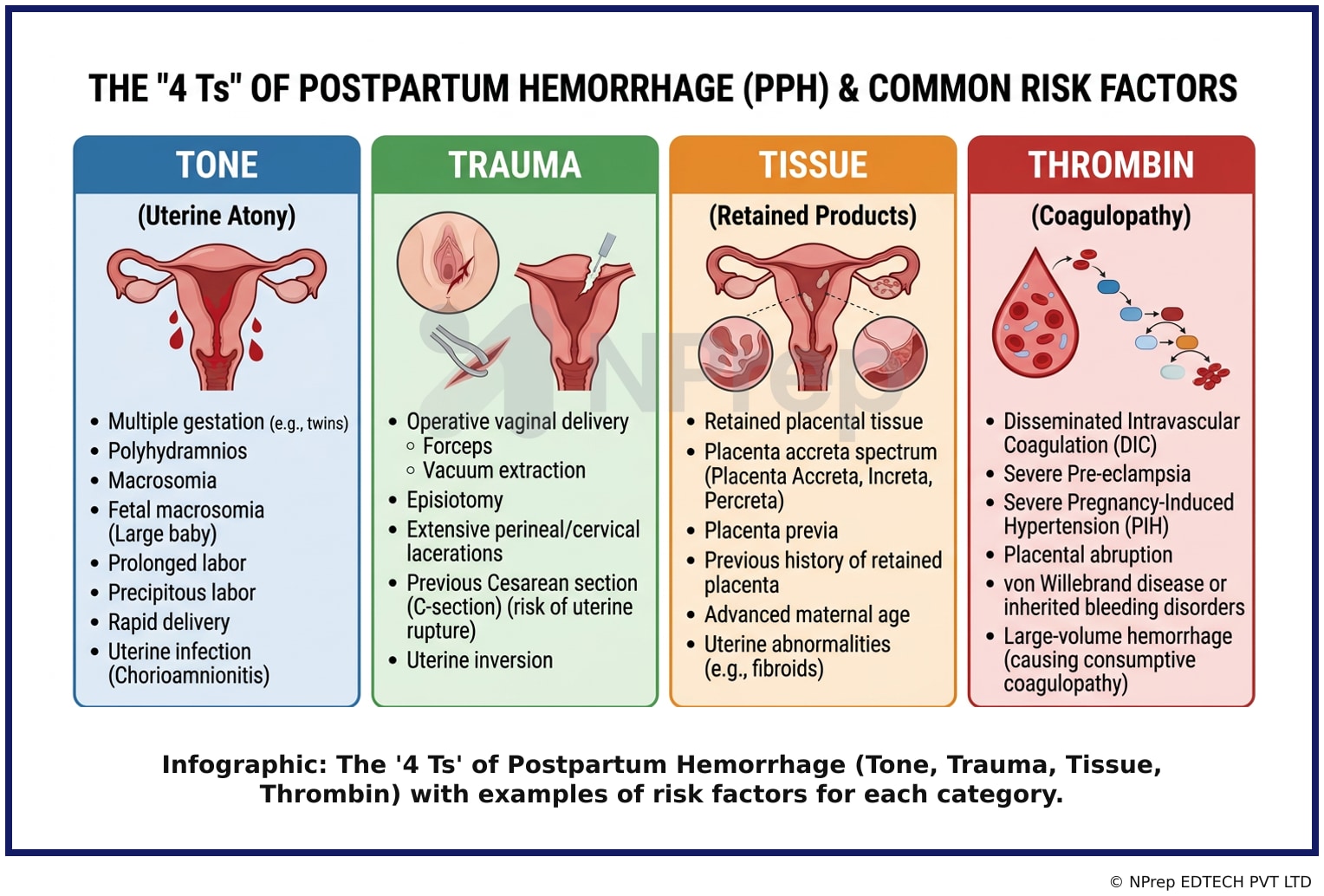
- Visual 1: Infographic: The '4 Ts' of Postpartum Hemorrhage (Tone, Trauma, Tissue, Thrombin) with examples of risk factors for each category.
- Visual 2: Table: A comprehensive list of antenatal, intrapartum, and postpartum risk factors for PPH.
Clinical Relevance
- Nursing practice connection: This is primarily an exam-oriented knowledge point with limited direct bedside application, so retain Identification of risk factors for Postpartum Hemorrhage (PPH) as background academic context rather than a clinical decision trigger.
- Antenatal identification of PPH risk factors is a critical nursing responsibility to ensure the healthcare team is prepared for a potential emergency.
- For patients with high-risk factors, nurses should ensure proactive measures are in place, such as securing large-bore IV access, ensuring availability of uterotonic drugs, and confirming blood products are on standby.
- What if? If a patient has multiple risk factors, such as a twin pregnancy and a previous C-section, her risk for PPH is significantly compounded. This would necessitate a higher level of alertness, a multidisciplinary team briefing, and potentially activating a massive hemorrhage protocol pre-emptively.
How to Approach the Question
- First, identify the negative keyword 'EXCEPT' in the question stem. This means you are looking for the option that is NOT a risk factor.
- The core concept is risk factors for Postpartum Hemorrhage (PPH).
- Recall the primary causes of PPH, commonly remembered by the mnemonic of the '4 Ts': Tone (uterine atony), Trauma (lacerations), Tissue (retained placenta), and Thrombin (coagulopathy).
- Evaluate each option to see if it relates to one of the 4 Ts.
- Pregnancy-Induced Hypertension can lead to coagulopathy (Thrombin).
- Twin Pregnancy can lead to uterine overdistension and atony (Tone).
Concept Tested & Keywords
- Concept Tested: Identification of risk factors for Postpartum Hemorrhage (PPH).
- Stem keywords: Postpartum Hemorrhage, PPH, high-risk factors
- Lead-in keywords: EXCEPT
- Clinical cues: Age/sex group narrows the expected diagnosis, intervention, or normal reference range.
- Negative lead-in flag: Question asks to identify the option that is NOT a risk factor.
Question ID
Q59l3n9IG3MoUKokOPSDdz
Practise the full KGMU 2023
Attempt every question from this paper in a timed mock, then review the full solution for each one.
More Complications of the Third Stage of Labor Questions
- Post-partum women having bleeding within 24 hrs after delivery is called:
- Which of the following drug is preferrably administered immediately after delivery of baby?
- How is blood loss measured in Post-partum hemorrhage?
- Which of the following medication is used in PPH (Post-Partum Hemorrhage)?
- Duration of secondary PPH?
- The nurse in the postpartum unit is caring for a client who has just delivered a newborn infant following a pregnancy with placenta previa. The nurse…
- What nursing interventions should be performed during uterine Fundus Examination after post partum?
- Post-partum women having bleeding from 1st day after delivery is called as?
- The condition where the uterus turns inside out is called?
- Postpartum haemorrhage is the condition in which there is loss of more than ml vaginal blood?
More KGMU 2023 Questions
- The teacher scalded Aruna in front of her classmates during Project submission. Conclusion I: Aruna was not as popular as her other classmates. Concl…
- Aruna leaves and goes 8 meters in the North direction from a certain point. Then she turns right and travels for 12 meters. She again turns right and…
- Kiran is Sister of Raj. Raj is Son of Suresh and Vinita is Mother of Suresh then what is relation between Vinita and Kiran?
- A person who lives at the same time with another?
- Select the most appropriate meaning of the below idiom. A black sheep?
- The train has arrived...the station.
- A vendor sold 20 kg of potato at 18 Rs. per kg. He bought 2-liter milk at the rate of 46 Rs./liter, 2 kg sugar at the rate of 35 Rs./kg and 10 packet…
- Which one is the perfect square?
- A is the smallest. C is taller than B and D. E is neither the tallest nor the smallest. Find which one is the tallest?
- From an entrance, a person walks 28 meters left, then turns right and walks 13 meters. They turn right again and walk 12 meters, and then walk 16 met…