
KGMU 2023
Applied Nutrition & Dietetics
Easy
Adding brick dust to chili powder is an example of what?
Appeared in: KGMU 2023
Explanation
- Food adulteration is the practice of adding a foreign, often inferior or harmful, substance to a food product to increase quantity or improve appearance for economic gain.
- Brick dust is a non-food, harmful substance used to increase the weight and mimic the color of chili powder.
- This practice is illegal and poses significant health risks, including stomach problems, and potential toxicity from heavy metals in the brick dust.
- The Prevention of Food Adulteration (PFA) Act in India defines such practices as adulteration, making the food unfit for consumption.
Why Other Options Were Wrong
- Option B: Food decontamination is the process of removing contaminants, which is the opposite of adding a substance like brick dust.
- Option C: Food purification involves removing impurities to make a food product cleaner or of higher quality. Adding brick dust is adding an impurity.
- Option D: Food refinement is a processing step to change a food's texture or properties, not the fraudulent addition of a non-food item.
Related Visual
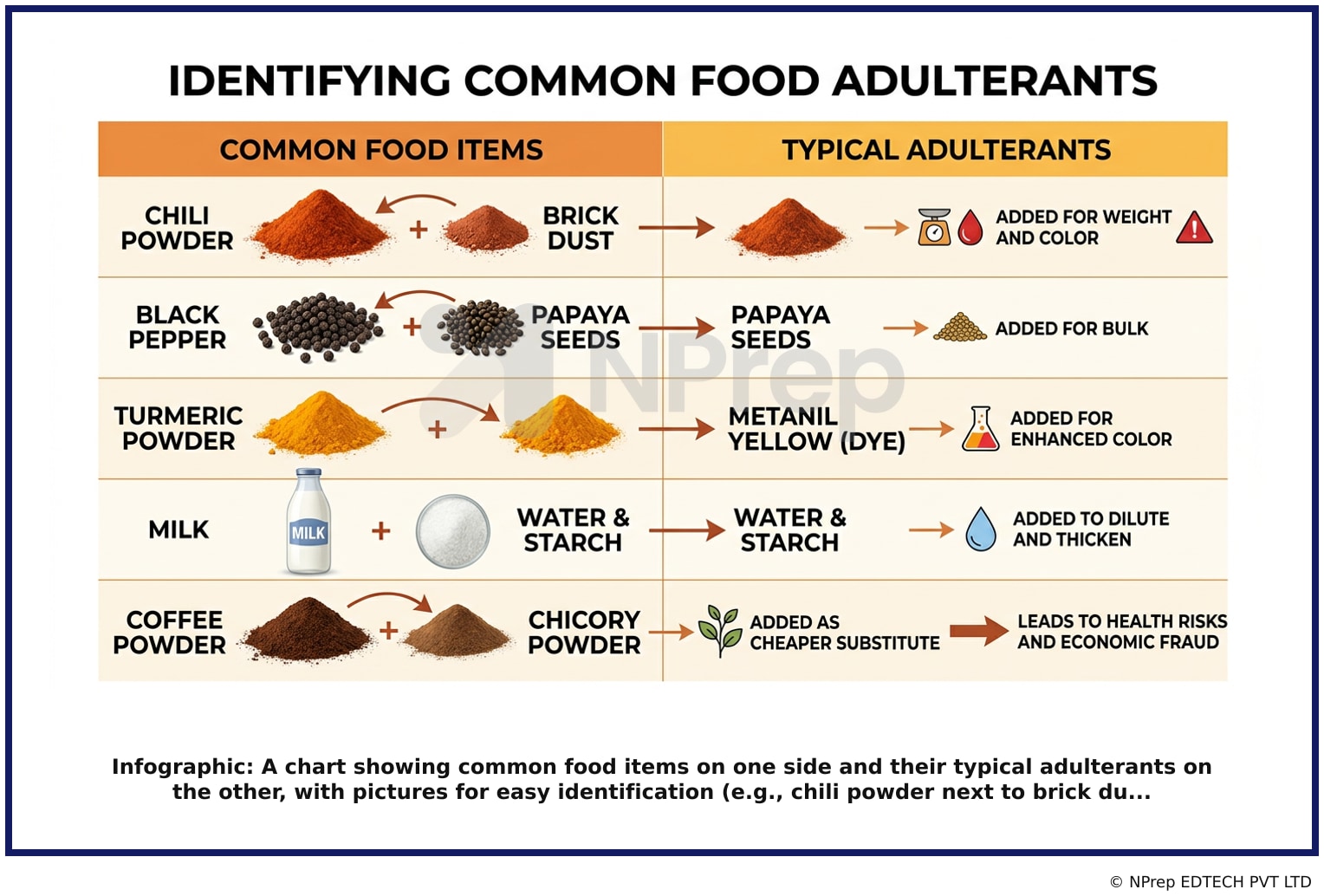
- Visual 1: Infographic: A chart showing common food items on one side and their typical adulterants on the other, with pictures for easy identification (e.g., chili powder next to brick dust, black pepper next to papaya seeds).
Clinical Relevance
- Nursing practice connection: This is primarily an exam-oriented knowledge point with limited direct bedside application, so retain Food Adulteration as background academic context rather than a clinical decision trigger.
- Nurses play a role in community health education, which includes teaching about food safety and the dangers of adulterated foods.
- Consumption of adulterated food can lead to a range of health issues from acute gastroenteritis to chronic toxicity and organ damage, which nurses may encounter in clinical practice.
- What if? If a patient presents with unexplained abdominal pain, nausea, and vomiting after consuming spices from an unverified source, the nurse should consider the possibility of food adulteration as a contributing factor and report it accordingly.
How to Approach the Question
- First, analyze the action described in the question: adding a non-food item (brick dust) to a food item (chili powder).
- Consider the purpose of this action. It's not to clean, purify, or process the food; it's to add bulk or color fraudulently.
- Evaluate the given options. 'Food Adulteration' is the specific term for intentionally debasing the quality of food by adding other substances.
- Eliminate the other options by understanding their definitions: 'Decontamination' and 'Purification' involve removing substances, and 'Refinement' is a form of processing.
Concept Tested & Keywords
- Concept Tested: Food Adulteration
- Stem keywords: brick dust, chili powder, adulteration
- Lead-in keywords: example of what
Question ID
QPM78J7wo8dCWaXIenbpa4
Practise the full KGMU 2023
Attempt every question from this paper in a timed mock, then review the full solution for each one.
More Cookery Rules and Preservation of Nutrients Questions
- Epidemic dropsy is due to:
- All of the following are measures for nutrient preservation, EXCEPT:
- Which of the following diseases is caused due to food adulteration of Arhar Dal with Kesari Dal?
- What is the food standardization by the Directorate of Marketing and Inspection of the Government of India?
- Lathyrism, caused by consuming Khesari dal in large quantities, can be prevented by which of the following methods?
- Food cooked in copper utensils lose ascorbic acid quickly because it?
- Generally Parboiling technique is used for preserving nutritive quality of which grain?
- Drying method used for preservation of food?
- International food standard is?
- Mixing of brick powder with Chili powder is a case of:
More KGMU 2023 Questions
- The teacher scalded Aruna in front of her classmates during Project submission. Conclusion I: Aruna was not as popular as her other classmates. Concl…
- Aruna leaves and goes 8 meters in the North direction from a certain point. Then she turns right and travels for 12 meters. She again turns right and…
- Kiran is Sister of Raj. Raj is Son of Suresh and Vinita is Mother of Suresh then what is relation between Vinita and Kiran?
- A person who lives at the same time with another?
- Select the most appropriate meaning of the below idiom. A black sheep?
- The train has arrived...the station.
- A vendor sold 20 kg of potato at 18 Rs. per kg. He bought 2-liter milk at the rate of 46 Rs./liter, 2 kg sugar at the rate of 35 Rs./kg and 10 packet…
- Which one is the perfect square?
- A is the smallest. C is taller than B and D. E is neither the tallest nor the smallest. Find which one is the tallest?
- From an entrance, a person walks 28 meters left, then turns right and walks 13 meters. They turn right again and walk 12 meters, and then walk 16 met…