
NORCET 10 Prelims-2026
Obstetrics & Gynaecology
Easy
According to the LaQshya guidelines, which practice is correct during normal vaginal delivery (NVD)?
Appeared in: NORCET 10 Prelims-2026
Explanation
- The LaQshya guidelines, aligned with WHO recommendations, advocate for delayed cord clamping (DCC) in vigorous newborns.
- This practice involves waiting for at least 1-3 minutes (or until pulsations cease) before clamping the umbilical cord.
- The primary benefit is allowing placental transfusion, which transfers an additional 80-100 mL of blood to the infant.
- This significantly increases the newborn's iron stores, reducing the risk of iron-deficiency anemia in the first few months of life.
- DCC is a simple, low-cost intervention with significant health benefits for the neonate.
Why Other Options Were Wrong
- Option A: Routine episiotomy is an outdated practice. Modern evidence-based guidelines, including LaQshya, recommend a restrictive approach to episiotomy.
- Option B: Immediate cord clamping is the opposite of the recommended practice for vigorous term and preterm newborns.
- Option D: While limiting visitors is a crucial component of infection control in the labor room and is part of the LaQshya quality standards, it is a general environmental policy rather than a specific clinical practice performed on the mother or baby during the act of delivery.
Related Visual
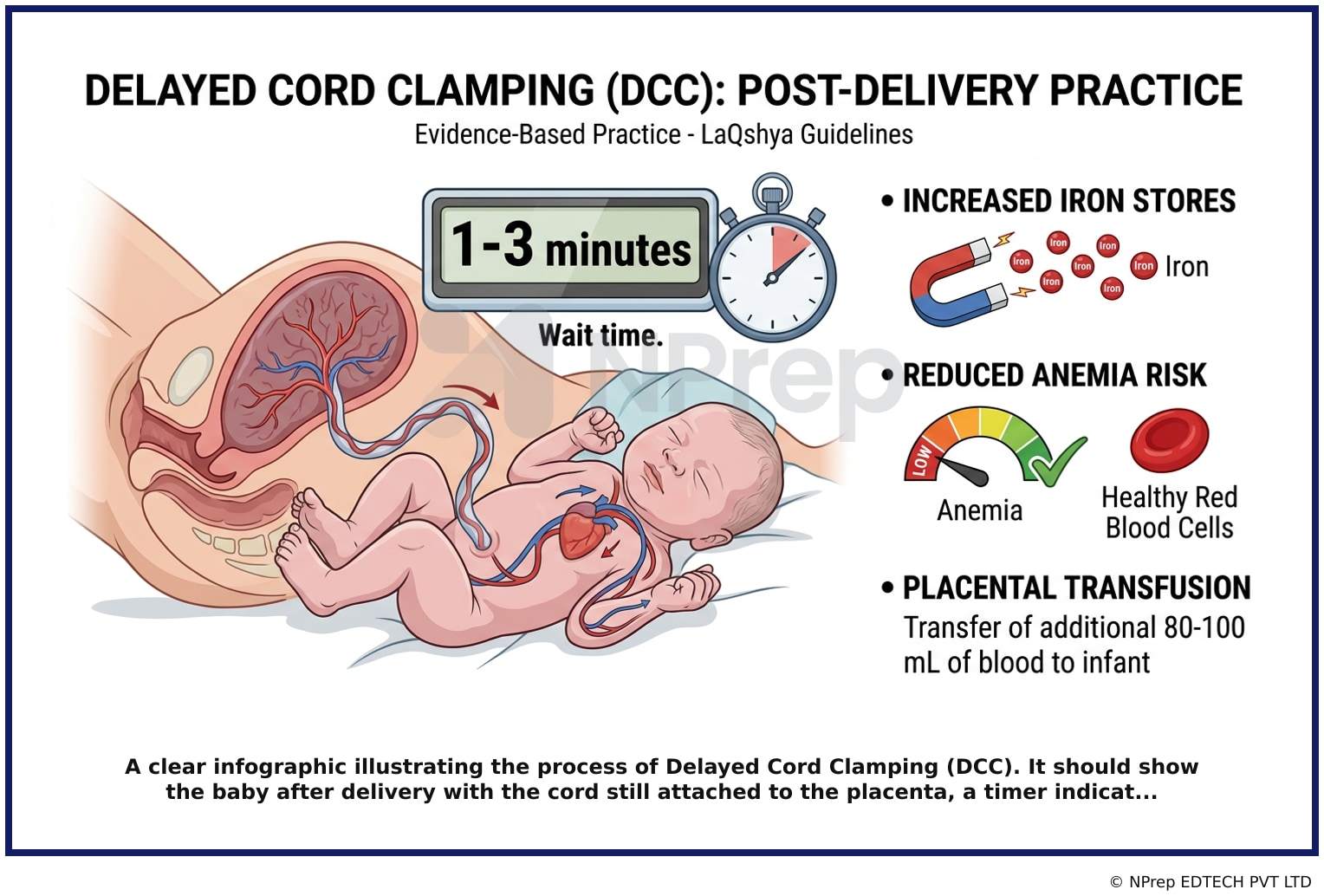
- Visual 1: Infographic - A clear infographic illustrating the process of Delayed Cord Clamping (DCC). It should show the baby after delivery with the cord still attached to the placenta, a timer indicating 1-3 minutes, and bullet points listing the benefits (increased iron stores, reduced anemia risk).
- Visual 2: Comparison Chart - A simple chart comparing 'Immediate Cord Clamping' vs. 'Delayed Cord Clamping', highlighting the differences in blood volume transferred and the impact on neonatal iron levels and risk of anemia.
Clinical Relevance
- Nursing practice connection: This is primarily an exam-oriented knowledge point with limited direct bedside application, so retain Evidence-based practices during normal vaginal delivery as per LaQshya guidelines as background academic context rather than a clinical decision trigger.
- The nurse's role is critical in ensuring adherence to DCC protocols. This includes timing the delay, assessing the newborn's condition, and communicating the plan with the delivery team and the parents.
- Advocating for DCC is a key patient safety and quality improvement action. It directly impacts the long-term health of the newborn by preventing a common nutritional deficiency.
- What if? If a newborn is born apneic, limp, and with a low heart rate (non-vigorous), the priority shifts to resuscitation. In this case, the nurse should anticipate and facilitate immediate cord clamping so the baby can be moved to the radiant warmer for life-saving interventions without delay.
How to Approach the Question
- First, identify the core of the question: It asks for a 'correct practice' according to 'LaQshya guidelines' for a 'normal vaginal delivery'.
- Analyze the options based on current evidence-based maternity care practices. LaQshya is an Indian initiative that promotes such practices.
- Evaluate Option A (Routine Episiotomy): Recall that routine episiotomy is no longer standard practice. It's now restrictive. So, this is incorrect.
- Evaluate Option B (Immediate Cord Cutting): Recall that delayed cord clamping is the current recommendation for vigorous babies. Immediate clamping is the opposite. So, this is incorrect.
- Evaluate Option C (Delayed Cord Clamping for 2-3 mins): This aligns perfectly with WHO and modern guidelines for improving infant iron stores. This is a strong candidate.
- Evaluate Option D (Limited Visitors): While infection control is important, this is a general hospital policy, not a specific clinical procedure during the delivery itself. Option C is a more direct and critical clinical action.
Concept Tested & Keywords
- Concept Tested: Evidence-based practices during normal vaginal delivery as per LaQshya guidelines.
- Stem keywords: LaQshya guidelines, normal vaginal delivery, NVD
- Lead-in keywords: which practice is correct
- Negative lead-in flag: false
Question ID
QhkJsWwItTLC26xCfBM7RA
Practise the full NORCET 10 Prelims-2026
Attempt every question from this paper in a timed mock, then review the full solution for each one.
More Normal Labor Questions
- At how much interval BP measurement for a mother should be done during second stage of labor?
- How long do contractions last during second stage of labor at an interval of 3-5 minutes of rest?
- Braxton-Hicks are:-
- The third stage of labour comprises:-
- According to the World Health Organization (WHO), which of the following is recommended in the management of the second stage of labor?
- The process by which muscular fibres of the cervix are pulled upwards and merged with the fibres of the lower uterine segment is known as
- What reflex is an expulsive uterine contraction experienced by the mother during labor?
- Episiotomy should be done at?
- The second stage of labor starts?
- A newborn's assessment at 1 minute include muscle tone moderately active, body pink extremity blue, well cry, heart rate 110. Calculate the APGAR sco…
More NORCET 10 Prelims-2026 Questions
- A patient who underwent abdominal surgery 7 days ago comes to the OPD with the wound condition shown in the image below. This indicates which conditi…
- Lateral bowing of the legs is known as:
- A patient with a below-knee plaster cast reports that the cast has become wet. What is the most appropriate nursing action?
- At what level should neoplastic drugs be maintained
- 3-year-old child who had been toilet trained starts bedwetting after hospitalization. Which statement best describes this condition?
- 250 mL of 5% dextrose contains 12,500 units of heparin. The infusion is running at 18 mL/hour. How many units of heparin are delivered per hour?
- Find the incorrect statement regarding blood transfusion:
- According to the National Family Health Survey (NFHS-6), what are the approximate values of Total Fertility Rate (TFR) and Contraceptive Prevalence R…
- During which period did India experience its most significant 'population explosion'?
- A post-surgery patient has abdominal distension and discomfort. During physical assessment (inspection, auscultation, percussion, palpation), which f…