
KGMU 2023
Obstetrics & Gynaecology
Hard
A woman who is 3 days postpartum has a temperature of 100°F and breast engorgement. Which nursing action is most appropriate?
Appeared in: KGMU 2023
Explanation
- A low-grade fever and breast engorgement around the third postpartum day are classic signs of physiological engorgement, also known as 'milk fever,' which is a normal part of the lactation process.
- This condition arises from increased milk volume, blood flow, and lymphatic congestion as mature milk production begins (lactogenesis stage II).
- The most appropriate nursing action is to encourage the expression of breast milk, either through frequent breastfeeding or manual expression.
- Removing milk relieves the pressure and discomfort, softens the areola to facilitate a better latch for the infant, and prevents milk stasis, which can lead to complications like mastitis.
Why Other Options Were Wrong
- Option A: The patient's symptoms are characteristic of physiological engorgement, not an infection. Antibiotics are not indicated.
- Option C: Stopping breastfeeding is contraindicated as it would worsen milk stasis, leading to more severe engorgement and significantly increasing the risk of developing mastitis or a breast abscess.
- Option D: This advice is the opposite of the correct management. Infrequent or restricted breastfeeding is a cause of engorgement.
Related Visual
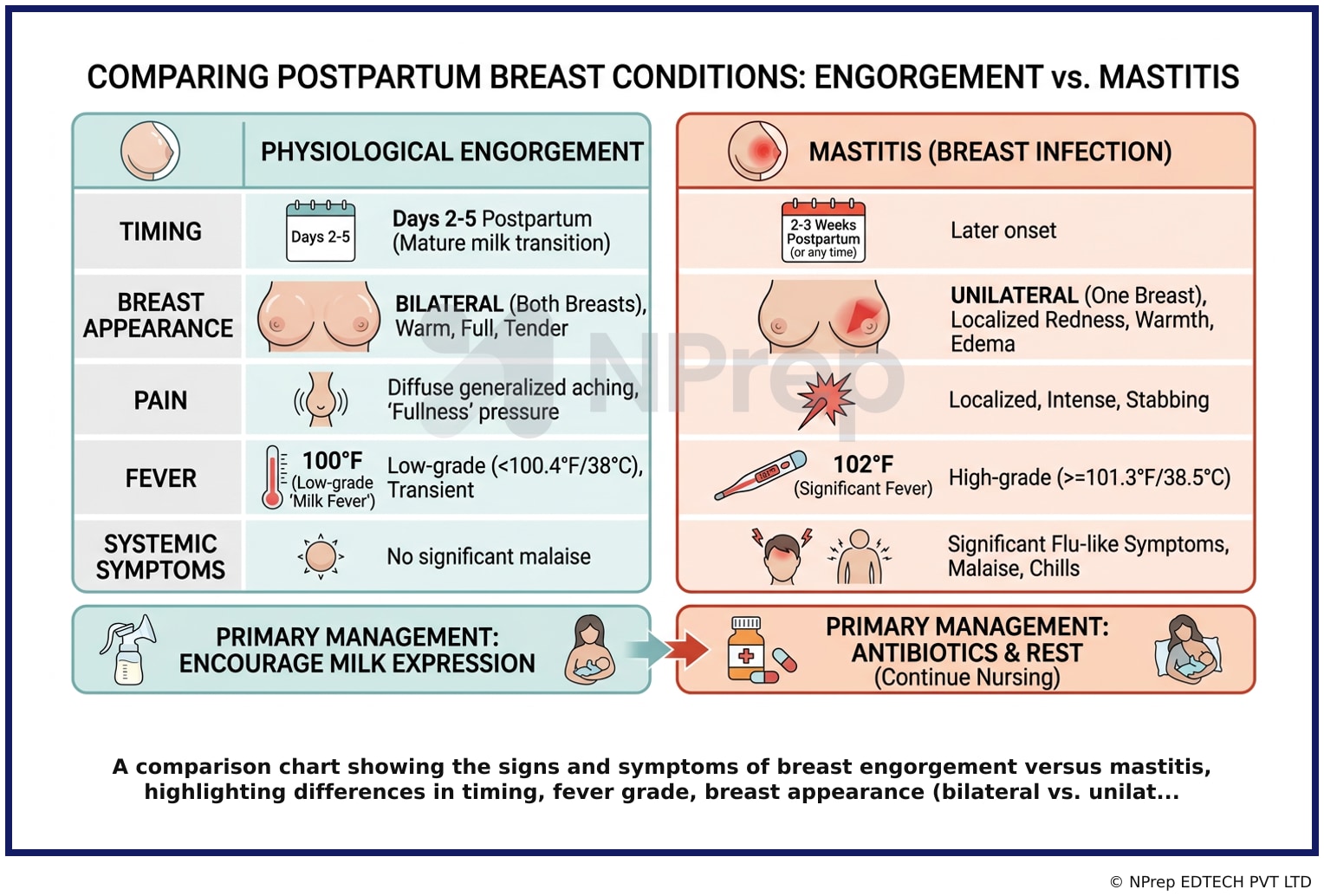
- Visual 1: Infographic - A comparison chart showing the signs and symptoms of breast engorgement versus mastitis, highlighting differences in timing, fever grade, breast appearance (bilateral vs. unilateral), and pain type.
Clinical Relevance
- Nursing practice connection: Knowing Management of postpartum breast engorgement helps nurses interpret findings accurately and avoid errors in routine assessment, medication administration, and patient teaching.
- Nurses play a critical role in educating new mothers to differentiate between normal physiological engorgement and infectious mastitis. This empowers the mother, reduces anxiety, and prevents unnecessary medical interventions like antibiotics.
- Effective management of breast engorgement is essential for supporting the breastfeeding relationship, ensuring infant nutrition, and preventing painful complications such as blocked ducts, mastitis, and breast abscesses.
- What if? - If the patient presented at 3 weeks postpartum with a fever of 102°F and a painful, red, wedge-shaped area on one breast, the most appropriate action would be to refer her for immediate medical evaluation. These are classic signs of infectious mastitis, which requires antibiotic therapy.
How to Approach the Question
- First, analyze the clinical data provided in the question: the patient is 3 days postpartum, has a temperature of 100°F, and breast engorgement.
- Recognize that the timing (day 3 postpartum) is a key clue, as this is the classic period for the onset of mature milk production (lactogenesis II).
- Interpret the temperature of 100°F (37.8°C) as a low-grade fever, which is characteristic of physiological 'milk fever' associated with engorgement.
- Differentiate this clinical picture from infectious mastitis. Mastitis typically presents later (after the second week), with a higher fever, and unilateral, localized breast inflammation.
- Evaluate the options based on the underlying problem: milk stasis. The goal is to relieve the pressure by removing milk.
- Conclude that encouraging the expression of breast milk is the only option that directly addresses the cause and provides relief, while the other options are either ineffective or harmful.
Concept Tested & Keywords
- Concept Tested: Management of postpartum breast engorgement.
- Stem keywords: 3 days postpartum, temperature of 100°F, breast engorgement
- Lead-in keywords: most appropriate
- Clinical cues: 3 days postpartum: This timing is characteristic of physiological engorgement as mature milk comes in, distinguishing it from later-onset mastitis.
- Clinical cues: 100°F temperature: This represents a low-grade fever, often termed 'milk fever,' which is a common, transient physiological response to engorgement, not necessarily an infection.
Question ID
QMBkj7SwCz-uZ_UEmA48EB
Practise the full KGMU 2023
Attempt every question from this paper in a timed mock, then review the full solution for each one.
More Normal Puerperium Questions
- Lochia alba follows lochia serosa and usually lasts from the 1st to 3rd week PP. What is lochia?
- The breastfeeding should be initiated within the delivery after
- A woman in labour is known as:-
- What is the best nursing action in the latent phase of the first stage of labor?
- A postpartum nurse is taking the vital signs of a woman who delivered a healthy newborn infant 4 hours ago. The nurse notes that the mother's tempera…
- What is the ideal time to initiate breast feeding after birth? (Choose the most appropriate option from below)
- What is the postnatal period commonly referred to?
- During lactation, a mother's fluid intake should be: (Choose the most appropriate option from below)
- Oxytocin is mainly involved in which of the following functions?
- Type of lochia, EXCEPT?
More KGMU 2023 Questions
- The teacher scalded Aruna in front of her classmates during Project submission. Conclusion I: Aruna was not as popular as her other classmates. Concl…
- Aruna leaves and goes 8 meters in the North direction from a certain point. Then she turns right and travels for 12 meters. She again turns right and…
- Kiran is Sister of Raj. Raj is Son of Suresh and Vinita is Mother of Suresh then what is relation between Vinita and Kiran?
- A person who lives at the same time with another?
- Select the most appropriate meaning of the below idiom. A black sheep?
- The train has arrived...the station.
- A vendor sold 20 kg of potato at 18 Rs. per kg. He bought 2-liter milk at the rate of 46 Rs./liter, 2 kg sugar at the rate of 35 Rs./kg and 10 packet…
- Which one is the perfect square?
- A is the smallest. C is taller than B and D. E is neither the tallest nor the smallest. Find which one is the tallest?
- From an entrance, a person walks 28 meters left, then turns right and walks 13 meters. They turn right again and walk 12 meters, and then walk 16 met…