
KGMU 2023
Obstetrics & Gynaecology
Easy
A woman in the immediate postpartum period suddenly starts bleeding heavily. What is the first priority nursing intervention?
Appeared in: KGMU 2023
Explanation
- The most common cause of immediate postpartum hemorrhage (PPH) is uterine atony, where the uterus fails to contract effectively after childbirth.
- The first and most critical nursing action is to firmly massage the uterine fundus. This provides direct mechanical stimulation to the myometrium, causing it to contract and constrict the open blood vessels at the former placental site.
- This intervention is the fastest way to control the bleeding at its source and takes precedence over pharmacological or supportive measures.
Why Other Options Were Wrong
- Option A: While oxytocin is a key medication for PPH, it is not the first action. Fundal massage provides a more immediate effect.
- Option C: Oxygen therapy does not address the cause of the bleeding (uterine atony). It is a supportive measure for complications.
- Option D: While essential for managing blood loss and preventing shock, fluid resuscitation does not stop the active bleeding. The priority is to control the source of the hemorrhage.
Related Visual
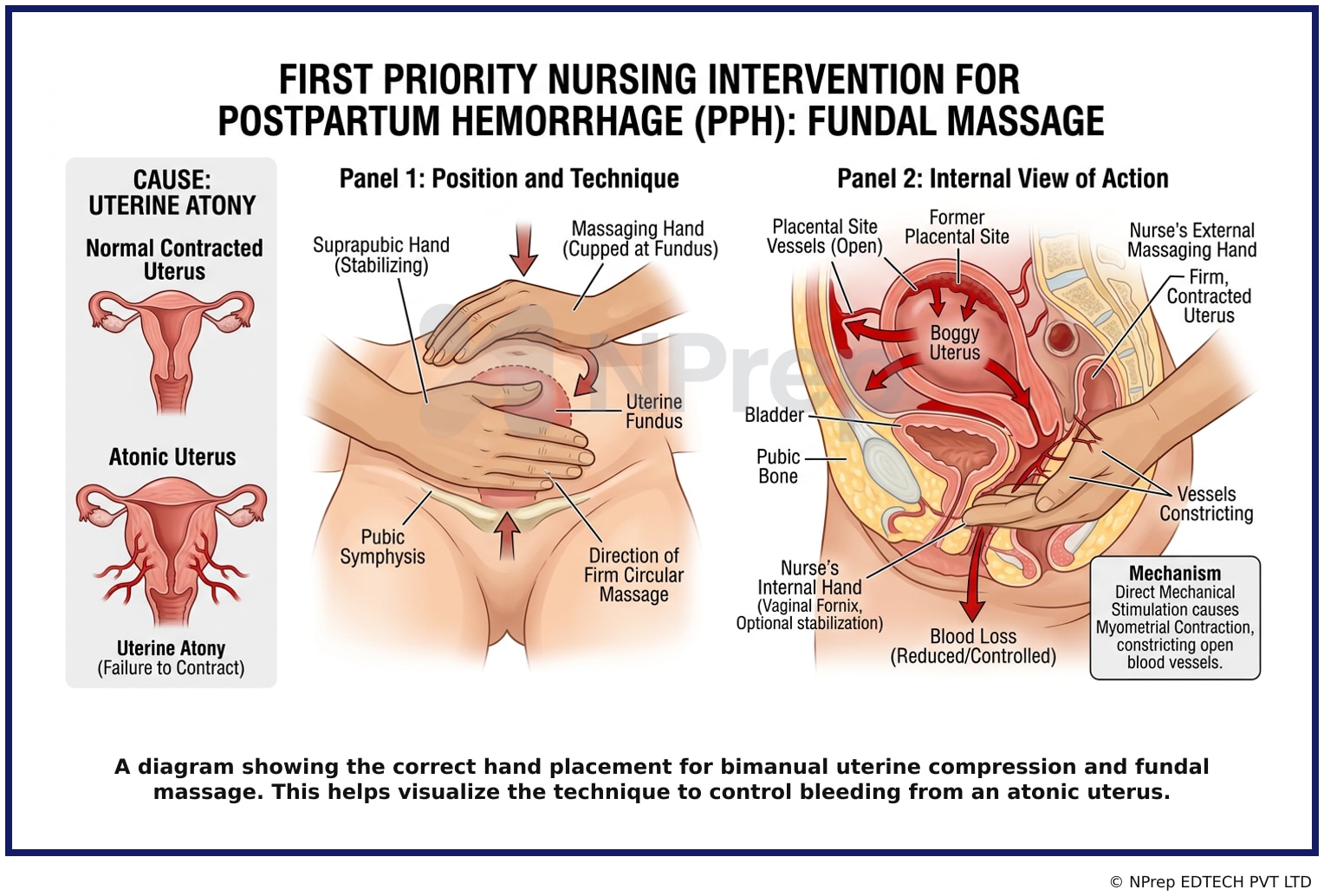
- Visual 1: Diagram - A diagram showing the correct hand placement for bimanual uterine compression and fundal massage. This helps visualize the technique to control bleeding from an atonic uterus.
- Visual 2: Flowchart - A flowchart illustrating the stepwise management protocol for postpartum hemorrhage, starting with fundal massage and escalating to uterotonics, fluid resuscitation, and other interventions. This clarifies the sequence of actions.
Clinical Relevance
- Nursing practice connection: Safe nursing care depends on performing Priority nursing intervention for postpartum hemorrhage (PPH) in the correct sequence, documenting the action clearly, and monitoring for the expected response.
- Recognizing and acting on PPH is a critical nursing skill. The '4 Ts' mnemonic (Tone, Trauma, Tissue, Thrombin) helps remember the causes, with Tone (uterine atony) being the most common (70-80% of cases).
- Prompt fundal massage can be life-saving and is a core competency for any nurse working in maternity care.
- What if? If the fundus is firm upon massage but bleeding persists, the priority shifts. The nurse should suspect a different cause, such as a cervical or vaginal laceration (Trauma), and immediately notify the provider for a sterile vaginal examination.
How to Approach the Question
- First, identify the question type. This is a priority-based question, asking for the 'first' nursing intervention in an emergency.
- Analyze the clinical scenario: a patient in the immediate postpartum period is bleeding heavily. This points towards a diagnosis of postpartum hemorrhage (PPH).
- Recall the most common cause of immediate PPH: uterine atony. The uterus is 'boggy' and not contracting.
- Evaluate the options based on the principle of 'stop the bleed first'. Which action directly addresses uterine atony most quickly?
- Fundal massage is the most direct and immediate physical intervention to stimulate uterine contraction.
- Compare this to other options: Oxytocin takes time to administer and take effect. Oxygen and IV fluids are supportive measures for the consequences of bleeding, not the cause. Therefore, fundal massage is the highest priority.
Concept Tested & Keywords
- Concept Tested: Priority nursing intervention for postpartum hemorrhage (PPH).
- Stem keywords: immediate postpartum period, suddenly starts bleeding heavily, first priority
- Lead-in keywords: first priority
- Clinical cues: suddenly starts bleeding heavily: Indicates an acute hemorrhagic event requiring immediate action.
- Clinical cues: immediate postpartum period: Narrows the cause to common early PPH etiologies like uterine atony.
Question ID
QBetXQwR_Gtvtt4c4kFrH2
Practise the full KGMU 2023
Attempt every question from this paper in a timed mock, then review the full solution for each one.
More Complications of the Third Stage of Labor Questions
- Post-partum women having bleeding within 24 hrs after delivery is called:
- Which of the following drug is preferrably administered immediately after delivery of baby?
- How is blood loss measured in Post-partum hemorrhage?
- Which of the following medication is used in PPH (Post-Partum Hemorrhage)?
- Duration of secondary PPH?
- The nurse in the postpartum unit is caring for a client who has just delivered a newborn infant following a pregnancy with placenta previa. The nurse…
- What nursing interventions should be performed during uterine Fundus Examination after post partum?
- Post-partum women having bleeding from 1st day after delivery is called as?
- The condition where the uterus turns inside out is called?
- Postpartum haemorrhage is the condition in which there is loss of more than ml vaginal blood?
More KGMU 2023 Questions
- The teacher scalded Aruna in front of her classmates during Project submission. Conclusion I: Aruna was not as popular as her other classmates. Concl…
- Aruna leaves and goes 8 meters in the North direction from a certain point. Then she turns right and travels for 12 meters. She again turns right and…
- Kiran is Sister of Raj. Raj is Son of Suresh and Vinita is Mother of Suresh then what is relation between Vinita and Kiran?
- A person who lives at the same time with another?
- Select the most appropriate meaning of the below idiom. A black sheep?
- The train has arrived...the station.
- A vendor sold 20 kg of potato at 18 Rs. per kg. He bought 2-liter milk at the rate of 46 Rs./liter, 2 kg sugar at the rate of 35 Rs./kg and 10 packet…
- Which one is the perfect square?
- A is the smallest. C is taller than B and D. E is neither the tallest nor the smallest. Find which one is the tallest?
- From an entrance, a person walks 28 meters left, then turns right and walks 13 meters. They turn right again and walk 12 meters, and then walk 16 met…