
AIIMS Raipur NO - 2017 (Shift-1)
Mental Health Nursing
Easy
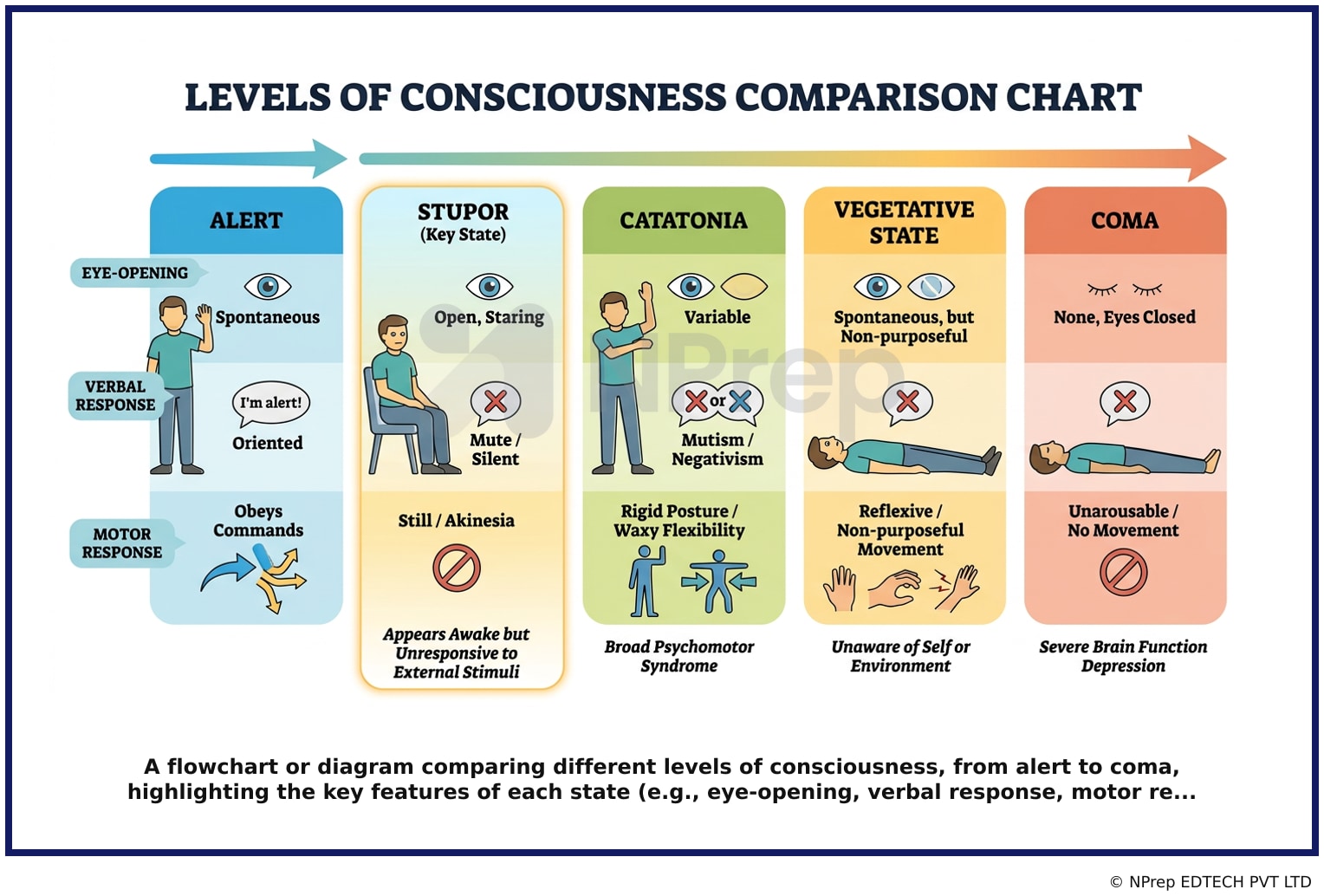
A state of diminished consciousness in which the patient remains mute and still with the eyes open is called?
Appeared in: AIIMS Raipur NO - 2017 (Shift-1)
Explanation
- Stupor is a state of reduced consciousness and responsiveness.
- In a neurological or psychiatric context, it is defined by a lack of spontaneous movement (akinesia) and speech (mutism), while the person's eyes remain open.
- The patient appears to be awake but does not respond to external stimuli, matching the description in the question perfectly.
- It is distinct from coma, where the eyes are closed and the patient is unarousable.
Why Other Options Were Wrong
- Option A: Catatonia is a broader psychomotor syndrome, not just a single state. While stupor is a primary symptom of catatonia, catatonia also includes other signs like waxy flexibility, posturing, negativism, or excitement.
- Option C: Panic is a state of extreme anxiety and fear, characterized by physiological and psychological agitation. It is the opposite of being 'mute and still'.
- Option D: Hysteria is an outdated historical term. It is no longer used as a formal diagnosis in modern psychiatry and lacks clinical precision.
Related Visual
Clinical Relevance
- Nursing practice connection: Use the key finding related to Definitions of Altered States of Consciousness to guide bedside assessment, documentation, and the next nursing action.
- Accurate assessment and documentation of a patient's level of consciousness are critical nursing responsibilities. Using precise terms like 'stupor' instead of vague ones like 'unresponsive' provides clearer communication for the healthcare team.
- Differentiating between psychiatric stupor (e.g., from catatonia) and neurological stupor (e.g., from a brain lesion or metabolic encephalopathy) is vital for determining the correct diagnostic and treatment pathway.
- What if? If the patient was mute and still but their eyes were closed and they could not be aroused even with painful stimuli, the correct term would be 'Coma'. This distinction is critical as coma indicates a more severe depression of brain function.
How to Approach the Question
- This is a definition-based recall question. Start by identifying the key descriptive words in the question stem: 'diminished consciousness', 'mute' (not speaking), 'still' (not moving), and 'eyes open'.
- Evaluate each option against this set of keywords.
- Recognize that 'Stupor' is the clinical term that precisely matches the description of being motionless and mute but with open eyes, appearing awake but unresponsive.
- Differentiate 'Stupor' from 'Catatonia' by remembering that stupor is a specific state, while catatonia is a broader syndrome that includes stupor among other possible symptoms.
- Eliminate 'Panic' as it involves agitation, the opposite of being still. Eliminate 'Hysteria' as it is an obsolete term.
Concept Tested & Keywords
- Concept Tested: Definitions of Altered States of Consciousness
- Stem keywords: diminished consciousness, mute, still, eyes open
- Lead-in keywords: is called
Question ID
QVrbVKtQgKseon6ImRvo41
Reference Book
E6 Medicine Harrison 22e Part 1 p. 228-230
E6 Kaplan Sadock's Synopsis of Psychiatry-2022 (pp 1-3768 of 3768) p. 1090-1092
Practise the full AIIMS Raipur NO - 2017 (Shift-1)
Attempt every question from this paper in a timed mock, then review the full solution for each one.
More Psychiatric Emergencies Questions
- Patient is taking haloperidol and at home Patient is not able to sit quietly, during the clinic visit Patient has the urge to walk. What is suffering…
- A client is admitted to the emergency room with symptoms of delirium tremens. After admitting the client to a private room, the priority nursing inte…
- A 38-year-old female client with a history of chronic schizophrenia, paranoid type, is currently an outpatient at the local mental health and mental…
- Which of the following would be a priority nursing intervention for a patient who has suicidal behaviour?
- A patient receiving haloperidol for schizophrenia reports an inner feeling of motor restlessness, stating, "I can't stop moving my legs, I feel like…
- A patient who was admitted after a suicide attempt following a job loss now appears cheerful, energetic, and states, "I've figured everything out and…
- Which of the following clinical features alerts the nurse to lithium toxicity?
- What clinical presentation should be assessed in a mentally unhealthy patient who is prone to suicide?
- A psychiatric client is receiving antipsychotic drugs and is experiencing symptoms of agitation, restlessness, dysphoria, and difficulty in sleeping.…
- Behavioral clues of impending suicide are as follows, EXCEPT
More AIIMS Raipur NO - 2017 (Shift-1) Questions
- The disadvantages of Electronic Health Records are the following, except?
- The idea of storing a program and the data to be processed in the same memory was contributed by?
- During physical assessment of children, asymmetry of the skull indicates?
- The use of transistors instead of vacuum tubes in computers emerged in which generation?
- The type of pelvis in which the features are a heart-shaped brim, narrow pelvis, and sciatic notch with prominent ischial spines and a suprapubic ang…
- The mode of transmission of trachoma from one person to another is?
- It was observed by a nurse that the medication prescription given by the doctor was wrongly noted by the nurse of the previous shift. Who among the f…
- The activities a person engages in, believing himself ill, are characteristic of?
- The cardinal signs of the body include the following, EXCEPT?
- The primary role of the pediatric nurse is to provide nursing care as?