
KGMU 2023
Psychiatric Nursing
Medium
A patient who drinks heavily cannot remember specific incidents that occurred while drinking, despite being conscious at the time. The patient is experiencing what?
Appeared in: KGMU 2023
Explanation
- Blackouts are defined as episodes of temporary anterograde amnesia that occur during a period of alcohol intoxication.
- During a blackout, the individual is awake and conscious but later cannot recall all or part of what occurred during the drinking period.
- This phenomenon is caused by alcohol's impairment of the hippocampus, which blocks the consolidation of short-term memories into long-term storage.
- It is a key sign of drinking at a high-risk level.
Why Other Options Were Wrong
- Option A: A hangover refers to the set of unpleasant physical and mental symptoms, such as headache, nausea, and fatigue, that occur after the intoxicating effects of alcohol have worn off.
- Option B: Delirium is an acute state of severe confusion, disorientation, and altered consciousness. The patient in the scenario is described as being conscious.
- Option C: Dementia is a chronic, progressive, and largely irreversible decline in overall cognitive function that develops over many years of heavy alcohol use. The question describes a temporary, event-specific memory loss.
Related Visual
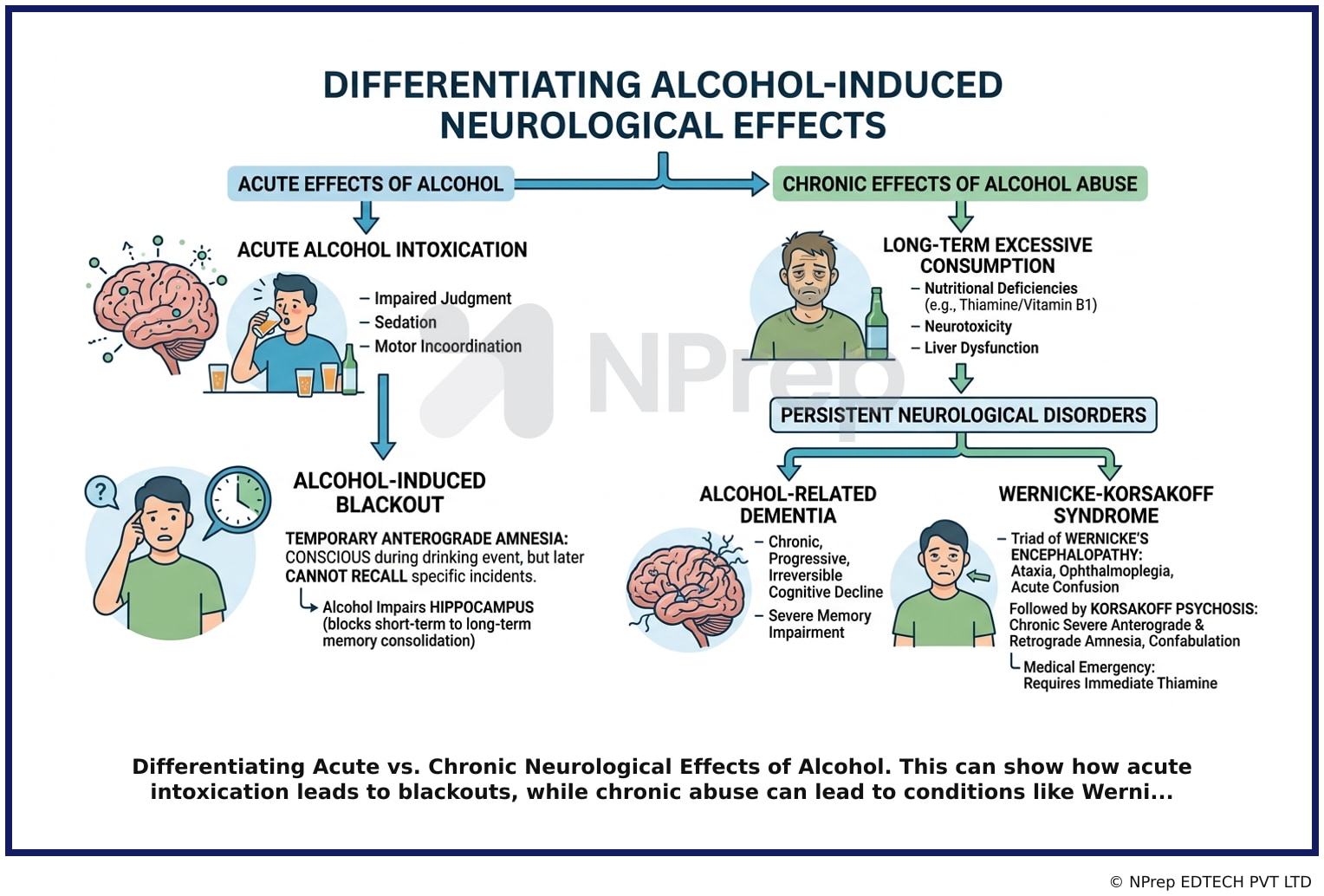
- Visual 1: Flowchart - Differentiating Acute vs. Chronic Neurological Effects of Alcohol. This can show how acute intoxication leads to blackouts, while chronic abuse can lead to conditions like Wernicke-Korsakoff syndrome and dementia.
- Visual 2: Infographic - 'What is an Alcohol Blackout?'. This visual could illustrate the effect of alcohol on the hippocampus and contrast what a person is doing (appearing normal) with what their brain is doing (not recording memories).
Clinical Relevance
- Nursing practice connection: Use the key finding related to Alcohol-Induced Neurological Effects to guide bedside assessment, documentation, and the next nursing action.
- Identifying blackouts is a critical nursing assessment for patients with potential alcohol misuse. It is a strong indicator of dangerous drinking patterns that increase the risk for accidents, injuries, and victimization.
- Nurses should educate patients that having blackouts is not a normal or harmless part of drinking but a sign of acute brain dysfunction that can have long-term consequences.
- What if the patient reported memory loss along with ataxia (unsteady gait) and ophthalmoplegia (eye muscle weakness)? This triad of symptoms would point towards Wernicke's encephalopathy, a medical emergency requiring immediate thiamine administration, rather than a simple blackout.
How to Approach the Question
- First, identify the core elements of the scenario: heavy drinking, memory loss for a specific period, and retained consciousness during that period.
- The phrase 'cannot remember specific incidents' points directly to amnesia.
- The qualifier 'despite being conscious at the time' is crucial. It rules out conditions that involve a loss or significant alteration of consciousness.
- Evaluate each option against these core elements: 'Hangover' is post-drinking symptoms. 'Delirium' involves altered consciousness. 'Dementia' is a chronic, global decline.
- Recognize that 'Blackouts' is the specific medical term for temporary, alcohol-induced anterograde amnesia while conscious, which perfectly matches the scenario.
Concept Tested & Keywords
- Concept Tested: Alcohol-Induced Neurological Effects
- Stem keywords: drinks heavily, cannot remember, conscious at the time
- Lead-in keywords: experiencing what
- Clinical cues: The combination of being conscious but having no memory of events is the classic presentation of an alcohol-induced blackout.
- Negative lead-in flag: false
Question ID
Q_cT46Ee7iBqSFvdtXwbxQ
Practise the full KGMU 2023
Attempt every question from this paper in a timed mock, then review the full solution for each one.
More Substance Use Disorders Questions
More KGMU 2023 Questions
- The teacher scalded Aruna in front of her classmates during Project submission. Conclusion I: Aruna was not as popular as her other classmates. Concl…
- Aruna leaves and goes 8 meters in the North direction from a certain point. Then she turns right and travels for 12 meters. She again turns right and…
- Kiran is Sister of Raj. Raj is Son of Suresh and Vinita is Mother of Suresh then what is relation between Vinita and Kiran?
- A person who lives at the same time with another?
- Select the most appropriate meaning of the below idiom. A black sheep?
- The train has arrived...the station.
- A vendor sold 20 kg of potato at 18 Rs. per kg. He bought 2-liter milk at the rate of 46 Rs./liter, 2 kg sugar at the rate of 35 Rs./kg and 10 packet…
- Which one is the perfect square?
- A is the smallest. C is taller than B and D. E is neither the tallest nor the smallest. Find which one is the tallest?
- From an entrance, a person walks 28 meters left, then turns right and walks 13 meters. They turn right again and walk 12 meters, and then walk 16 met…