
KGMU 2023
Medical Surgical Nursing
Medium
A patient's random blood sugar (RBS) level is 40 mg/dl. What is the immediate management?
Appeared in: KGMU 2023
Explanation
- A blood glucose level of 40 mg/dL is defined as severe hypoglycemia, which is a life-threatening emergency.
- The immediate goal is to rapidly raise the blood glucose level to prevent neurological damage.
- 50% Dextrose is a highly concentrated intravenous solution that delivers a large amount of glucose (25g in 50mL) quickly into the circulation.
- Among the given choices, 50% Dextrose is the most effective and appropriate intervention for an adult with severe hypoglycemia who may be unable to take oral glucose.
Why Other Options Were Wrong
- Option A: 5% Dextrose is an isotonic solution and is too dilute to effectively and rapidly treat severe hypoglycemia. It would require a large volume and significant time to raise blood sugar to a safe level.
- Option C: Insulin's function is to lower blood glucose. Administering insulin to a patient who is already severely hypoglycemic is contraindicated and would be extremely dangerous, potentially leading to coma or death.
- Option D: Normal saline is a crystalloid solution used for fluid and electrolyte replacement. It contains no glucose and therefore will not correct hypoglycemia.
Related Visual
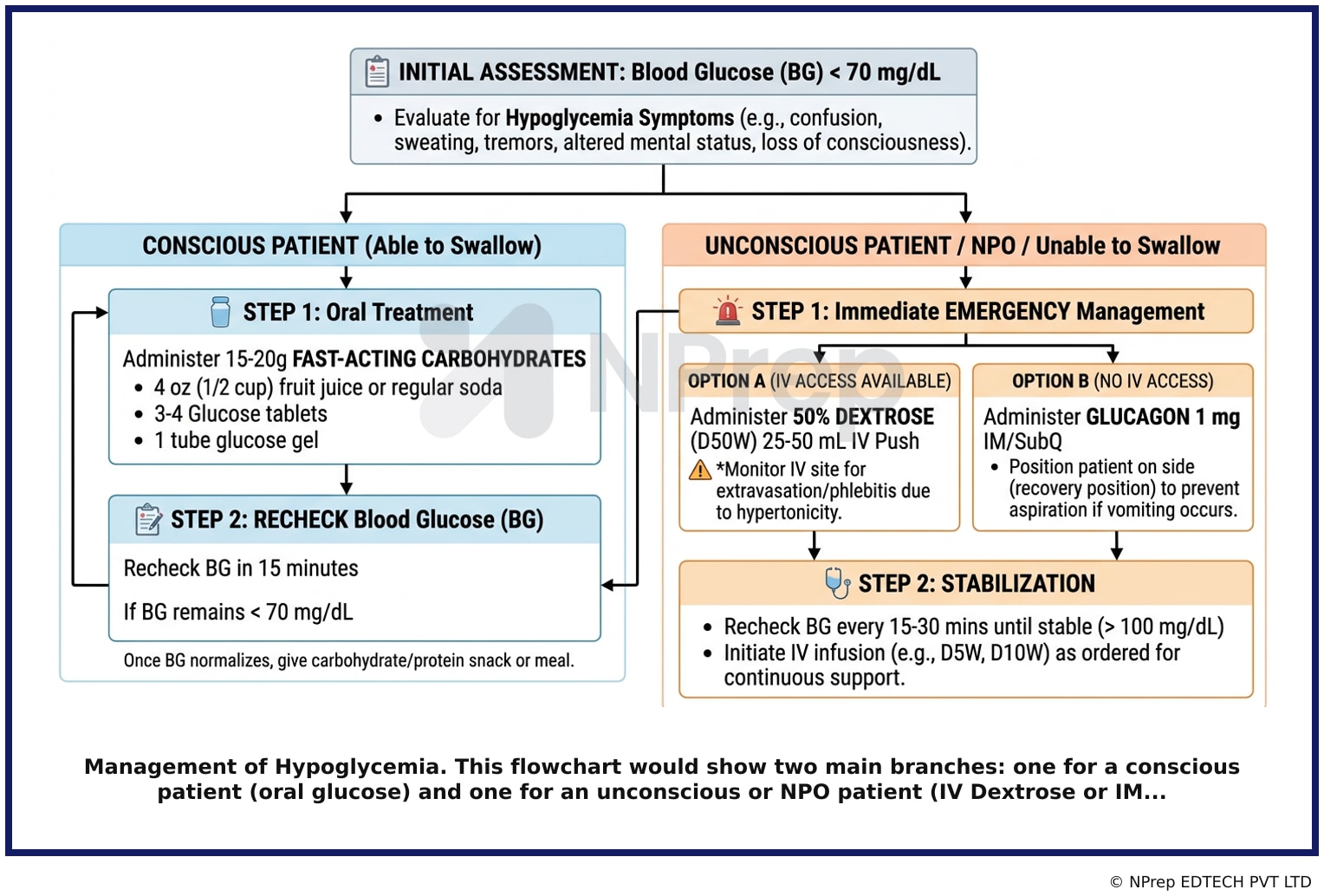
- Visual 1: Flowchart - Management of Hypoglycemia. This flowchart would show two main branches: one for a conscious patient (oral glucose) and one for an unconscious or NPO patient (IV Dextrose or IM Glucagon), guiding the user through the decision-making process.
- Visual 2: Diagram - IV Push of D50. An illustration showing a nurse administering 50% Dextrose from a pre-filled syringe into a patient's IV line, highlighting the emergency nature of the procedure.
Clinical Relevance
- Nursing practice connection: Use the key finding related to Emergency management of severe hypoglycemia to guide bedside assessment, documentation, and the next nursing action.
- Rapid recognition and treatment of severe hypoglycemia are critical nursing responsibilities. The brain relies almost exclusively on glucose for energy, and prolonged hypoglycemia can cause permanent neurological deficits.
- Nurses must be vigilant in monitoring for signs of hypoglycemia (e.g., confusion, sweating, tremors, altered consciousness) especially in diabetic patients, those who are NPO, or those receiving insulin.
- Patient safety: Due to its high osmolarity, 50% Dextrose is caustic to veins and can cause severe tissue damage if it extravasates (leaks into surrounding tissue). It must be administered slowly into a large, patent IV line.
How to Approach the Question
- First, identify the critical information in the question stem: the patient's random blood sugar (RBS) is 40 mg/dl.
- Recognize that this value represents a medical emergency. A blood glucose level below 70 mg/dl is hypoglycemia, and below 55 mg/dl is considered severe.
- The question asks for 'immediate management,' indicating the need for a rapid and effective intervention.
- Evaluate each option's physiological effect. The goal is to raise blood sugar.
- Eliminate options that would not raise blood sugar (Normal saline) or would lower it further (Insulin).
- Compare the remaining glucose solutions. 50% dextrose is a highly concentrated, rapid-acting solution designed for emergencies, whereas 5% dextrose is a dilute maintenance fluid. Select the most potent and appropriate option for the severe condition.
Concept Tested & Keywords
- Concept Tested: Emergency management of severe hypoglycemia.
- Stem keywords: random blood sugar (RBS), 40 mg/dl, immediate management
- Lead-in keywords: immediate management
- Clinical cues: RBS 40 mg/dl: This value is critically low and signifies severe hypoglycemia, a medical emergency.
Question ID
QMCqKJXeV7CY6FAslsuGsh
Practise the full KGMU 2023
Attempt every question from this paper in a timed mock, then review the full solution for each one.
More Insulin, Glucose Homeostasis & Diabetes Mallitus Questions
More KGMU 2023 Questions
- The teacher scalded Aruna in front of her classmates during Project submission. Conclusion I: Aruna was not as popular as her other classmates. Concl…
- Aruna leaves and goes 8 meters in the North direction from a certain point. Then she turns right and travels for 12 meters. She again turns right and…
- Kiran is Sister of Raj. Raj is Son of Suresh and Vinita is Mother of Suresh then what is relation between Vinita and Kiran?
- A person who lives at the same time with another?
- Select the most appropriate meaning of the below idiom. A black sheep?
- The train has arrived...the station.
- A vendor sold 20 kg of potato at 18 Rs. per kg. He bought 2-liter milk at the rate of 46 Rs./liter, 2 kg sugar at the rate of 35 Rs./kg and 10 packet…
- Which one is the perfect square?
- A is the smallest. C is taller than B and D. E is neither the tallest nor the smallest. Find which one is the tallest?
- From an entrance, a person walks 28 meters left, then turns right and walks 13 meters. They turn right again and walk 12 meters, and then walk 16 met…