
KGMU 2023
Medical Surgical Nursing
Medium
A patient arrives in the emergency room with severe burns on the face and neck. Which action should receive priority?
Appeared in: KGMU 2023
Explanation
- The fundamental principle of emergency care is the ABCs: Airway, Breathing, and Circulation. Airway is always the first priority.
- Burns to the face and neck carry a very high risk of causing inhalation injury and subsequent swelling (edema) of the upper airway.
- This swelling can progress rapidly, leading to a complete airway obstruction, which is a life-threatening emergency.
- Therefore, the immediate and non-negotiable first action is to assess the airway's patency, provide supplemental oxygen, and prepare for potential intubation before swelling makes it impossible.
Why Other Options Were Wrong
- Option A: This addresses 'Circulation' in the ABCs. While critical for preventing hypovolemic shock from fluid loss, it is the second priority after a patent airway is established.
- Option C: This is a diagnostic test to evaluate the effectiveness of 'Breathing' and to check for carbon monoxide poisoning. It is an important assessment but is performed after the airway is secured and initial oxygen therapy has begun.
- Option D: Pain management is essential for compassionate care but is a lower priority than life-saving interventions. Addressing airway, breathing, and circulation must come first.
Related Visual
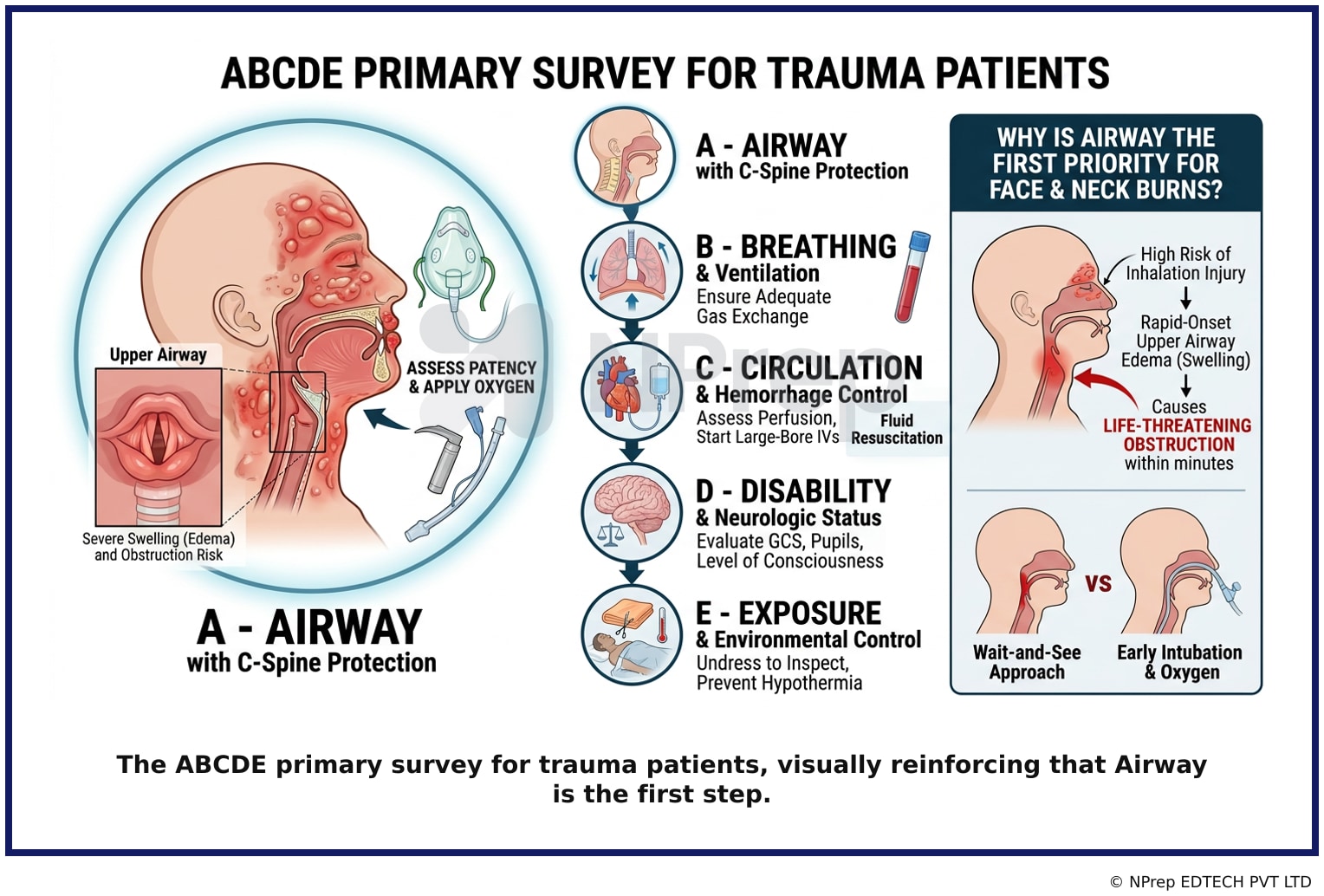
- Visual 1: Infographic - The ABCDE primary survey for trauma patients, visually reinforcing that Airway is the first step.
- Visual 2: Diagram - A cross-section of the upper airway, showing a normal airway next to one with severe laryngeal edema to illustrate the risk of obstruction from burns.
Clinical Relevance
- Nursing practice connection: Prioritize focused assessment, early escalation, and real-time monitoring when managing Prioritization of care in emergency burn management in acute care settings.
- A nurse's ability to rapidly apply the ABC framework in an emergency is a core competency that directly impacts patient survival. In facial burns, the nurse must anticipate airway compromise and proactively gather equipment for intubation.
- What if? - If the patient had circumferential burns on the chest instead of the face, the priority would shift slightly. While still assessing Airway first, the immediate concern under 'Breathing' would be to monitor for restricted chest wall movement and prepare for a possible escharotomy (surgical incision through the burn eschar) to allow the chest to expand.
How to Approach the Question
- First, identify the question type as a prioritization question set in an emergency context.
- Recall the universal framework for prioritizing care in emergencies: ABCs (Airway, Breathing, Circulation).
- Analyze the clinical information provided. The key phrase is 'burns on the face and neck,' which directly threatens the 'A' (Airway).
- Evaluate each option based on the ABC framework. 'Assessing the airway' is 'A'. 'Starting an IV' is 'C'. 'Obtaining blood gases' is a diagnostic part of 'B'. 'Administering pain medication' is a later priority.
- Conclude that the intervention addressing the 'Airway' must be the highest priority and the first action taken.
Concept Tested & Keywords
- Concept Tested: Prioritization of care in emergency burn management
- Stem keywords: severe burns, face and neck, emergency room, priority action
- Lead-in keywords: priority
- Clinical cues: Burns on the face and neck: This specific location is a critical indicator for potential airway compromise due to inhalation injury and edema.
Question ID
Q-jMLjPVDh18X93jTRV37E
Practise the full KGMU 2023
Attempt every question from this paper in a timed mock, then review the full solution for each one.
More Integumentary System and Burns Questions
- A patient has a pressure ulcer in which subcutaneous fat is visible BUT bone, tendon or muscle is not exposed or visible. This is a:
- A patient is found to have a reddened area of skin with serum-filled blister formation. The wound is staged as
- Superficial ulceration of the skin, appearing as an abrasion and a blister is a characteristic of?
- Diffuse, purulent inflammation of a tissue is called?
- A................is an elevation of skin filled with fluid and is less than 1 cm in diameter?
- Large heaped-up mass of scar tissue developed and extending beyond the wound surface is known as?
- A patient is admitted to the emergency department with a burn. Following the treatment and procedures used for healing the wound, identify the type o…
- Which patient is most prone to pressure ulcers?
- Vascular skin lesions which are benign tumor consisting of blood and lymph vessels are called
- Wound caused by an injury with a blunt object, leading to tearing of soft tissue is known as
More KGMU 2023 Questions
- The teacher scalded Aruna in front of her classmates during Project submission. Conclusion I: Aruna was not as popular as her other classmates. Concl…
- Aruna leaves and goes 8 meters in the North direction from a certain point. Then she turns right and travels for 12 meters. She again turns right and…
- Kiran is Sister of Raj. Raj is Son of Suresh and Vinita is Mother of Suresh then what is relation between Vinita and Kiran?
- A person who lives at the same time with another?
- Select the most appropriate meaning of the below idiom. A black sheep?
- The train has arrived...the station.
- A vendor sold 20 kg of potato at 18 Rs. per kg. He bought 2-liter milk at the rate of 46 Rs./liter, 2 kg sugar at the rate of 35 Rs./kg and 10 packet…
- Which one is the perfect square?
- A is the smallest. C is taller than B and D. E is neither the tallest nor the smallest. Find which one is the tallest?
- From an entrance, a person walks 28 meters left, then turns right and walks 13 meters. They turn right again and walk 12 meters, and then walk 16 met…