
KGMU 2023
Mental Health Nursing
Medium
A nurse returns home after serving in a war zone. Three months later, she experiences intrusive memories, insomnia, depression, and loss of appetite. The nurse is likely suffering from what?
Appeared in: KGMU 2023
Explanation
- The diagnosis is Post-Traumatic Stress Disorder (PTSD) because the symptoms have persisted for three months, which is longer than the one-month threshold for an Acute Stress Disorder diagnosis.
- The symptom cluster, including intrusive memories (re-experiencing the trauma), insomnia (hyperarousal), and depression (negative alterations in mood), is characteristic of PTSD following a significant traumatic event like serving in a war zone.
- The key diagnostic criterion separating PTSD from Acute Stress Disorder is the duration of the disturbance. Symptoms lasting more than one month point to PTSD.
Why Other Options Were Wrong
- Option B: While depression is a symptom, the presence of intrusive memories directly linked to the trauma is a hallmark of PTSD, making it a more specific diagnosis than severe depression alone.
- Option C: Adjustment disorder is a response to an identifiable stressor, but the symptoms are generally less severe and do not include the specific re-experiencing phenomena (intrusive memories) seen in PTSD. The trauma of a war zone is typically considered severe enough to precipitate PTSD.
- Option D: This diagnosis is incorrect because the symptoms have lasted for three months. Acute Stress Reaction (or Disorder) is diagnosed when symptoms last from three days up to a maximum of one month following the traumatic event.
Related Visual
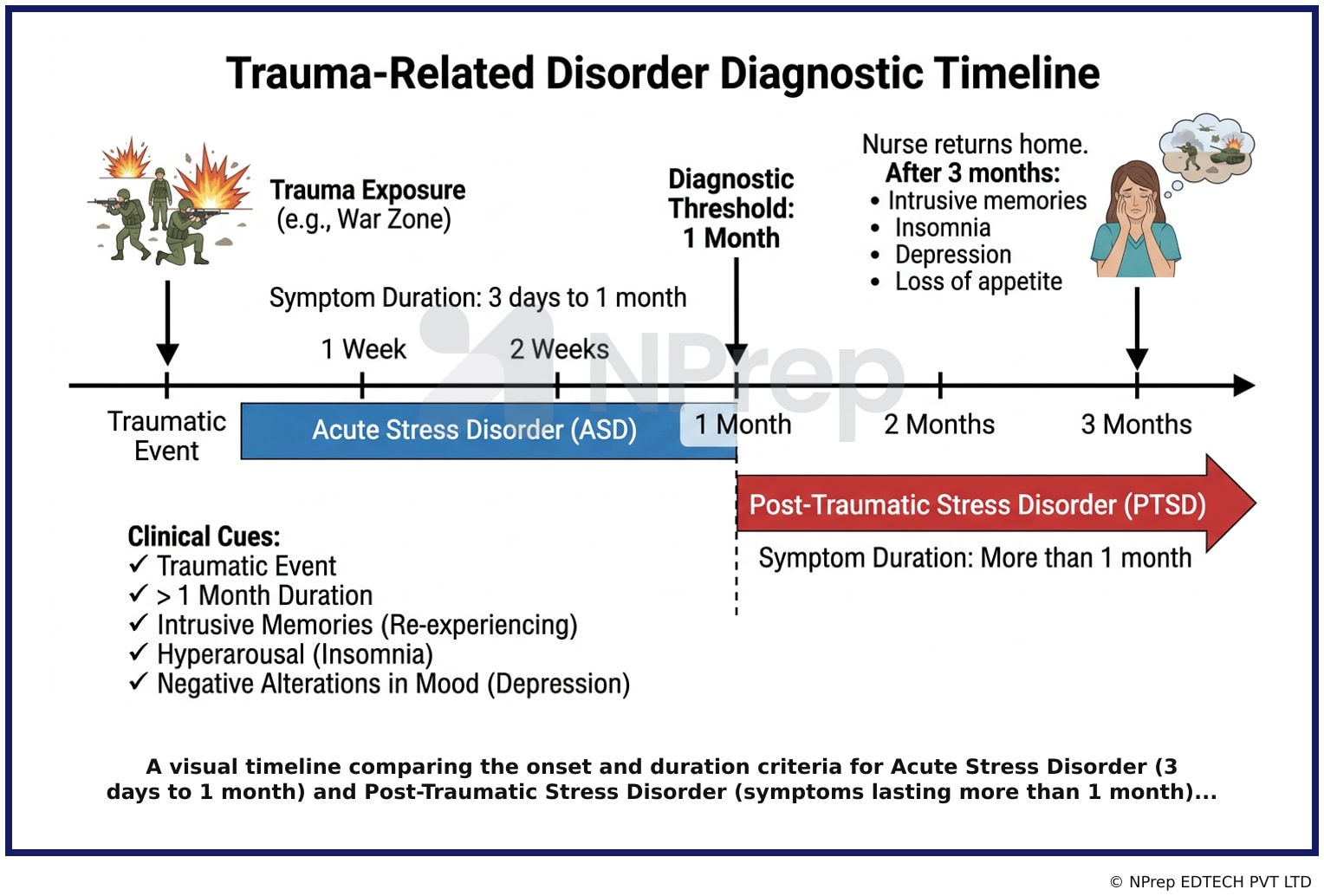
- Visual 1: Timeline Diagram - A visual timeline comparing the onset and duration criteria for Acute Stress Disorder (3 days to 1 month) and Post-Traumatic Stress Disorder (symptoms lasting more than 1 month). This clarifies the key difference.
- Visual 2: Infographic - An infographic listing the four main symptom clusters of PTSD: Intrusion, Avoidance, Negative Alterations in Cognition/Mood, and Alterations in Arousal/Reactivity, with examples for each.
Clinical Relevance
- Nursing practice connection: Safe nursing care depends on performing Differential diagnosis of trauma- and stressor-related disorders based on symptom duration and characteristics in the correct sequence, documenting the action clearly, and monitoring for the expected response.
- Nurses must be vigilant in screening for PTSD in high-risk populations, including veterans, first responders, and victims of violence, as early intervention improves outcomes.
- Untreated PTSD in a healthcare professional can pose a patient safety risk due to potential cognitive impairments, emotional dysregulation, and burnout.
- What if? If the nurse's symptoms had started only two weeks ago, the most likely diagnosis would be Acute Stress Reaction, and the focus would be on immediate support and monitoring to see if symptoms resolve within the month or progress to PTSD.
How to Approach the Question
- First, identify the key components of the clinical scenario: the patient's history (trauma: 'war zone'), the presenting symptoms ('intrusive memories, insomnia, depression'), and the timeline ('three months later').
- Second, analyze the timeline. The three-month duration is a critical clue.
- Third, evaluate the options based on diagnostic criteria. Recall that Acute Stress Reaction is short-term (less than one month).
- Fourth, recognize that symptoms lasting longer than one month after a trauma point towards PTSD.
- Finally, differentiate from other diagnoses. The presence of 'intrusive memories' makes PTSD more specific than 'severe depression' or 'adjustment disorder' in this context.
Concept Tested & Keywords
- Concept Tested: Differential diagnosis of trauma- and stressor-related disorders based on symptom duration and characteristics.
- Stem keywords: war zone, three months later, intrusive memories, insomnia, depression, loss of appetite
- Lead-in keywords: likely suffering from
- Clinical cues: The timeline 'three months later' is the most critical piece of information for differentiating between PTSD and Acute Stress Reaction.
- Clinical cues: The symptom 'intrusive memories' points specifically to a trauma-related disorder rather than general depression.
Question ID
Qm1Kj3PnpHHtuZQfopAjxQ
Practise the full KGMU 2023
Attempt every question from this paper in a timed mock, then review the full solution for each one.
More Neurotic, stress related and somatisation disorders Questions
- Following are associated with post traumatic stress disorder except?
- Which of the following disorder is commonly seen in rape victim girl?
- Which of the following is NOT a sign/symptom of the obsessive-compulsive disorder?
- The La Belle indifference is related to?
- A person suffering from, a severe anxiety disorder, is able to speak freely with certain people only and is not able to speak with others, especially…
- Anxiety is caused by?
- What is the term coined for circumscribed fear of a discrete object or situation?
- Which of the following options describes transient situational disturbances?
- What is the term used to explain the condition in which a patient perceives that his/her face is distorted and his/her legs have become short?
- The level of anxiety that enhances the individual's power of perception is?
More KGMU 2023 Questions
- The teacher scalded Aruna in front of her classmates during Project submission. Conclusion I: Aruna was not as popular as her other classmates. Concl…
- Aruna leaves and goes 8 meters in the North direction from a certain point. Then she turns right and travels for 12 meters. She again turns right and…
- Kiran is Sister of Raj. Raj is Son of Suresh and Vinita is Mother of Suresh then what is relation between Vinita and Kiran?
- A person who lives at the same time with another?
- Select the most appropriate meaning of the below idiom. A black sheep?
- The train has arrived...the station.
- A vendor sold 20 kg of potato at 18 Rs. per kg. He bought 2-liter milk at the rate of 46 Rs./liter, 2 kg sugar at the rate of 35 Rs./kg and 10 packet…
- Which one is the perfect square?
- A is the smallest. C is taller than B and D. E is neither the tallest nor the smallest. Find which one is the tallest?
- From an entrance, a person walks 28 meters left, then turns right and walks 13 meters. They turn right again and walk 12 meters, and then walk 16 met…