
RRB Nsg. Superintendent-20 July 2019 (Shift-3rd)
Reasoning
Hard
A man walks $10\mathrm{km}$ in the South direction. He takes a right and walks $5\mathrm{km}$ and takes another right turn to walk $6\mathrm{km}$ . He then finally takes another right turn and walks $5\mathrm{km}$ to reach the destination. How far is he from the starting point?
Appeared in: RRB Nsg. Superintendent-20 July 2019 (Shift-3rd)
Explanation
- The man's 5 km westward journey is completely nullified by his 5 km eastward journey, bringing him back to the same north-south line he started on.
- His initial 10 km southward movement is partially reversed by a 6 km northward movement.
- The net displacement is the difference between the southward and northward travel: 10 km - 6 km = 4 km.
- He ends up 4 km south of his starting point, which is the final distance from the origin.
Why Other Options Were Wrong
- Option A: This value does not correspond to any logical calculation based on the given movements.
- Option B: This is the distance of the first leg of the journey, not the final displacement from the origin after all subsequent movements.
- Option D: This is the distance of the third leg of the journey (northward), not the final net distance from the start.
Related Visual
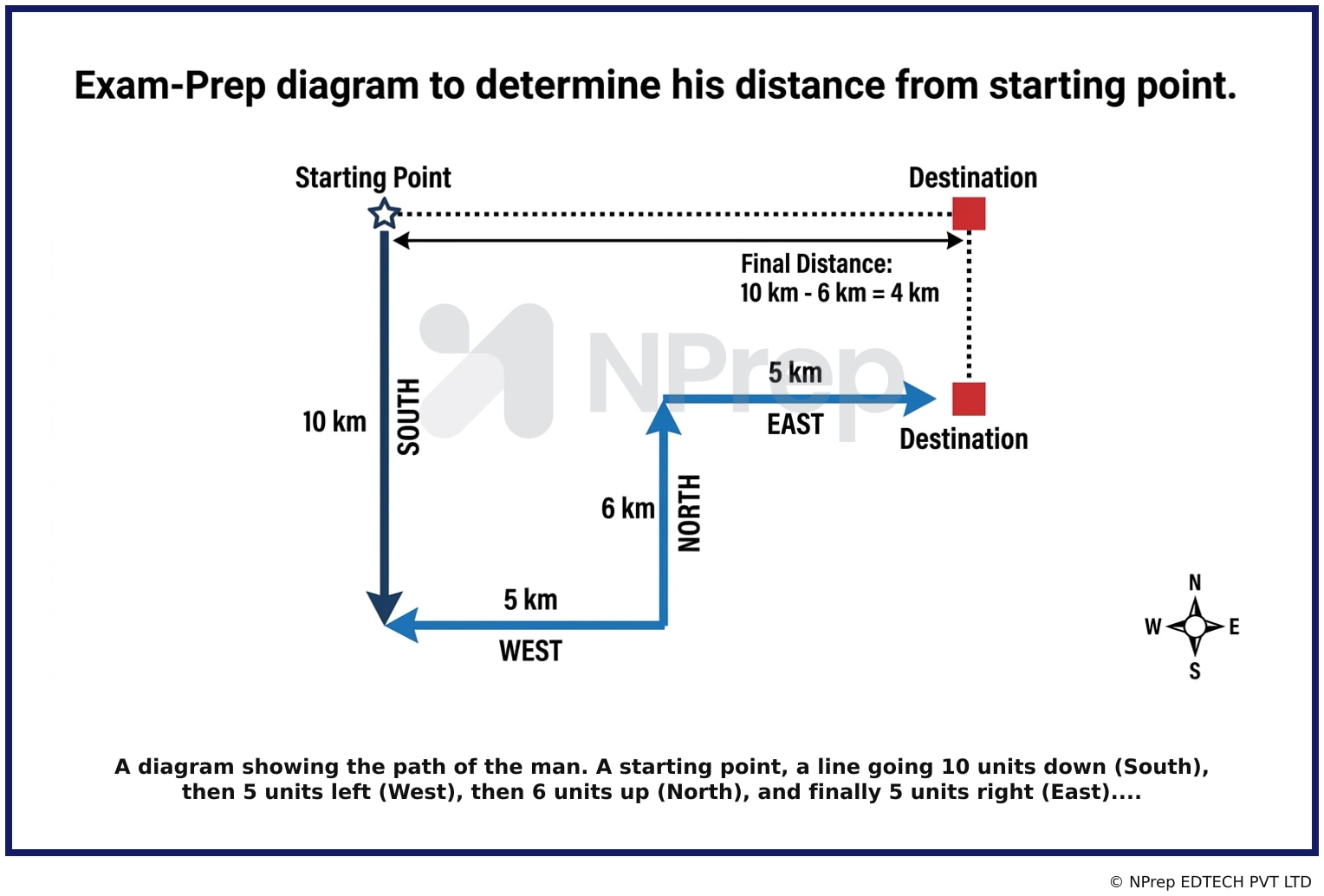
- Visual 1: Diagram - A diagram showing the path of the man. A starting point, a line going 10 units down (South), then 5 units left (West), then 6 units up (North), and finally 5 units right (East). The final point is shown to be 4 units directly below the starting point.
Clinical Relevance
- Nursing practice connection: This is primarily an exam-oriented knowledge point with limited direct bedside application, so retain Solving direction and distance problems involving multiple turns as background academic context rather than a clinical decision trigger.
- This type of logical reasoning is crucial for systematically processing information and making decisions, a skill applicable in many professional fields, including nursing, where step-by-step procedures and assessments are common.
- It tests spatial awareness and the ability to visualize and manipulate paths mentally, which is useful for tasks like navigating a hospital or understanding anatomical relationships.
- What if the second turn was left instead of right? Facing West, a left turn would be South. He would walk 6 km South, ending up 16 km South and 5 km West from the start. The distance would then be √(16² + 5²) = √281 km, using the Pythagorean theorem.
How to Approach the Question
- Read the question carefully, noting the starting direction and each subsequent turn and distance.
- Visualize or sketch the path. It's helpful to use a simple coordinate system or draw arrows for North, South, East, and West.
- Track the movement on each axis (North-South and East-West) separately.
- Calculate the net movement. Add movements in the same direction and subtract movements in opposite directions (e.g., South vs. North, East vs. West).
- In this case, the 5 km West and 5 km East movements cancel out.
- The final distance is the net North-South movement: 10 km South minus 6 km North equals 4 km.
Concept Tested & Keywords
- Concept Tested: Solving direction and distance problems involving multiple turns.
- Stem keywords: walks, South, right turn, km, far from starting point
- Lead-in keywords: How far
Question ID
Q7wzJVbdShUisjXGrulBYy
Practise the full RRB Nsg. Superintendent-20 July 2019 (Shift-3rd)
Attempt every question from this paper in a timed mock, then review the full solution for each one.
More Direction Sense Questions
- Simran moved in her North-West direction for 2 km. From there, she turned 90° clockwise and moved 2 km again. She turned 90° clockwise and traveled 2…
- A girl stands on the lawn facing East direction. She turns 45 degrees in clockwise direction and 135 degrees in anticlockwise direction. Which direct…
- Railway station is 5 km east from house. Post office is 5 km south of railway station then the location of post office from home?& x20;
- In the evening, A and D were standing face to face in the sunlight. Person A's shadow was on D's right side. In which direction is D standing?
- A man walks 5 km toward south and then turns to the left. After walking 4 km he turns to the left and walks 5 km. Now how much distance from the star…
- A person walks 6 km towards north, then turns towards west and walks 3 km. He then turns left and walks 4 km, and then again turns left and walks for…
- Pole H is to the east of pole R and to the North of pole D, pole D is in which direction with respect to pole R?
- A person walks 5 km towards north and then turns towards east and walks 8 km. He then turns right and walks 10 km and again turns right and walk 6 km…
- Two men Kashish and Yash start from the same point. Kashish walks 0.3 km west, then turns north and walks 0.45 m, then turns to his right and walks 0…
- Hari walked 40 meters towards the east. Then he turns right and walks 20 meters, then he turns right and walks 18 meters. He again turns right and wa…
More RRB Nsg. Superintendent-20 July 2019 (Shift-3rd) Questions
- Where is oxytocin synthesized?
- What is the name of the muscle that extends from the sphenoid bone to the mandible?
- Complementary feeding should be initiated at the completion of \ \ \ \ \ \
- Where is kidney located?
- Psychosocial development stage for infants is \ \ \ \ \ \ \ \ \ \
- What immunization is given at birth?
- Functional nursing is a method of providing
- Which disease is the dementia associated with asymmetric atrophy of the frontal and temporal lobes?
- Thromboangiitis obliterans is also known as
- What is the other name of pyridoxine?