
INI-CET EXAM -2025
Pathology & Genetics
Easy
A 62-year-old man presents with generalized lymphadenopathy and splenomegaly. Peripheral smear shows small to medium-sized lymphoid cells with irregular nuclear contours. Cytogenetic analysis demonstrates a t(11;14) (q13;q32) translocation. Which of the following markers is most closely associated with the pathogenesis of this lymphoma?
1. Cyclin D
2. SOX 11
3. CD -200
4. CD 10
Appeared in: INI-CET EXAM -2025
Explanation
- The clinical scenario describes Mantle Cell Lymphoma (MCL), a type of B-cell non-Hodgkin lymphoma.
- The pathognomonic cytogenetic finding in MCL is the t(11;14) translocation, which is present in over 90% of cases.
- This translocation leads to the overexpression of Cyclin D1, a protein that regulates the cell cycle, causing uncontrolled cell growth.
- SOX11 is a transcription factor that is also a highly specific and sensitive marker for MCL, being expressed in the vast majority of cases.
- Therefore, both Cyclin D1 and SOX11 are the markers most closely associated with the pathogenesis and diagnosis of this lymphoma.
Why Other Options Were Wrong
- Option B: This option incorrectly includes CD200. CD200 is typically negative in Mantle Cell Lymphoma and is a key marker for Chronic Lymphocytic Leukemia (CLL), helping to distinguish it from MCL.
- Option C: This option incorrectly includes CD10. Mantle Cell Lymphoma is characteristically CD10-negative. CD10 is a marker for germinal center B-cells.
- Option D: This option includes two markers, CD200 and CD10, that are both typically negative in Mantle Cell Lymphoma.
Related Visual
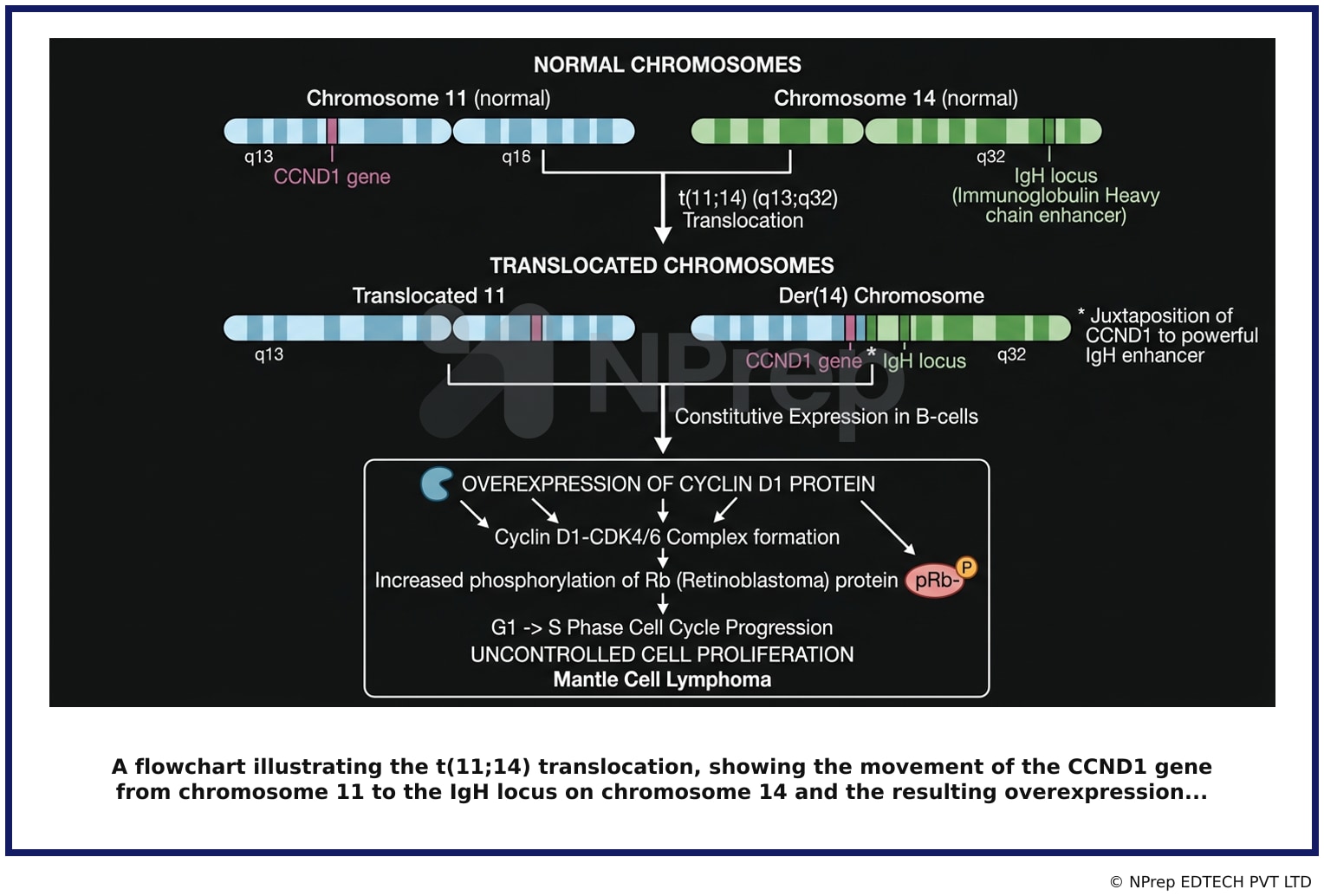
- Visual 1: Diagram - A flowchart illustrating the t(11;14) translocation, showing the movement of the CCND1 gene from chromosome 11 to the IgH locus on chromosome 14 and the resulting overexpression of Cyclin D1 protein.
- Visual 2: Micrograph - An immunohistochemistry slide staining for Cyclin D1 and SOX11, showing strong nuclear positivity in the lymphoma cells, confirming the diagnosis of Mantle Cell Lymphoma.
Clinical Relevance
- Nursing practice connection: This is primarily an exam-oriented knowledge point with limited direct bedside application, so retain Pathogenesis and key molecular markers of Mantle Cell Lymphoma (MCL) as background academic context rather than a clinical decision trigger.
- Identifying Cyclin D1 and SOX11 is crucial for the accurate diagnosis of Mantle Cell Lymphoma, distinguishing it from other small B-cell lymphomas like CLL or Follicular Lymphoma, which have different treatments and prognoses.
- Nurses caring for patients with lymphoma need to understand the significance of these markers for patient education and for anticipating treatment plans, which may include targeted therapies against pathways involving Cyclin D1.
- What if? - If the cytogenetic analysis had shown a t(14;18) translocation instead, the diagnosis would be Follicular Lymphoma. The key pathogenic marker would be BCL2 overexpression, not Cyclin D1, leading to a different treatment approach.
How to Approach the Question
- First, analyze the clinical and laboratory data provided in the stem. The most critical piece of information is the cytogenetic analysis result: t(11;14)(q13;q32).
- Recognize that the t(11;14) translocation is the classic, defining genetic abnormality of Mantle Cell Lymphoma (MCL).
- Recall the molecular consequence of this translocation: it causes the overexpression of the Cyclin D1 (CCND1) gene.
- Next, consider the other markers provided. Recall or deduce the key immunophenotypic markers for MCL.
- Evaluate the options based on this knowledge. Cyclin D1 is the direct result of the translocation. SOX11 is another highly specific marker for MCL.
- Eliminate options containing markers not typically associated with MCL, such as CD10 (Follicular Lymphoma) and CD200 (CLL).
Concept Tested & Keywords
- Concept Tested: Pathogenesis and key molecular markers of Mantle Cell Lymphoma (MCL).
- Stem keywords: lymphadenopathy, splenomegaly, t(11;14) translocation, lymphoma
- Lead-in keywords: markers, most closely associated, pathogenesis
- Clinical cues: The t(11;14) translocation is the pathognomonic genetic marker for Mantle Cell Lymphoma.
Question ID
qu0BLvR5i9A9-7fvh01UL
Practise the full INI-CET EXAM -2025
Attempt every question from this paper in a timed mock, then review the full solution for each one.
More Clinical Pathology Questions
- Lymphocytes in viral infection?
- In hemophilia A disease bleeding occurs due to the deficiency of?
- Cell with a horseshoe shaped nucleus and abundant cytoplasm in a peripheral blood smear is?
- Cell concentration techniques include all of the following, except?
- Which of the following are not the symptoms of Leukemia?
- The composition of blood transfused to a hemophilia patient is?
- Which type of anemia is characterized by macrocytic RBCs with megaloblastic changes?
- Thalassemia is a congenital?
- Mongoloid faces are seen in children suffering from?
- One of the following disorders in which an abnormal haemoglobin leads to chronic hemolytic anemia with other clinical manifestations due to point mut…
More INI-CET EXAM -2025 Questions
- The highlighted structure in the provided image articulates with which bone?& x20;
- Through which of the following foramina does the nerve supplying the muscles of mastication pass?& x20;
- In the given image, which region is correctly paired with its corresponding brain structure? • Middle cerebellar peduncle • Fasciculus cuneatus • Sup…
- Which of the following muscles is NOT typically associated with dysphagia or dysarthria?
- A muscle of mastication involved in opening the mouth exhibits the following characteristics. Identify the incorrect statement about it:
- In the illustrated image, which of the following structures is NOT associated with the area marked by the arrow?& x20;
- Match the following embryonic aortic arches with their respective adult derivatives: A. 1st Arch 1. Maxillary artery& x20; B. 2nd Arch 2. Common caro…
- Which of the following histology image is not an endocrine structure?& x20;
- Marked structure separates which of the following:
- Which of the following bones of the skull gives passage to a nerve arising from the brain & x20;