
Chitranjjan National Cancer Institute Kolkata - 2021
Nursing Foundation
Hard
A 36-year-old man with lymphoma presents with signs of impending septic shock 9 days after chemotherapy. The nurse could expect which of the following to be present?
Appeared in: Chitranjjan National Cancer Institute Kolkata - 2021
Explanation
- The patient is 9 days post-chemotherapy, the typical nadir period, leading to neutropenia and a very high risk of infection.
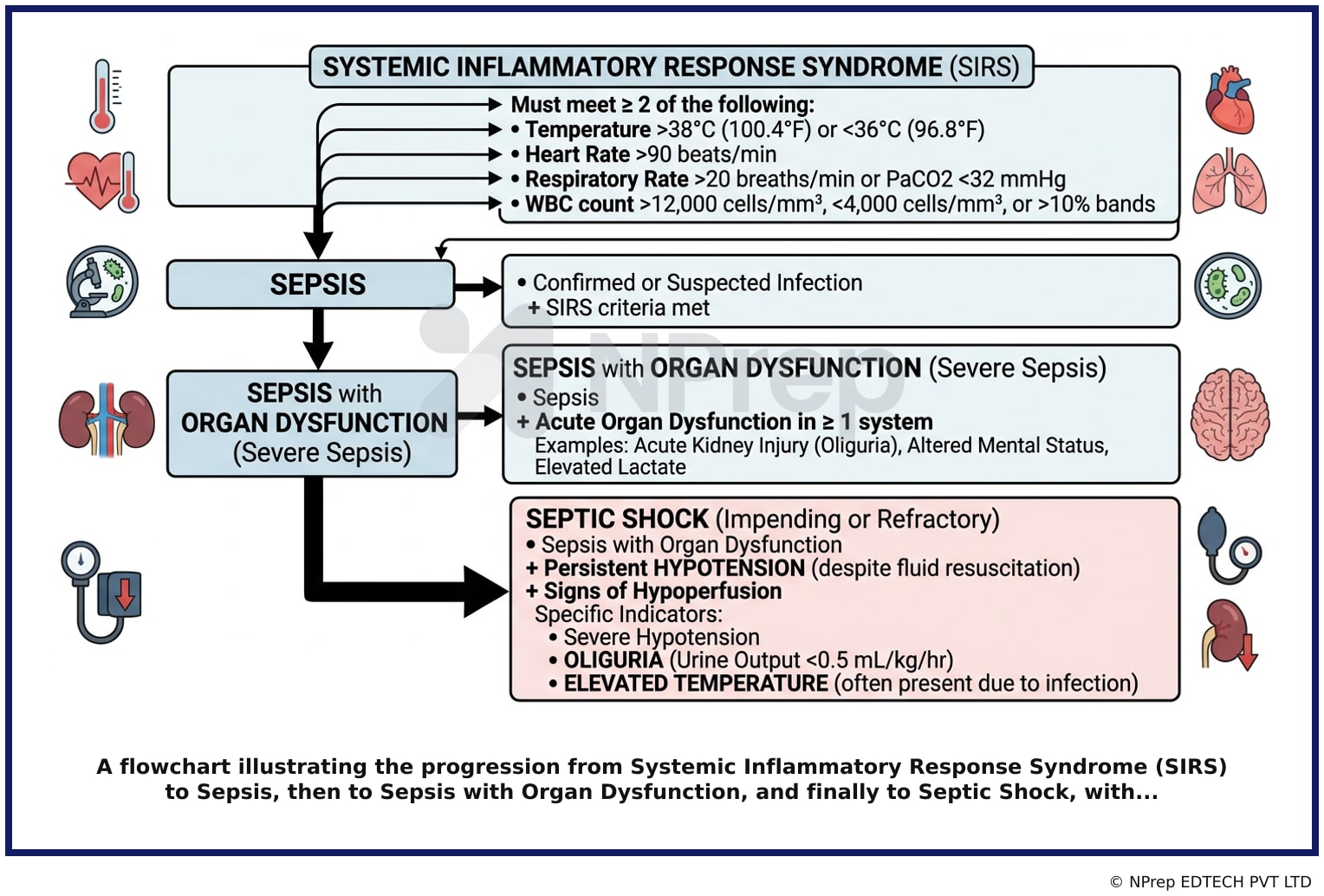
- Impending septic shock signifies the transition from sepsis to a state of circulatory collapse and organ failure.
- This state is characterized by persistent hypotension (low blood pressure) and signs of end-organ hypoperfusion.
- Oliguria (urine output less than 0.5 mL/kg/hr) is a critical sign of acute kidney injury due to poor blood flow, a hallmark of developing shock.
- The combination of fever (from infection), hypotension, and oliguria is a classic triad indicating progression to septic shock.
Why Other Options Were Wrong
- Option A: This option describes features of early 'warm' septic shock. However, oliguria (in the correct option) is a more specific and severe indicator of organ hypoperfusion and impending circulatory collapse.
- Option B: Low-grade fever, chills, and tachycardia are classic signs of early sepsis or a systemic infection. They do not, by themselves, indicate the progression to organ dysfunction or the hypotension characteristic of impending shock.
- Option D: The presence of a normal blood pressure rules out shock. While fever and increased respirations are signs of sepsis, the compensated blood pressure means the patient has not yet progressed to septic shock.
Related Visual
Clinical Relevance
- Nursing practice connection: Prioritize focused assessment, early escalation, and real-time monitoring when managing Clinical presentation of impending septic shock in an immunocompromised patient in acute care settings.
- Recognizing the transition to septic shock is a critical nursing skill. Mortality increases by nearly 8% for every hour that treatment is delayed.
- For neutropenic patients, a fever (temperature greater than 38.3°C or 101°F once, or greater than 38°C or 100.4°F for an hour) is a medical emergency requiring immediate evaluation and initiation of broad-spectrum antibiotics within one hour.
- The 'Sepsis Six' or 'Hour-1 Bundle' are protocols that guide immediate nursing and medical actions: obtain lactate and blood cultures, administer antibiotics and fluids, and begin vasopressors if needed.
How to Approach the Question
- First, identify the patient's core problem and risk factors. A patient with lymphoma, 9 days post-chemotherapy, is at an extremely high risk for neutropenic sepsis.
- Next, analyze the key term in the question: 'impending septic shock.' This is a more severe condition than just sepsis and implies that organ dysfunction and hypotension are developing.
- Recall the definitions of the sepsis continuum: Sepsis involves infection plus a systemic response (fever, tachycardia). Septic shock involves sepsis plus persistent hypotension and signs of organ hypoperfusion.
- Evaluate each option against the definition of impending shock. Look for the option that includes both hypotension and a clear sign of organ damage (like oliguria).
- Eliminate options that describe early sepsis (where blood pressure is still normal) or those that have less specific signs of organ failure.
Concept Tested & Keywords
- Concept Tested: Clinical presentation of impending septic shock in an immunocompromised patient.
- Stem keywords: lymphoma, septic shock, chemotherapy, 9 days after
- Lead-in keywords: could expect
- Clinical cues: 36-year-old man: Indicates an adult patient.
- Clinical cues: Lymphoma: An underlying malignancy that often requires immunosuppressive chemotherapy.
Question ID
QOWPb6szTuuC_CasxS3dLs
Reference Book
E6 Nursing Brunner Adult Health 3SA Vol 2 Part 3 p. 38-40
E6 Medicine Harrison 22e Part 1 p. 621-623
Practise the full Chitranjjan National Cancer Institute Kolkata - 2021
Attempt every question from this paper in a timed mock, then review the full solution for each one.
More Vital Signs Questions
- In which condition, distal pulse is preferred rather than apical pulse?
- Identify the Instrument below:
- In the following, all are the contraindications for measurement of rectal temperature; EXCEPT:
- The core temperature is measured from which of the following sites?
- In a normal client the maximum time for checking pulse rate is:
- During a routine assessment, you notice that a 60-year-old patient's radial pulse is weak and difficult to palpate. The patient's other vital signs a…
- You are assessing a patient's cardiovascular status and notice a discrepancy between the apical and radial pulse rates. The apical pulse is 80 beats…
- Core body temperature can be measured using all of the following methods; except:
- Suppose you are a nurse on duty and you are asked to measure BP of an adult. While choosing the cuff, the correct ratio of bladder in length and widt…
- A patient's blood pressure is 160/80 mm hg then what is the pulse pressure of the patient?
More Chitranjjan National Cancer Institute Kolkata - 2021 Questions
- Warning signs of lung cancer include persistent cough, bloody sputum, dyspnea and which of the other following symptoms?
- At the time of diagnosis of Hodgkin's lymphoma, which of the following area is often involved?
- Which of the following is a malignant tumor of the connective tissue?
- Which of the following is suggested surgical intervention for Ca Prostate?
- Which type of cancer has poorest prognosis given below?
- Which of the following is the feature of benign tumor?
- The patient with cancer is receiving chemotherapy and develops thrombocytopenia The nurse identifies which intervention as the highest priority in th…
- In the patient with terminal lung cancer, the focus of nursing care is on which of the following nursing interventions?
- Mrs. Sharma with advanced breast cancer is prescribed tamoxifen (Nolvadex). When teaching the patient about this drug, the nurse should emphasize the…
- Kaposi's sarcoma is the type of cancer which is common in people with?