
ESIC Nursing Officer 2016 (Shift -2)
Non Nursing Subjects
Hard
Appeared in: ESIC Nursing Officer 2016 (Shift -2)
Explanation
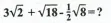
- The core task is to simplify the expression 3√2 + √18 - (1/2)√8.
- The terms √18 and √8 must be simplified first. √18 simplifies to 3√2, and (1/2)√8 simplifies to √2.
- Substituting these back gives 3√2 + 3√2 - √2.
- Combining the coefficients (3 + 3 - 1) results in 5, making the final answer 5√2.
Why Other Options Were Wrong
- Option B: This result (6√2) is obtained if the last term (√2) is ignored or incorrectly added, i.e., 3√2 + 3√2 = 6√2.
- Option C: This result (4√2) would stem from a miscalculation when combining the coefficients, for example, incorrectly calculating 3 + 3 - 1.
- Option D: This result (7√2) is obtained if the last term is incorrectly added instead of subtracted: 3√2 + 3√2 + √2 = 7√2.
Related Visual

- Visual 1: Flowchart: A flowchart illustrating the step-by-step process of simplifying the radical expression. It would show breaking down √18 and √8, substituting them back, and combining the like terms to reach the final answer.
Clinical Relevance
- Nursing practice connection: Knowing Simplification of expressions involving radicals (square roots) helps nurses interpret findings accurately and avoid errors in routine assessment, medication administration, and patient teaching.
- This is a general mathematics question testing algebraic skills, not a nursing-specific concept.
- While direct clinical application is absent, strong numeracy skills are fundamental for nurses for tasks like medication dosage calculations, IV drip rate adjustments, and interpreting lab values, all of which require precision and accuracy.
- What if the question involved fractions in a dosage calculation? A similar need for finding a common denominator and performing accurate arithmetic would be required, highlighting the importance of these foundational math skills.
How to Approach the Question
- First, analyze the expression to identify the operations (addition, subtraction) and the terms involved (radicals).
- Check each term to see if the radical can be simplified. A radical is simplified if the number under the root has no perfect square factors.
- To simplify a radical like √18, find the largest perfect square that divides 18 (which is 9), and rewrite it as √(9 * 2).
- Use the property √(a*b) = √a * √b to separate the terms, so √(9 * 2) becomes √9 * √2, which simplifies to 3√2.
- After simplifying all terms, substitute them back into the original expression.
- Combine the 'like terms' by adding or subtracting their coefficients. All terms with the same radical (e.g., √2) are like terms.
Concept Tested & Keywords
- Concept Tested: Simplification of expressions involving radicals (square roots).
- Stem keywords: Radicals, Square Roots, Simplification, Algebra
- Lead-in keywords: Solve, Simplify
Question ID
Q5WAif9ychVK5aWTPCWr3n
Practise the full ESIC Nursing Officer 2016 (Shift -2)
Attempt every question from this paper in a timed mock, then review the full solution for each one.
More Mathematics Questions
- The ratio of number of girls to boys in a school of 2520 students is 27:29. How many more girls should be admitted to make the ratio 1:1?
- Three candidates contested an election and received 4500, 7500 and 8000 votes respectively. What percentage of votes did the winning candidates get?
- Two bells ring at intervals of 59 seconds and 70 seconds. If they both ring at 10 O'clock in the morning together, after how many seconds will they r…
- The average of four numbers is 61. The largest number among them is 85 and the smallest number is 21. What will be the larger of the remaining two nu…
- In what ratio should water be mixed with milk so that on selling the mixture at cost price a profit of 20% is made?
- A quality control analyst rejects 0.08% of the fabric produced, finding it defective. How many meters of fabric must he examine to reject 4 meters?
- A man traveled from his village to the post office at a speed of 25km/hr and returned at a speed of 4km/hr. If the entire journey took 5 hours and 48…
- A train is running at 60 km/hr. How much time will it require to cross a 2 km bridge?
- The average monthly income of R1 and R2 is Rs. 99,500. The average monthly income of R2 and R3 is Rs. 1,15,600 and the average monthly income of R1 a…
- If Rohan bought 20 books at the rate of Rs. 120 each, 30 books at the rate of Rs. 150 each, and 15 books at the rate of Rs. 100 each, then find the a…
More ESIC Nursing Officer 2016 (Shift -2) Questions
- During abdominal palpation, the uterus just above the symphysis pubis is at?
- Hydrocele is accumulation of fluid in?
- Decreased platelet count is a typical manifestation of?
- BP is measured with the help of?
- Male sex hormone is?
- Myopia can be corrected with the help of?
- Duration of pregnancy is?
- Ripeness of cervix is assessed with?
- Chief regulatory among the immune cells are?
- Hydronephrosis means?